
Multi-State HR Compliance is an important responsibility for US companies that hire employees in different states. Remote work allows businesses to recruit talent across the country. However, it also means employers must manage different state labor laws, payroll taxes, employee benefits, and workplace requirements.
For international entrepreneurs, these rules can be difficult to manage without a clear process. Even hiring one remote employee in a new state may trigger additional employer registration and compliance obligations. This guide explains the main challenges of multi-state employment and how companies can build a more reliable HR management system.
1. Why Multi-State HR Compliance Matters
Remote work has changed how US companies recruit and manage employees. Instead of hiring only near their headquarters, businesses can now build teams across several states. This approach offers three main advantages.
Access to a Wider Talent Pool
Companies can recruit qualified employees regardless of their distance from the main office. This is especially useful for technology, finance, marketing, human resources, and customer support roles.
As a result, businesses have more options when looking for employees with specialized skills.
Better Control of Employment Costs
Labor costs vary across the United States. For example, California and New York often have higher minimum wages or more extensive employment requirements than some other states, including Texas and Indiana.
However, lower labor costs do not automatically mean lower overall expenses. Employers must also consider payroll taxes, insurance, benefits, and local compliance requirements before deciding where to hire.

Long-Term Remote Work Strategies
Remote work remains an important option for many businesses. It can improve flexibility and help companies attract and retain employees.
At the same time, a distributed workforce requires clear policies and consistent management. Therefore, Multi-State HR Compliance should be part of the company's hiring strategy from the beginning.
2. Key Multi-State HR Compliance Challenges
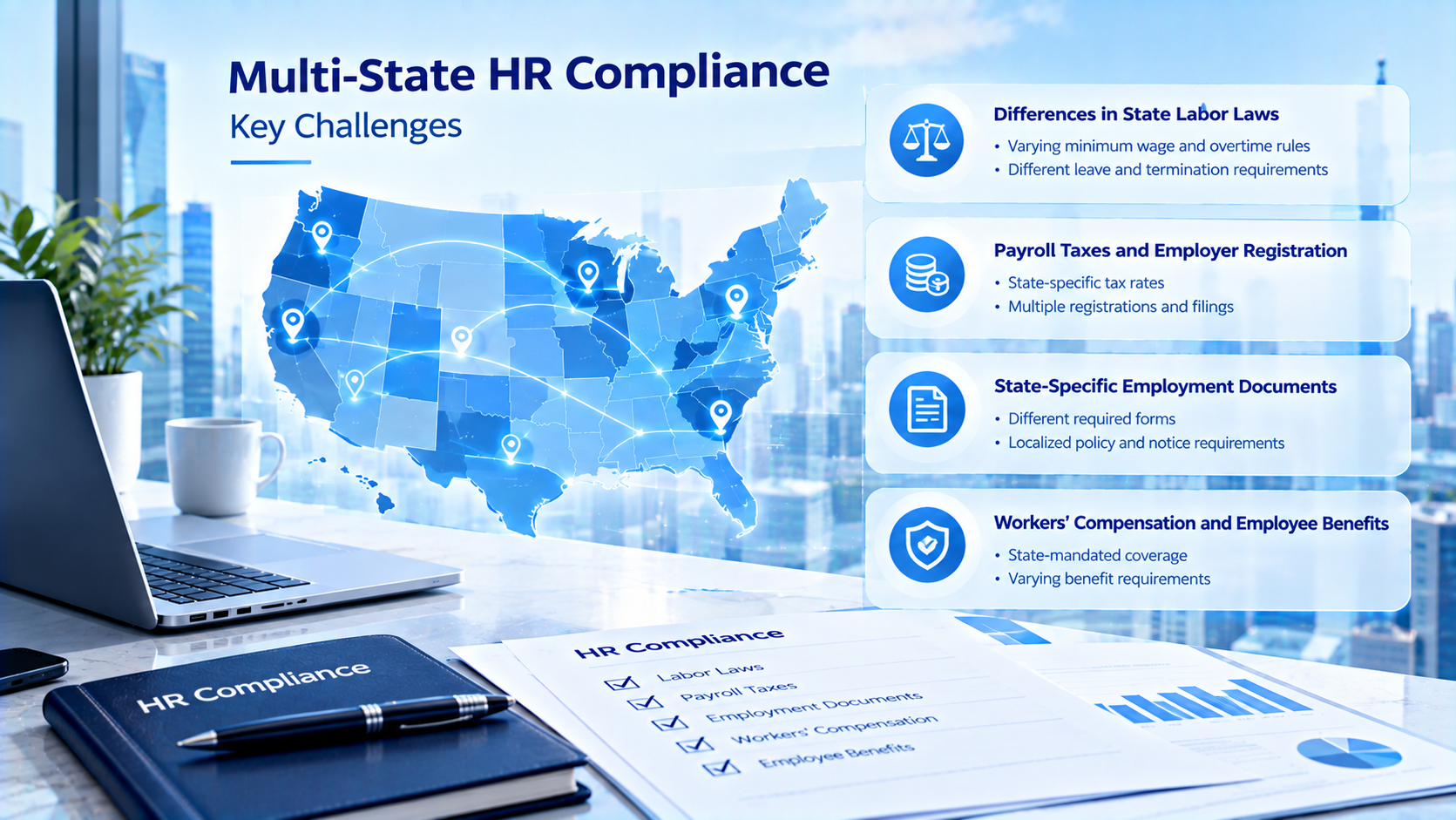
The main challenge of multi-state employment is that labor and tax rules differ by state. Employers must understand which requirements apply to each employee rather than relying on a single nationwide policy.
Differences in State Labor Laws
State employment laws can affect several parts of the employee relationship.
- At-will employment: Although at-will employment is common in the United States, exceptions and additional protections vary by state. Employers must also follow applicable anti-discrimination and anti-retaliation laws.
- Paid leave and employee benefits: Some states require paid sick leave, paid family leave, or other benefits. Eligibility rules and available leave can differ.
- Wages and working hours: Minimum wages, overtime rules, meal breaks, rest periods, and final paycheck deadlines may vary by state. California and New York, for example, have detailed employment requirements.
Consequently, companies should review the laws that apply where each employee works. A policy that meets the requirements in one state may not be sufficient in another.
Payroll Taxes and Employer Registration
Payroll compliance becomes more complicated when employees work across state lines.
Depending on the circumstances, employers may need to:
- Register for state payroll tax accounts.
- Withhold applicable state and local income taxes.
- Pay state unemployment insurance contributions.
- Meet state disability insurance requirements where applicable.
- Submit payroll reports and make payments by the required deadlines.
An employee working in another state can also create an employment or tax connection, often called nexus. However, the exact obligations depend on state law, the employee's work location, and the company's circumstances.
Incorrect withholding or late registration may result in penalties, interest, and additional administrative work. Therefore, employers should review payroll requirements before an employee starts working in a new state.
State-Specific Employment Documents
Employee handbooks, offer letters, and employment agreements may need state-specific provisions. In addition, certain states require employers to provide particular notices or written policies.
For example, a company may need to update its leave policy, wage information, or employee notices when hiring in a new state. These changes help ensure that the company's documents reflect the applicable local rules.
Workers' Compensation and Employee Benefits
Workers' compensation requirements vary by state. Employers should confirm that their insurance covers employees in every state where they work.
Otherwise, a policy that does not provide the required coverage may create financial and legal risks. Companies should also review state-specific benefit requirements and make sure their employee benefit arrangements meet applicable rules.
3. Remote Team Management: HR Practices and Challenges
Multi-State HR Compliance involves more than payroll and legal paperwork. Companies must also maintain effective communication, employee engagement, and consistent management across locations.
Manage the Full Employee Lifecycle
A clear process helps employees understand their responsibilities while allowing managers to maintain consistent standards.
| Stage | Key HR Tasks |
|---|---|
| Onboarding | Complete required forms, provide policy training, and arrange system access. |
| Performance management | Set clear goals, align KPIs or OKRs, and conduct regular reviews. |
| Offboarding | Transfer knowledge, recover company equipment, remove system access, and conduct exit interviews. |
By standardizing these steps, companies can reduce administrative errors while adapting required documents to each state's rules.
Establish a Clear Remote Work Policy
Without a written remote work policy, companies may face misunderstandings about working hours, employee responsibilities, and information security.
A practical policy should cover:
- Working hours, attendance, and communication standards.
- Approval requirements for moving to another state or country.
- Company equipment and IT security.
- Data privacy and employee monitoring.
- Reporting procedures for workplace issues.
In particular, employees should understand that moving to another state may require advance approval because the change can affect payroll, taxes, insurance, and employment obligations.
Protect Employee Data and Privacy
Federal and state laws may impose different requirements on employee monitoring and personal data. California, for example, has specific privacy requirements that may affect how employers collect and use employee information.
Therefore, companies should explain relevant monitoring practices, collect only information needed for legitimate purposes, and review applicable notice and consent requirements. A clear policy can help protect both employee privacy and company information.
4. Building a Scalable Multi-State HR Compliance Framework
As a company expands into more states, informal HR practices become harder to manage. A standardized framework can help businesses maintain consistent processes while meeting local requirements.
Standardize HR Processes and Documents
Companies should create standard operating procedures for the main stages of employment, including:
- Recruitment and hiring.
- Onboarding and training.
- Performance reviews and promotion.
- Disciplinary action and termination.
However, standardization does not mean using identical documents everywhere. Employers should review state requirements and add local provisions where necessary, particularly for disciplinary procedures, wage rules, and termination.
Integrate Payroll and HR Systems
Suitable software can reduce manual errors and improve visibility across a distributed workforce.
For example, companies can use:
- Multi-state payroll software to manage applicable withholding, contributions, and payroll reports.
- Human Resources Information Systems (HRIS) to organize employee records, leave, performance data, and documents.
- Compliance tools to track filing deadlines, employee notices, and required updates.
In addition, businesses should assign responsibility for reviewing system settings and keeping employee information accurate. Automation can support compliance, but it does not replace regular checks of current state requirements.
Use a Multi-State Compliance Checklist
Whenever a company hires an employee in a new state, it should review the following tasks before the employee begins work:
- Confirm whether employer registration is required.
- Review applicable state and local payroll tax rules.
- Check unemployment insurance and workers' compensation requirements.
- Update the employee handbook and state-specific documents.
- Provide required notices and policies.
- Confirm that payroll and HR systems support the new work location.
- Record the employee's work location and establish a process for tracking future changes.
For international business owners, these tasks can be difficult to coordinate alongside company formation and other administrative responsibilities. IngStart provides company registration and ongoing compliance services for international businesses, helping owners organize corporate documents and manage recurring business requirements as they establish and expand their US operations.
Conclusion
Multi-State HR Compliance is essential for US companies that employ people in different states. While remote hiring expands access to talent, it also creates additional responsibilities involving labor laws, payroll taxes, employee benefits, insurance, and HR documentation.
The most effective approach is to review the rules that apply in each employee's work location, standardize core HR processes, and use suitable systems to track payroll and compliance tasks. At the same time, companies should update their policies whenever employees move or new state requirements apply.
For international entrepreneurs, planning these responsibilities before expanding a remote team can reduce compliance risks and make long-term US operations easier to manage.
Article Recommendations
- U.S. Employee Insurance: A Compliance Guide for Global Businesses
- US Worker Classification: Employee Tax Guide
- US LLC States for Non-US Residents: A Practical Guide
If you still have questions, please contact our team on WhatsApp at +1 213 751 2111. We'll help you find the right solution for your business and keep your company compliant as it grows.