
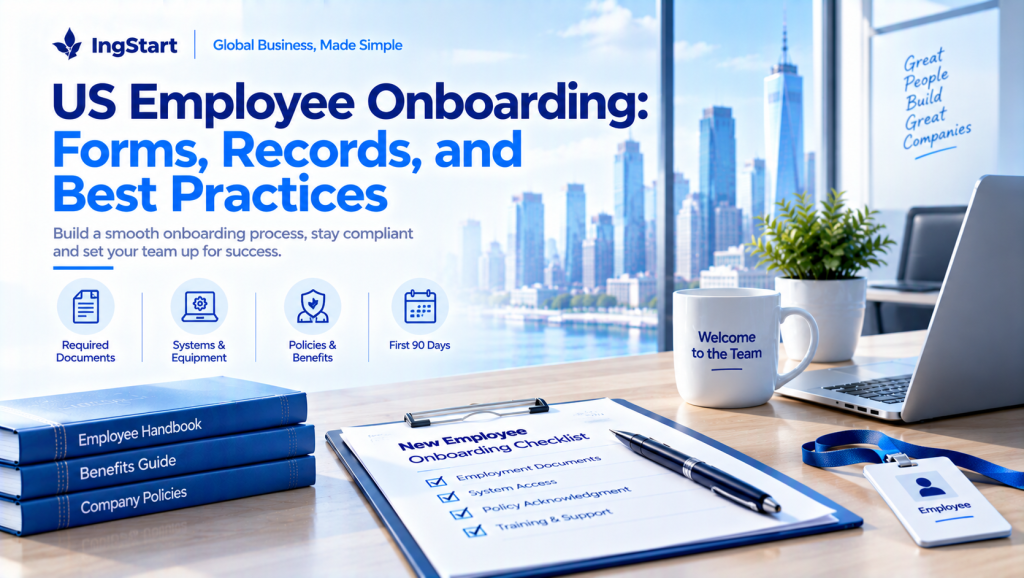
US Employee Onboarding involves more than welcoming a new employee to the team. For international businesses hiring in the United States, it also means completing employment forms, maintaining accurate records, explaining company policies, and preparing employees to start work.
A smooth process helps new hires settle in faster. More importantly, it helps employers avoid paperwork errors and meet their legal obligations. In 2026, companies should pay particular attention to employment eligibility verification, payroll tax information, document security, and state-specific employment rules.
US Employee Onboarding: Four Essential Stages
A well-organized onboarding process gives employees a clear starting point and helps managers handle their responsibilities consistently. Rather than collecting forms at the last minute, employers should prepare documents, equipment, and training before the employee's first day.
1. Prepare the Required Employment Documents
Employment paperwork establishes the foundation of the working relationship. Missing signatures, incorrect dates, or incomplete records can create problems later. Therefore, employers should prepare a standard document package for every new hire.
| Document | Main purpose | What employers should check |
|---|---|---|
| Form I-9 | Verifies identity and employment authorization | Completion deadlines and acceptable documents |
| Form W-4 | Provides information for federal income tax withholding | Employee information and withholding instructions |
| Offer letter or employment agreement | Records employment terms | Job title, pay, responsibilities, and applicable terms |
| Confidentiality agreement | Protects eligible confidential business information | Scope, enforceability, and proper signatures |
| Other required forms | Covers applicable state tax, benefits, and company policies | Requirements for the employee's work location |
Form I-9 has specific completion deadlines. Employees generally complete Section 1 no later than their first day of employment. Employers must complete Section 2 within three business days after the employee starts work. If the employment will last fewer than three business days, Section 2 must be completed by the first day.

Employers can review the official USCIS Form I-9 guidance to confirm current requirements and acceptable procedures.
Employers must also retain completed I-9 forms for the required period: three years after the date of hire or one year after employment ends, whichever is later.
2. Prepare Systems and Equipment Before Day One
Few things make a poor first impression faster than a new employee who cannot access their email or required work tools. To prevent this, HR and IT should coordinate before the start date.
The preparation process may include:
- Creating a company email account.
- Setting up access to Slack, Microsoft Teams, or other communication tools.
- Preparing HR and payroll system accounts.
- Assigning access to shared folders and project management software.
- Providing required equipment and explaining security procedures.
Access should match the employee's role. In addition, companies should avoid giving new hires unnecessary permissions to sensitive files or business systems.
3. Introduce Company Policies and Benefits
The first day is also an opportunity to explain how the company works. Employees should understand their responsibilities, where to find support, and which policies apply to their roles.
A useful orientation should cover:
- Workplace policies: Working hours, attendance, leave, conduct, and complaint procedures.
- Company culture: Business goals, team responsibilities, and communication expectations.
- Benefits: Health insurance, retirement plans, and available leave.
- Information security: Password management, data handling, and acceptable use of company devices.
Keep the introduction practical rather than overwhelming employees with every policy at once. Written guidance and a designated contact person can help them find answers after orientation.
Because employment rules differ by state, companies should also review whether their handbook and benefits information meet local requirements.
4. Follow Up During the First 90 Days
Onboarding should continue after the first day. Regular check-ins help managers identify problems, clarify expectations, and support employee development.
| Time | Main objective | Suggested action |
|---|---|---|
| First 30 days | Help the employee settle in | Review training, answer questions, and clarify responsibilities |
| First 60 days | Assess progress and collaboration | Discuss workload, team communication, and support needs |
| First 90 days | Review early performance | Evaluate initial goals and agree on next steps |
These conversations also help managers identify gaps in training before they affect performance. As a result, the company can improve both the employee experience and its onboarding process.
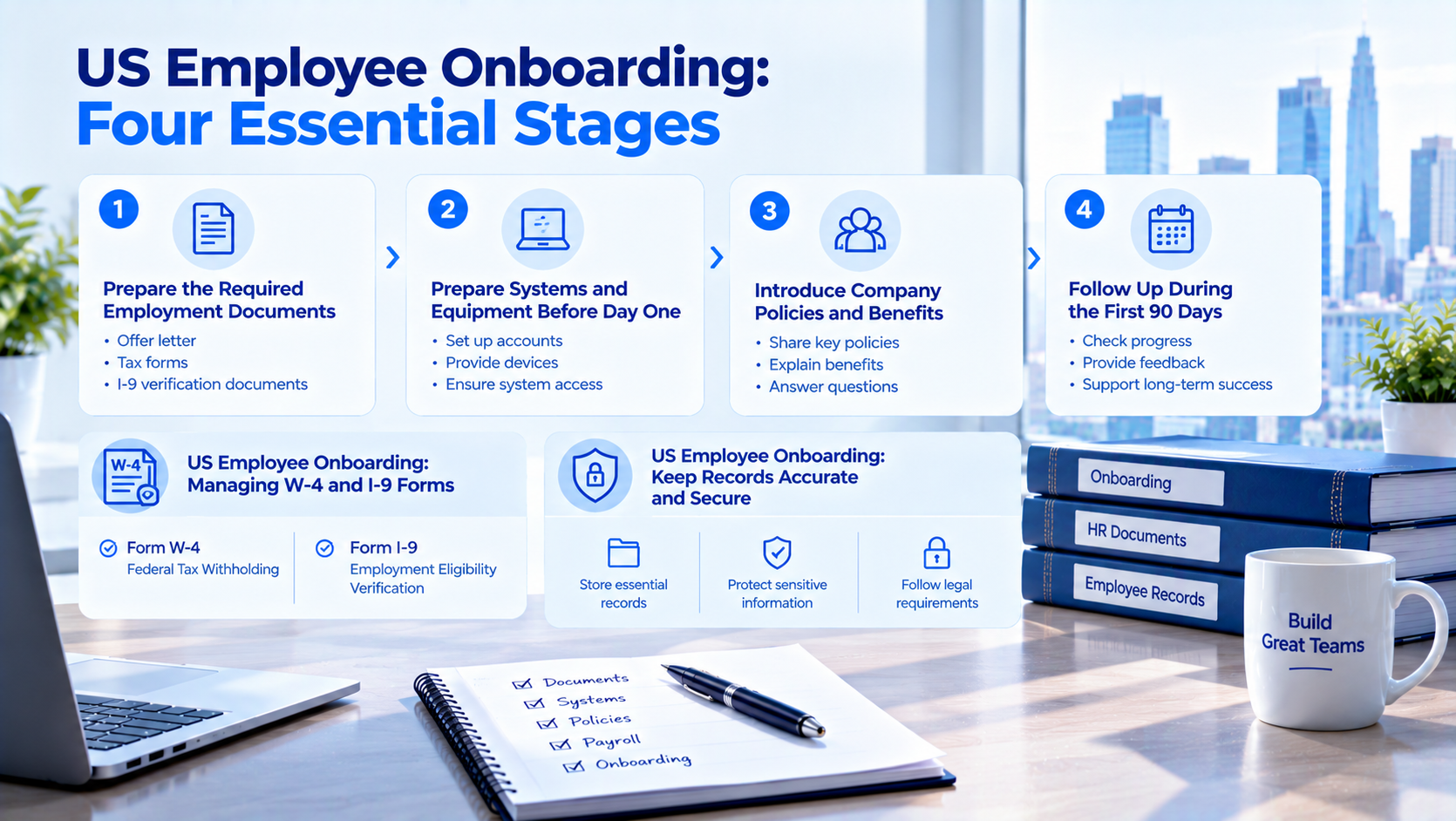
US Employee Onboarding: Managing W-4 and I-9 Forms
Although both forms are part of the hiring process, W-4 and I-9 serve different purposes. Employers should understand the distinction and handle each form correctly.
Form W-4: Federal Tax Withholding
Employees use Form W-4, Employee's Withholding Certificate, to provide information that helps employers calculate federal income tax withholding. The form may include filing status, adjustments for multiple jobs, credits, deductions, and additional withholding requests.
Employers should collect the completed form and enter the relevant information into the payroll system. However, they should not make personal tax decisions for employees. If an employee has multiple jobs, nonresident alien status, or other complex circumstances, the employer can direct them to the IRS Form W-4 instructions or a qualified tax professional.
Form I-9: Employment Eligibility Verification
Form I-9 confirms an employee's identity and authorization to work in the United States. Employers must follow the applicable document examination and completion rules.
To manage I-9 records properly, employers should:
- Use the current accepted form and instructions.
- Complete each section within the required deadline.
- Follow the rules for examining acceptable documents.
- Correct errors using the proper procedures.
- Store records securely and retain them for the required period.
Employers should also apply the verification process consistently and avoid requesting specific documents simply because of an employee's citizenship or national origin. The employee generally chooses which acceptable documents to present from the relevant lists.
US Employee Onboarding: Keep Records Accurate and Secure
Collecting documents is only one part of employee record management. Businesses also need a reliable system for storing information, tracking deadlines, and controlling access.
A practical recordkeeping process should include:
- Separate sensitive records: Keep Form I-9 records and sensitive medical information separate from general personnel files where required or appropriate.
- Limit access: Allow only authorized staff to view personal, payroll, and identity documents.
- Review records regularly: Check for missing signatures, incorrect dates, and incomplete forms.
- Monitor legal changes: Update procedures when federal, state, or local requirements change.
- Follow retention rules: Keep documents for the applicable period and dispose of them securely when permitted.
Electronic storage can make records easier to organize and retrieve. However, digital files still require suitable access controls, security measures, and backup procedures.
For international entrepreneurs setting up a US company, a clear US Employee Onboarding checklist can help coordinate paperwork, payroll setup, and employee training. IngStart provides company registration and ongoing compliance support. Keeping corporate documents and administrative tasks organized can help business owners prepare for hiring and manage their wider business responsibilities.
Conclusion
US Employee Onboarding works best when paperwork, technology, training, and follow-up are treated as one connected process. Employers should prepare employment documents before the start date, complete W-4 and I-9 requirements correctly, and maintain secure employee records.
A consistent 30/60/90-day follow-up process can also help new hires adapt and understand their responsibilities. Since employment requirements vary by state and may change over time, companies should confirm the rules that apply to each employee's work location. With clear procedures in place, businesses can create a better first impression while reducing avoidable HR and compliance risks.
Article Recommendations
- Startup HR Compliance: 5 Essential Tasks for US Companies
- US Labor Laws: 2026 Minimum Wage and Paid Leave Guide
- Multi-State HR Compliance: A US Guide for Employers
If you still have questions, please contact our team on WhatsApp at +1 213 751 2111. We'll help you find the right solution for your business and keep your company compliant as it grows.