
US Labor Laws continue to change in 2026, particularly in minimum wage rates and paid leave requirements. For international businesses hiring employees in the United States, these rules affect payroll costs, employee benefits, and everyday HR decisions.
The federal minimum wage remains $7.25 per hour. However, many states and cities require higher pay. At the same time, more states are implementing paid family and medical leave programs. As a result, employers need to look beyond federal rules and check the requirements that apply to each employee's work location.
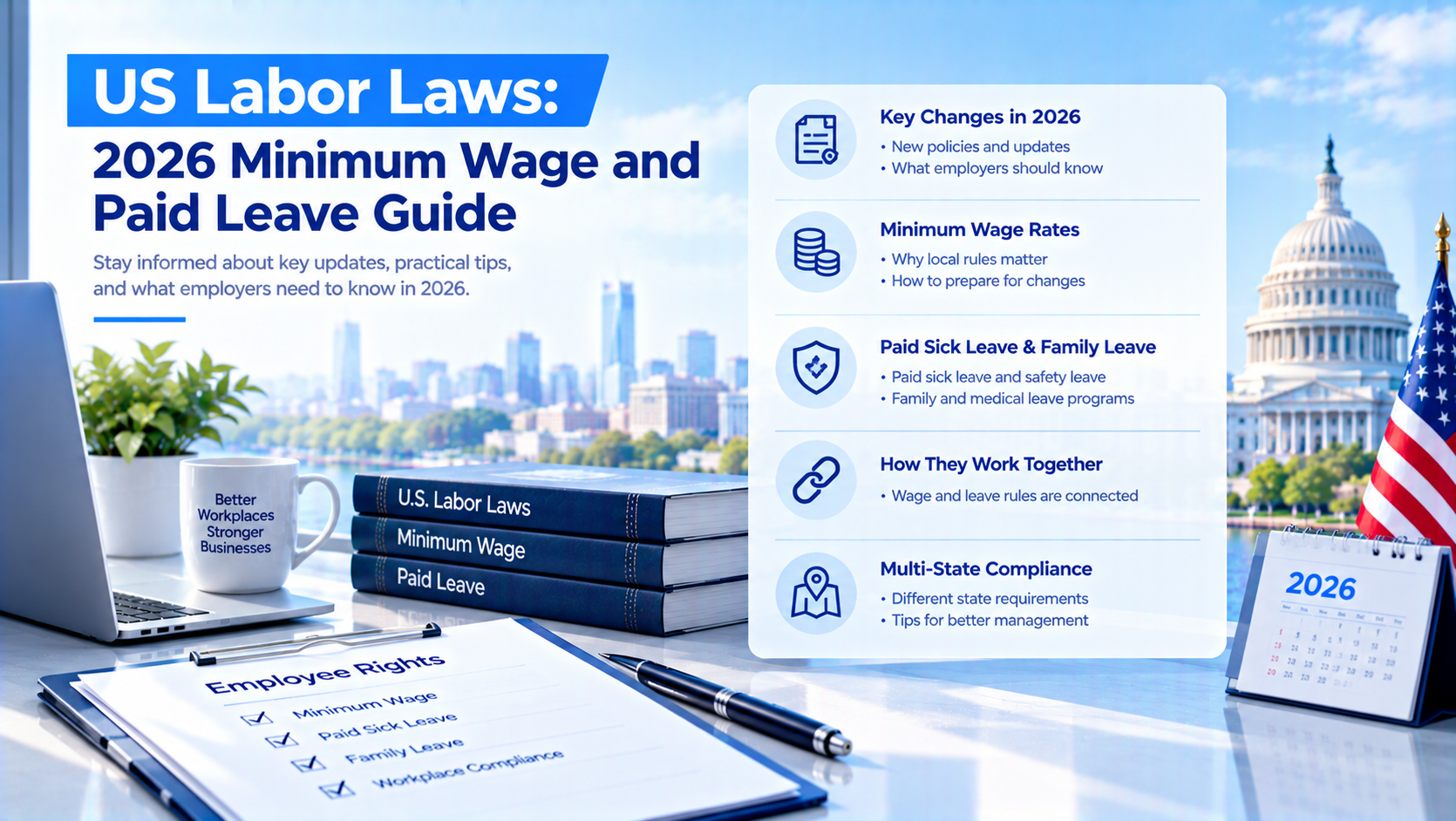
US Labor Laws: Key Changes in 2026
Three developments are particularly important for employers this year.
State and local wage rates remain different. Many states adjust their minimum wages annually. Some cities also set higher rates than their states, so one company may need to apply several wage standards.
Paid leave programs continue to expand. Some states now provide benefits under newly implemented programs, while others are still preparing for future launches. Employers need to distinguish between contribution dates and the dates when employees can claim benefits.
Remote work creates additional compliance duties. An employee's physical work location can affect minimum wage, leave eligibility, payroll registration, and other employment requirements. Therefore, businesses with remote teams should review their policies regularly.

US Labor Laws: Minimum Wage Rates in 2026
The following table highlights selected state minimum wage rates in 2026. Rates are shown as of October 2026, with Florida's September increase included. Local rules and industry-specific requirements may set higher rates.
| State or jurisdiction | Minimum wage per hour | Key detail |
|---|---|---|
| Arizona | $15.15 | State rate effective in 2026 |
| California | $16.90 | Some cities and industries require more |
| Colorado | $15.16 | Local rates may be higher |
| Connecticut | $16.94 | Annual adjustment applies |
| Florida | $15.00 | Effective September 30, 2026 |
| Massachusetts | $15.00 | Statewide rate |
| New York City, Long Island and Westchester County | $17.00 | Higher regional rate |
| Rest of New York State | $16.00 | Different rate applies outside those areas |
| Texas | $7.25 | Matches the federal minimum |
| Washington State | $17.13 | Local rates may be higher |
| District of Columbia | $18.40 | Rate adjusted on July 1, 2026 |
The US Department of Labor's state wage table provides the official rates for most jurisdictions. Florida's increase to $15 took effect on September 30, 2026, under its state constitutional schedule.
Why Local Wage Rules Matter
A statewide rate does not always tell the full story. For example, a company with employees in California may need to check local minimum wages and industry-specific rules. Similarly, employers in Washington State should review city requirements before setting payroll rates.
Florida also shows why effective dates matter. Its minimum wage increased from $14 to $15 per hour on September 30, 2026. Employers should therefore use the correct rate for the relevant pay period rather than relying on an outdated annual schedule.
How Employers Can Prepare for Wage Changes
To reduce payroll errors, employers should:
- Confirm each employee's actual work location, including remote employees.
- Check both state and local minimum wage rules.
- Update payroll systems before a new rate takes effect.
- Review overtime calculations when an employee's regular rate changes.
- Provide required wage notices and retain accurate payroll records.
These steps are particularly useful for companies that employ staff across several states.
US Labor Laws: Paid Sick Leave and Family Leave
Minimum wage is only one part of employment compliance. Paid leave rules also vary by state, and some cities have additional requirements.
As of March 2026, 18 states, including the District of Columbia, had laws requiring eligible private-sector employers to provide paid sick leave. Three additional states—Illinois, Maine, and Nevada—had earned paid leave laws that allow employees to use leave for a wider range of reasons. Eligibility, accrual rates, and usage limits vary by jurisdiction.
Paid Sick Leave and Safety Leave
Paid sick leave generally allows eligible employees to take time off for their own health needs or to care for a family member. Some laws also cover safety-related situations, such as seeking assistance after domestic violence, sexual assault, or stalking.
Common features include:
- Accrual: Employees may earn leave based on hours worked.
- Usage limits: Annual limits depend on the applicable law.
- Employer size: Some jurisdictions apply different rules based on workforce size.
- Local requirements: Cities may provide more generous benefits than state law.
For example, a policy that meets statewide requirements may still fall short of a city's rules. Employers should therefore check the applicable local law before finalizing their leave policies.
Paid Family and Medical Leave Programs in 2026
Paid family and medical leave programs may replace part of an employee's wages during qualifying medical or family-related absences. Depending on the state, funding may come from payroll contributions shared by employers and employees.
Several implementation milestones are important in 2026:
- Delaware: Its Paid Leave program began accepting benefit claims on January 1, 2026. Eligible employees may receive wage replacement for qualifying parental, family caregiving, medical, and military-related leave.
- Maine: Paid family and medical leave benefits became available for qualifying leave taken on or after May 1, 2026. Eligible workers may receive up to 12 weeks of paid leave, subject to program rules.
- Minnesota: Its statewide paid family and medical leave program began providing benefits in January 2026.
- Maryland: Its statewide program is scheduled to begin providing benefits in 2028, rather than 2026. Employers should monitor its implementation schedule and current guidance.
These examples show why employers must check the status of each program. A law may be enacted well before contributions begin or benefits become available.
How Wage and Leave Rules Affect Each Other
Wage and leave requirements are closely connected. A change in one area can affect payroll calculations, staffing plans, and recordkeeping.
Payroll calculations: Employers may need to review the pay rate used for leave benefits or other wage calculations. The correct method depends on the applicable law and the employee's circumstances.
Overtime costs: Under federal law, covered non-exempt employees generally receive at least 1.5 times their regular rate for hours worked over 40 in a workweek, subject to applicable exceptions. A higher wage rate can therefore increase overtime costs.
Recordkeeping: Employers should keep accurate records of hours worked, wages paid, leave accrued, and leave used. These records may be relevant during wage-and-hour reviews or paid leave audits.
A consistent payroll and HR process can help businesses manage these connected requirements without treating each new rule as a separate administrative task.
Managing US Labor Laws Across Multiple States
For international businesses, managing employees in different states can quickly become complicated. A single employee handbook may not cover every local requirement, particularly when the workforce includes remote employees.
A practical approach is to maintain a compliance checklist for each work location. Include minimum wage rates, overtime rules, paid sick leave, family and medical leave, required notices, payroll registration, and record retention.
Businesses should also review their policies whenever an employee moves to another state or a new local rule takes effect. In addition, payroll and HR teams should record when each policy was reviewed and updated.
For international entrepreneurs setting up or managing a US business, IngStart provides company registration and ongoing compliance support. Organizing corporate records and administrative tasks early can help business owners prepare for the wider responsibilities of hiring and operating across jurisdictions.
Conclusion
US Labor Laws in 2026 require employers to look beyond the federal minimum wage. State and local wage rates differ, while paid sick leave and family and medical leave programs continue to develop.
For international businesses, the most reliable approach is to check the rules for each employee's work location, update payroll and HR policies on time, and maintain accurate employment records. Since requirements and implementation dates can change, employers should verify current rules with the relevant state or local labor agency before making payroll or leave decisions.
Article Recommendations
- U.S. Employee Insurance: A Compliance Guide for Global Businesses
- US Worker Classification: Employee Tax Guide
- Multi-State HR Compliance: A US Guide for Employers
If you still have questions, please contact our team on WhatsApp at +1 213 751 2111. We'll help you find the right solution for your business and keep your company compliant as it grows.