

OBBBA tax changes mark a major shift in the US federal tax system. President Donald Trump signed the One Big Beautiful Bill Act (OBBBA) into law on July 4, 2025. The law extends several tax provisions from the Tax Cuts and Jobs Act (TCJA). It also creates new deductions for eligible tips, overtime pay, and interest on certain car loans.
These changes affect more than income tax rates. They also cover standard deductions, child tax credits, savings accounts, and state and local tax deductions. Some provisions apply permanently, while others only cover 2025 through 2028. Therefore, taxpayers need to understand which rules apply to their circumstances.
This guide explains the main OBBBA tax changes in simple terms. It covers key provisions for individuals, families, workers, and investors. It also highlights points that people living outside the United States should consider if they have US tax obligations.
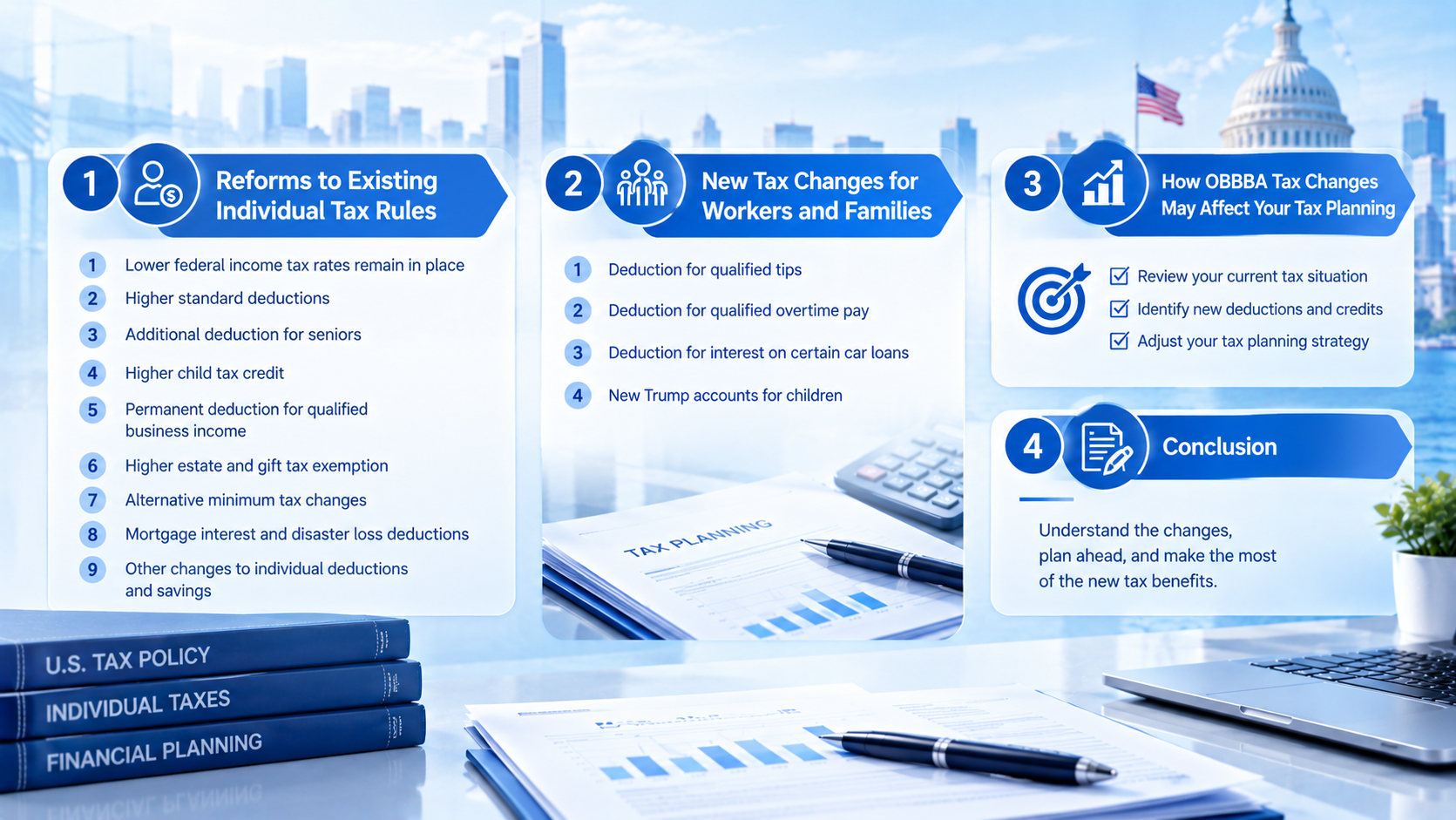
1. OBBBA Tax Changes to Existing Individual Tax Rules
Several TCJA provisions were due to expire after 2025. The OBBBA makes many of them permanent or extends them. It also adjusts some deduction limits and eligibility rules.
1.1 OBBBA Tax Changes to Federal Income Tax Rates
The OBBBA makes the individual income tax rate structure from the TCJA permanent. The seven federal marginal tax rates remain at 10%, 12%, 22%, 24%, 32%, 35%, and 37%.
Before the TCJA, the top marginal rate was 39.6%. The current structure preserves lower rates for many taxpayers compared with the previous system. However, your actual tax rate depends on your taxable income, filing status, and applicable tax brackets.

1.2 OBBBA Tax Changes to Standard Deductions
The law makes the higher standard deduction permanent and increases the amounts for 2025. This deduction reduces the income subject to federal income tax. Taxpayers generally choose it instead of itemizing eligible deductions.
| Filing status | 2017 standard deduction | 2025 standard deduction | 2026 standard deduction |
|---|---|---|---|
| Single | $6,350 | $15,750 | $16,100 |
| Married filing jointly | $12,700 | $31,500 | $32,200 |
| Married filing separately | $6,350 | $15,750 | $16,100 |
| Head of household | $9,350 | $23,625 | $24,150 |
The 2025 and 2026 figures reflect current law and inflation adjustments. They help taxpayers compare different tax years. However, individual circumstances can affect the final calculation.
1.3 OBBBA Tax Changes for Seniors
From 2025 through 2028, eligible taxpayers aged 65 or older can claim an additional deduction of up to $6,000 per person. A married couple may qualify for a combined deduction of up to $12,000 if both spouses meet the requirements.
Key conditions include:
- The taxpayer must meet the age requirement for the relevant tax year.
- The taxpayer must have a valid Social Security number.
- Eligible taxpayers can claim the deduction whether they take the standard deduction or itemize.
- The deduction begins to phase out when modified adjusted gross income exceeds $75,000 for single filers or $150,000 for joint filers.
This benefit is an additional deduction, not a separate tax credit. It can reduce taxable income, but it does not make all income received by seniors tax-free.
1.4 OBBBA Child Tax Credit Changes
The law increases the maximum Child Tax Credit to $2,200 per qualifying child, starting with the 2025 tax year. The credit remains subject to eligibility and income rules.
Other relevant provisions include:
- Eligible families may claim a refundable portion under the Additional Child Tax Credit rules.
- Certain taxpayers can claim a $500 nonrefundable credit for other dependents.
- The credit begins to phase out at modified adjusted gross income of $200,000 for single filers and $400,000 for married couples filing jointly.
- Social Security number requirements apply to taxpayers and qualifying children.
Families should review the latest IRS instructions before claiming the credit. This step matters especially when a child or parent has cross-border tax circumstances.
1.5 OBBBA Changes to Qualified Business Income Deductions
The OBBBA permanently extends the 20% deduction for qualified business income under Section 199A. Eligible owners of pass-through businesses may benefit. These businesses include certain sole proprietorships, partnerships, and S corporations.
The law also introduces a minimum deduction of $400 for eligible taxpayers with at least $1,000 in qualified business income from an actively conducted business. Other eligibility and income limits may apply.
Not every business owner qualifies. The business type, income level, and other tax rules determine the amount a taxpayer can claim.
1.6 OBBBA Estate and Gift Tax Changes
For 2026 and later years, the federal estate and gift tax exemption increases to $15 million per person, with inflation adjustments in future years. A married couple may potentially shelter up to $30 million, depending on eligibility and estate planning.
This change may affect long-term wealth transfers, gifts, and estate planning. However, the federal exemption does not eliminate state-level estate or inheritance taxes. People who hold assets in several countries should also consider how each jurisdiction treats gifts, estates, and inherited property.
1.7 OBBBA Changes to the Alternative Minimum Tax
The law makes the higher Alternative Minimum Tax (AMT) exemption permanent. It also changes the income thresholds at which the exemption begins to phase out.
The AMT uses a separate tax calculation to limit certain tax benefits for higher-income taxpayers. Under the new rules, some people may be less likely to owe AMT than under the previously scheduled rules. However, the result still depends on income, filing status, deductions, and other factors.
1.8 OBBBA Mortgage Interest and Disaster Loss Rules
The OBBBA retains the limit on mortgage debt that qualifies for the home mortgage interest deduction. Generally, taxpayers can deduct qualifying interest on debt of up to $750,000, or $375,000 for married taxpayers filing separately. Interest on home equity debt generally does not qualify unless the debt meets the applicable acquisition-indebtedness rules.
The law also permanently restricts personal casualty loss deductions. In general, individuals can claim qualifying personal casualty losses only when they relate to a federally declared disaster or certain qualifying state-declared disasters. Taxpayers must account for insurance reimbursements and other compensation when calculating the deductible amount.
1.9 Other OBBBA Tax Changes to Deductions and Savings
Several other OBBBA tax changes affect deductions, employee benefits, and savings arrangements:
- Miscellaneous itemized deductions: The law keeps the elimination of the former 2% floor for miscellaneous itemized deductions. Eligible educators can still deduct certain unreimbursed classroom expenses under applicable rules.
- Limits on itemized deductions: The law replaces the former Pease limitation with a new restriction on the tax benefit of itemized deductions for certain higher-income taxpayers.
- Commuting benefits: Employer-provided bicycle commuting reimbursements no longer receive the previous tax-free treatment.
- Moving expenses: Most taxpayers can no longer claim the moving expense deduction or exclusion. Exceptions apply to certain active-duty military moves and qualifying intelligence community members.
- ABLE accounts: The law extends rules that allow additional contributions to Achieving a Better Life Experience (ABLE) accounts. Eligible beneficiaries may also qualify for the Saver's Credit on qualifying contributions.
- 529 plan rollovers: Eligible taxpayers can roll qualifying funds from a 529 education savings plan into an eligible ABLE account tax-free, subject to annual contribution limits and other conditions.
- Student loan cancellation: The law extends the exclusion from gross income for certain student loan debts discharged because of death or total and permanent disability. Applicable Social Security number requirements still apply.
- State and local tax deductions: The deduction cap rises to $40,000 for eligible taxpayers in 2025. Higher-income taxpayers may face a phase-down. The cap increases by 1% annually through 2029 and is scheduled to return to $10,000 in 2030.
These provisions affect taxpayers differently. Before claiming a deduction, check the eligibility rules, income limits, and tax year.
2. New OBBBA Tax Changes for Workers and Families
Beyond extending existing provisions, the law introduces several new deductions. These changes may benefit workers who receive tips or overtime pay, people financing eligible vehicles, and families saving for children.
2.1 OBBBA Tax Deduction for Qualified Tips
From 2025 through 2028, eligible workers can deduct up to $25,000 in qualified tips each year. The deduction covers qualifying tips received in occupations that customarily and regularly received tips before the end of 2024.
Qualified tips generally include voluntary cash or charged tips from customers. Workers must meet the applicable reporting requirements. Eligible employees and self-employed individuals may qualify, depending on their work and business activities.
Important conditions include:
- The maximum annual deduction is $25,000.
- The deduction begins to phase out when modified adjusted gross income exceeds $150,000 for single filers or $300,000 for joint filers.
- A valid Social Security number is required.
- Certain employees and self-employed people in specified service trades or businesses cannot claim the deduction.
The phrase “no tax on tips” can be misleading. This provision offers a federal income tax deduction, not a blanket exemption from every tax. For example, other employment taxes may still apply.
2.2 OBBBA Tax Deduction for Qualified Overtime Pay
Eligible workers can deduct qualifying overtime compensation from 2025 through 2028. The maximum deduction is $12,500 for single filers and $25,000 for married couples filing jointly.
The deduction generally covers the portion of qualifying overtime pay that exceeds the employee's regular rate. For example, when an employer pays overtime at one and a half times the regular rate, the eligible amount may be the additional half rather than the entire overtime payment.
The main requirements include:
- Overtime compensation must meet the relevant federal requirements and reporting rules.
- The deduction begins to phase out above modified adjusted gross income of $150,000 for single filers or $300,000 for joint filers.
- A valid Social Security number is required.
- The provision applies from 2025 through 2028.
This deduction does not make all overtime income tax-free. Payroll taxes and other applicable obligations may still apply.
2.3 OBBBA Tax Deduction for Certain Car Loan Interest
The law allows eligible individuals to deduct up to $10,000 per year in interest paid on qualifying passenger vehicle loans. This deduction applies from 2025 through 2028.
To qualify, the loan generally must have been taken out after December 31, 2024, to purchase a vehicle for personal use. The vehicle must have undergone final assembly in the United States. Qualifying vehicles may include cars, minivans, vans, SUVs, pickup trucks, and motorcycles that meet the relevant weight requirements.
Other conditions include:
- The vehicle must serve personal rather than business use.
- Lease payments do not qualify.
- The taxpayer must report the vehicle identification number (VIN) on the tax return.
- The deduction begins to phase out above modified adjusted gross income of $100,000 for single filers or $200,000 for joint filers.
This provision matters to buyers comparing vehicle financing options. However, only eligible interest qualifies. The principal paid on the loan is not deductible under this rule.
2.4 OBBBA Tax Changes and New Trump Accounts for Children
The OBBBA creates a new type of tax-advantaged savings account for children, known as a Trump Account. These accounts aim to support long-term savings and investment.
Eligible accounts generally follow rules similar to traditional individual retirement accounts (IRAs). However, special restrictions apply before the beneficiary turns 18.
Key features include:
- Eligible beneficiaries must generally be under age 18 at the end of the tax year and have a Social Security number.
- Total annual contributions from individuals and other eligible sources may generally reach $5,000 before the beneficiary turns 18. The limit is scheduled to adjust for inflation starting in 2028.
- Individual contributions are generally not tax-deductible.
- Withdrawals face restrictions before age 18, subject to specific exceptions.
- Account holders can invest assets in qualifying mutual funds or exchange-traded funds that meet the applicable fee requirements.
The law also allows certain employers to contribute to an employee's Trump Account or an eligible account for the employee's dependent child. Employer contributions of up to $2,500 may qualify for special tax treatment and count toward the overall annual contribution limit.
In addition, the federal government provides a one-time $1,000 pilot-program contribution for eligible children born from 2025 through 2028. The child must meet the citizenship and Social Security number requirements, and an eligible taxpayer must make the required election.
These accounts have specific eligibility and withdrawal rules. Families should review official IRS guidance before making contributions or planning withdrawals.
3. How OBBBA Tax Changes May Affect Your Tax Planning
The impact of OBBBA tax changes depends on your income, filing status, family circumstances, and financial activities. Some taxpayers may benefit from higher deductions. Others may face income limits or restrictions on specific tax benefits.
Consider these practical steps:
- Review your filing status and deductions. Compare the standard deduction with your eligible itemized deductions before filing.
- Check worker deductions. If you receive tips or overtime pay, confirm that your occupation, income, and records meet the requirements.
- Review eligible vehicle loans. Keep loan statements and vehicle information if you plan to claim the car loan interest deduction.
- Plan family savings carefully. If you are considering Trump Accounts, 529 plans, or ABLE accounts, review the contribution and withdrawal rules.
- Check cross-border tax obligations. Non-US citizens and people living abroad may still have US tax filing obligations in certain circumstances. Citizenship, residency status, income source, and applicable tax treaties can affect the outcome.
- Keep supporting documents. Accurate records can help substantiate deductions and credits if the IRS requests further information.
For international entrepreneurs, company owners, and investors, tax planning may also involve business registration and ongoing compliance. IngStart provides company registration and compliance support across several jurisdictions. Its services help clients organise business documents and track related procedures. However, individuals should consult a qualified tax professional about their specific US tax obligations.
Conclusion
The OBBBA introduces major changes to the US individual tax system. It makes several TCJA provisions permanent, increases certain deductions, and creates new tax benefits for eligible workers and families.
However, not every provision applies to every taxpayer. Some benefits have income limits, specific reporting requirements, or temporary effective periods. Others may affect financial planning for several years.
Understanding the relevant OBBBA tax changes can help individuals prepare for tax filing and make informed financial decisions. Before claiming a deduction or changing a financial plan, check the latest IRS guidance and confirm how the rules apply to your circumstances.
Article Recommendations
- OBBBA Tax Changes: A New Era for US Business Taxes
- US Labor Laws: 2026 Minimum Wage and Paid Leave Guide
- US Securities Tax: Rules and Refund Guide for Foreign Investors
If you still have questions, please contact our team on WhatsApp at +1 213 751 2111. We'll help you find the right solution for your business and keep your company compliant as it grows.