
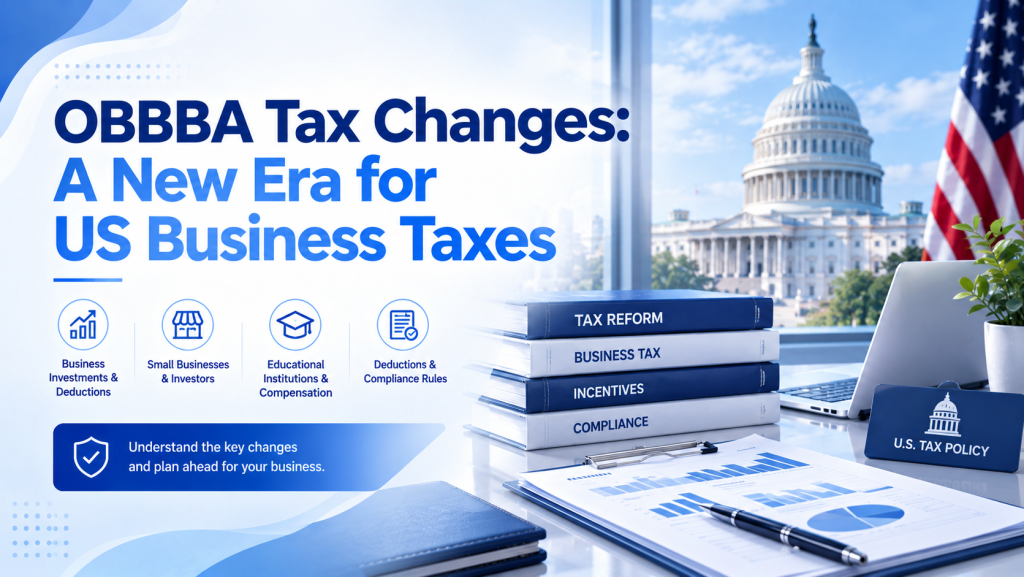
OBBBA tax changes are reshaping the US federal tax landscape for businesses, investors, and international entrepreneurs. The One Big Beautiful Bill Act (OBBBA) became law on July 4, 2025. It builds on the Tax Cuts and Jobs Act (TCJA) and changes business deductions, research costs, tax credits, and compliance rules.
For non-US business owners operating in the United States, these changes may affect investment plans, operating costs, and tax reporting. Some provisions make earlier tax incentives permanent, while others introduce new limits or eligibility requirements. This guide explains the main OBBBA tax changes and what businesses should review for the 2025 tax year and beyond.
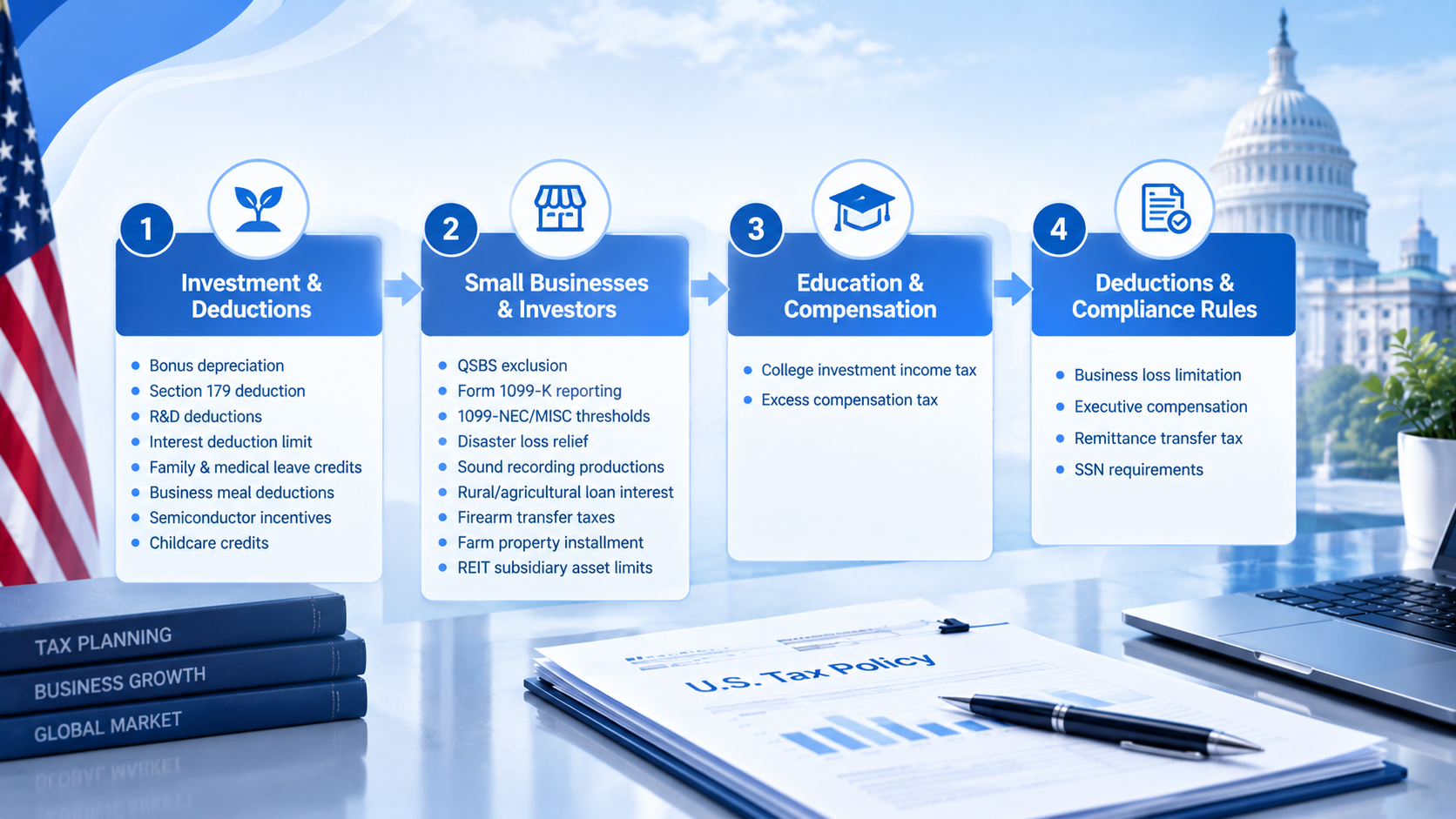
1. OBBBA Tax Changes for Business Investments and Deductions
The Act aims to encourage business investment in the United States. It changes how companies deduct equipment costs, account for research expenses, and calculate deductible interest. In addition, it extends or expands several tax credits.
1.1 OBBBA Tax Changes to Bonus Depreciation
Bonus depreciation allows a business to deduct the cost of certain qualifying assets more quickly instead of spreading the deduction over several years. Under the OBBBA tax changes, businesses can claim 100% bonus depreciation for qualifying property acquired and placed in service after January 19, 2025, subject to the applicable rules.
This provision can benefit businesses that purchase machinery, equipment, computers, and certain other assets. However, not every purchase qualifies. Eligibility depends on the asset type, acquisition date, and other tax requirements.
| Item | OBBBA rules | Previous TCJA phase-down |
|---|---|---|
| Qualifying property acquired and placed in service after January 19, 2025 | 100% bonus depreciation | Not applicable |
| 2023 | — | 80% |
| 2024 | — | 60% |
| 2025, before the new effective date | — | Generally 40% |
| 2026, under the former schedule | — | Generally 20% |
| 2027, under the former schedule | — | Generally 0% |
The former phase-down schedule still matters for certain property acquired before the new effective date. Businesses should check acquisition and placed-in-service dates before claiming a deduction.
1.2 Higher Section 179 Deductions Under OBBBA
Section 179 allows businesses to deduct the cost of qualifying property in the year they place it in service, subject to annual limits and other conditions. The OBBBA tax changes increase these limits for tax years beginning after December 31, 2024.
| Section 179 item | 2025 limit under OBBBA | Previous 2025 limit under TCJA |
|---|---|---|
| Maximum deduction | $2,500,000 | $1,250,000 |
| Investment phase-out threshold | $4,000,000 | $3,130,000 |
| SUV deduction limit | $31,300 | $31,300 |
The deduction begins to phase out when qualifying property purchases exceed the investment threshold. It also generally cannot exceed the business's taxable income from active business activities.
Qualifying property may include tangible business equipment, certain computer software, and eligible improvements to nonresidential property. However, special rules apply to different assets. If business use of certain property later falls to 50% or less, the business may need to recapture part of the previous deduction.
1.3 OBBBA Tax Changes to Research and Development Deductions
Research and development (R&D) costs can represent a major expense for technology companies, manufacturers, and other businesses. Under the previous TCJA rules, many businesses had to capitalize and amortize these costs over several years.
The OBBBA tax changes restore immediate deductions for qualifying domestic research or experimental expenditures paid or incurred in tax years beginning after December 31, 2024. Software development costs may also qualify.
However, foreign research costs generally remain subject to a 15-year amortization period. The law also gives businesses transition options for certain domestic R&D expenses from earlier years.
Key points include:
- Eligible domestic R&D expenses can generally be deducted in the year the business incurs them.
- Businesses may elect to capitalize qualifying domestic research costs and amortize them over at least 60 months.
- Eligible small businesses may be able to apply the new rules retroactively to certain earlier tax years, subject to the applicable gross-receipts test and election deadlines.
- Businesses with qualifying R&D costs from 2022 through 2024 may have options to deduct remaining unamortized amounts over a shorter period.
These rules can affect cash flow and taxable income. Therefore, businesses should review their accounting methods and choose appropriate elections before filing.
1.4 Business Interest Deduction Limits Under OBBBA
The OBBBA tax changes also revise the calculation used to limit business interest deductions under Section 163(j). For tax years beginning after December 31, 2024, the law restores an adjusted taxable income calculation based on earnings before interest, taxes, depreciation, and amortization (EBITDA).
Generally, businesses can deduct interest up to the sum of:
- Business interest income.
- 30% of adjusted taxable income.
- Qualifying floor plan financing interest.
Certain small businesses may qualify for an exemption under the gross-receipts test, subject to the applicable conditions. The law also expands the definition of vehicles eligible for the floor plan financing interest exception to include certain trailers and campers.
For businesses that rely on loans to finance equipment or expansion, these changes may increase the amount of interest they can deduct. Nevertheless, the actual benefit depends on the company's income, financing structure, and eligibility.
1.5 Extended Tax Credits for Paid Family and Medical Leave
The Act makes the employer tax credit for paid family and medical leave permanent, subject to the relevant requirements. Employers may qualify for a credit for eligible wages they pay to employees on qualifying leave.
The rules also allow employers to choose between eligible wage costs and qualifying insurance premiums when calculating the credit. Employers within the same controlled group generally count as a single employer for this purpose.
Businesses should review their leave policies and payroll records to determine whether they qualify.
1.6 OBBBA Changes to Business Meal Deductions
Under the previous rules, meals provided for the convenience of an employer generally faced a 50% deduction limit. The OBBBA includes an exception for certain meals associated with the sale of goods or services for adequate and full consideration.
For qualifying expenses paid or incurred after December 31, 2025, the exception may allow a full deduction for eligible meals provided for the employer's convenience. The rule has specific conditions, so businesses should not assume that all employee meals qualify for a 100% deduction.

1.7 Higher Semiconductor Manufacturing Tax Credits
The Act increases the Advanced Manufacturing Investment Credit under Section 48D from 25% to 35% for qualifying property placed in service after December 31, 2025. This credit supports eligible investments in semiconductor manufacturing facilities and related property.
For companies planning manufacturing investments in the United States, the higher credit may reduce the effective cost of qualifying projects. However, businesses must review construction-start dates, facility requirements, and other eligibility rules before relying on the credit.
1.8 Expanded Employer-Provided Childcare Tax Credits
The OBBBA tax changes expand the employer-provided childcare credit for qualifying expenses paid or incurred after December 31, 2025.
| Item | Previous rule | Expanded rule |
|---|---|---|
| General credit rate | 25% | 40% |
| Credit rate for qualifying small businesses | 25% | 50% |
| General maximum credit | $150,000 | $500,000 |
| Maximum for qualifying small businesses | $150,000 | $600,000 |
The credit limits will adjust for inflation beginning in 2027. The law also expands eligible expenses to include certain payments to third-party providers and qualifying childcare facilities jointly owned or operated with other parties.
These changes may help employers offset part of the cost of childcare support. Businesses should confirm their eligibility and maintain records of qualifying expenses.
2. OBBBA Tax Changes for Small Businesses and Investors
Beyond general business tax provisions, the Act introduces targeted measures for small businesses, investors, and selected industries. These measures cover qualified small business stock, information reporting, disaster losses, and certain agricultural activities.
2.1 Expanded Qualified Small Business Stock Benefits
The Act expands the tax benefits available for certain gains from qualified small business stock under Section 1202. The changes apply to qualifying stock issued after the date of enactment and introduce a more flexible framework for eligible investments.
Key changes include:
- The maximum eligible gain exclusion increases from $10 million to $15 million for qualifying stock, subject to the applicable rules.
- The gross-asset threshold increases from $50 million to $75 million for eligible corporations.
- The asset threshold and gain limit are scheduled to adjust for inflation beginning in 2027.
- The stock generally must come from a qualifying domestic C corporation and must be acquired by the shareholder at original issuance.
- The corporation must meet the active-business requirements, including the applicable 80% asset-use test.
Certain service businesses, financial businesses, and businesses involved in specific natural resource activities may not qualify. The tax treatment also depends on the stock's acquisition date, holding period, and other requirements.
For international investors considering US startup investments, these rules may affect after-tax returns. However, investors should confirm eligibility before assuming that a gain qualifies for exclusion.
2.2 Changes to Form 1099-K Reporting
The Act revises the reporting threshold for third-party settlement organizations, including certain payment platforms. The threshold returns to more than $20,000 in gross payments and more than 200 transactions during a calendar year.
The change applies retroactively to calendar years beginning after December 31, 2021. However, a reporting threshold does not determine whether income is taxable. Businesses and individuals must still report taxable income even when they do not receive Form 1099-K.
2.3 Higher Form 1099-NEC and 1099-MISC Reporting Thresholds
For payments made in tax years beginning after December 31, 2025, the reporting threshold for certain payments reported on Forms 1099-NEC and 1099-MISC increases to $2,000.
This change may reduce reporting requirements for some businesses. However, companies should continue to maintain accurate payment records and confirm which transactions they must report under the rules for the relevant tax year.
2.4 Expanded Tax Relief for Certain Disaster Losses
The Act extends and modifies tax relief for certain personal casualty losses resulting from qualifying disasters. Eligible taxpayers may claim deductions without the usual 10% adjusted gross income limitation.
The minimum loss threshold increases from $100 to $500, and qualifying losses may be deductible in addition to the standard deduction. The rules also cover certain major disasters declared within 60 days after the Act's enactment, subject to the statutory conditions.
Because eligibility depends on the type of disaster, location, and nature of the loss, affected taxpayers should check the applicable requirements before claiming relief.
2.5 Tax Treatment of Qualifying Sound Recording Productions
The Act adds qualifying sound recording productions to the types of productions eligible for certain deductions under Section 181. Eligible productions may qualify for immediate expensing of up to $150,000 and may also qualify for bonus depreciation when they meet the relevant requirements.
This provision may benefit eligible businesses in the music and recording industry. However, businesses should confirm that their productions meet the applicable requirements before claiming a deduction.
2.6 Tax Exemption for Interest on Certain Rural and Agricultural Loans
Interest income from qualifying real estate loans secured by rural or agricultural property may qualify for a 25% exemption under the Act. The provision applies to eligible loans issued after enactment, subject to the applicable conditions.
This measure aims to support financing in certain rural and agricultural areas. Lenders should review the property, loan, and borrower requirements before applying the exemption.
2.7 Changes to Certain Firearm Transfer and Manufacturing Taxes
The Act reduces certain federal excise taxes under Section 5811(a) of the Internal Revenue Code. The transfer tax for machine guns and destructive devices falls to $0, and the new provision also sets the tax on other covered firearms at $0.
These changes apply to specified statutory categories. They do not remove other federal, state, or local requirements.
2.8 Installment Payments for Certain Farm Property Sales
Eligible farmers may elect to pay tax on gains from the sale of qualifying farm property in four equal installments. This option may help them spread tax payments over time instead of paying the full amount at once.
However, the transaction and property must meet the applicable conditions. Farmers should review the requirements before choosing this payment option.
2.9 Higher Asset Limit for Certain REIT Subsidiaries
For tax years beginning after December 31, 2025, the Act increases the permitted asset limit for certain taxable real estate investment trust (REIT) subsidiaries from 20% to 25%.
This change may give REITs and their subsidiaries additional flexibility. Nevertheless, the rules apply to specific asset tests and do not remove other REIT qualification requirements.
3. OBBBA Tax Changes Affecting Educational Institutions and Compensation
Some OBBBA tax changes target large private educational institutions and tax-exempt organizations. These measures may increase tax costs for certain organizations with substantial investment income or highly paid employees.
3.1 Revised Excise Tax on Private College and University Investment Income
The Act revises the excise tax on the net investment income of certain private colleges and universities. The applicable rate depends on the institution's endowment assets per student.
| Endowment assets per student | Excise tax rate |
|---|---|
| $500,000–$749,999 | 1.4% |
| $750,000–$1,999,999 | 4% |
| $2 million or more | 8% |
The revised rules apply to tax years beginning after December 31, 2025. The actual rate depends on the institution's eligibility and the statutory calculation, so this table serves as a summary rather than a complete tax computation.
3.2 Expanded Tax on Excess Compensation at Tax-Exempt Organizations
The Act expands the definition of an applicable employee for the excise tax on excess compensation paid by certain tax-exempt organizations. The revised rules generally cover all employees for tax years beginning after December 31, 2025.
Organizations should review compensation arrangements and payroll records to determine whether the changes affect their tax obligations.
4. OBBBA Tax Changes to Deductions and Compliance Rules
Although many OBBBA tax changes create new deductions or expand existing benefits, the Act also preserves certain limitations and strengthens specific compliance requirements. Businesses should review both sides of the legislation when estimating their overall tax position.
4.1 Permanent Limitation on Excess Business Losses
The Act makes the limitation on excess business losses permanent for noncorporate taxpayers. The rule generally restricts how much business loss an individual can use to offset nonbusiness income in a given tax year.
Taxpayers can generally carry forward disallowed amounts and treat them as net operating losses, subject to the applicable rules.
For 2025, the excess business loss threshold is $313,000 for single filers and $626,000 for joint filers. Taxpayers should check these amounts against their filing circumstances and the rules that apply to them.
4.2 Allocation of Executive Compensation Deductions
The Act introduces additional aggregation rules for certain related entities when applying the $1 million deduction limit for compensation paid to covered executives of publicly held corporations.
The covered group includes the chief executive officer, chief financial officer, and other specified highly compensated officers. The revised rules apply to tax years beginning after December 31, 2025.
Companies with multiple related entities should review compensation arrangements and deduction calculations to determine whether the new rules apply.
4.3 Excise Tax on Certain Remittance Transfers
The Act introduces a 1% excise tax on certain remittance transfers made after December 31, 2025. The tax applies to covered transfers under the statutory rules, with exemptions and conditions that may depend on the payment method and transaction details.
For international entrepreneurs and businesses that regularly transfer money across borders, it is important to distinguish personal remittances from business payments. Not every international transfer is necessarily subject to this tax, so businesses should review each transaction before calculating the cost.
4.4 Social Security Number Requirements for Education Tax Credits
The Act adds Social Security number requirements for taxpayers and dependent students claiming the American Opportunity Tax Credit or the Lifetime Learning Credit.
The changes generally apply to tax years beginning after December 31, 2025. Eligible claimants should check the identification requirements before filing because failure to meet them may affect eligibility for the credits.
What International Business Owners Should Do Next
The OBBBA tax changes may create opportunities for businesses investing in the United States, but the benefits depend on company structure, expenses, income, and tax status. International business owners should not assume that a deduction or credit automatically applies simply because their company operates in the United States.
Before filing, consider these practical steps:
- Review asset purchases and placed-in-service dates to determine whether bonus depreciation or Section 179 deductions may apply.
- Check how to treat domestic and foreign R&D expenses.
- Reassess business interest deductions and available tax credits.
- Review reporting obligations, cross-border payments, and the tax treatment of related entities.
- Consult a qualified US tax professional about elections, transition rules, and filing deadlines.
For international entrepreneurs who also need help managing US company setup and ongoing compliance, IngStart provides company registration and business compliance services. Its support can help business owners organize company documents, track compliance deadlines, and coordinate administrative tasks while they work with qualified tax professionals on tax-specific decisions.
Conclusion
The One Big Beautiful Bill Act introduces significant changes to US business taxation. Its provisions restore 100% bonus depreciation for qualifying property under the new rules, increase Section 179 limits, allow immediate deductions for qualifying domestic R&D expenses, and expand selected business tax credits. At the same time, the Act changes reporting requirements, compensation rules, and certain tax limitations.
For international business owners, the key is to understand which provisions apply to their companies and when the new rules take effect. Reviewing the legislation early, keeping accurate records, and seeking professional tax advice can help businesses make informed decisions and avoid unnecessary compliance risks.
Article Recommendations
- Corporate Estimated Tax: Rules and Deadlines
- US Labor Laws: 2026 Minimum Wage and Paid Leave Guide
- US Securities Tax: Rules and Refund Guide for Foreign Investors
If you still have questions, please contact our team on WhatsApp at +1 213 751 2111. We'll help you find the right solution for your business and keep your company compliant as it grows.