

Texas Company Registration is a popular option for international entrepreneurs who want to establish a business in the United States. Texas has a large economy, strong infrastructure, and a business-friendly environment. In addition, the state does not impose a personal income tax, which makes it attractive to many business owners.
However, Texas Company Registration involves more than choosing a company name and submitting an application. International entrepreneurs need to choose a suitable business structure, appoint a registered agent, complete state filings, and understand their ongoing tax and compliance obligations.
This 2026 guide explains the main requirements, registration process, advantages, and annual compliance rules for starting a company in Texas.
Texas Company Registration Requirements
Before starting Texas Company Registration, international entrepreneurs should understand the main formation requirements. The exact requirements may vary depending on the business structure, but the following points are generally important.
Texas Company Registration: Company Name
The first step is to choose a unique company name that meets Texas legal requirements. Your company name should be distinguishable from the names of other registered entities.
An LLC generally needs to include an appropriate designation, such as LLC or Limited Liability Company. A corporation must also use a suitable corporate designation. Before filing, it is a good idea to prepare several alternative names. This can help you avoid delays if your first choice is unavailable.
Texas Company Registration: Registered Office and Address
A Texas company must maintain a registered office with a physical street address in Texas. The registered office must allow the registered agent to receive official legal documents and government notices during normal business hours. It cannot simply be a mailbox service. The registered office may be different from the company's main business location.
Texas Company Registration: Registered Agent
Every Texas filing entity must maintain a registered agent in the state. The registered agent receives legal documents, government correspondence, and other official notices on behalf of the company. The agent must agree to serve in this role. For international entrepreneurs without a physical presence in Texas, using a professional registered agent service can help meet this requirement.
Texas Company Registration: Owners and Directors
Texas generally allows foreign individuals and foreign entities to participate in the ownership and management of a company. The specific structure depends on the type of business. An LLC may have members and managers, while a corporation may have shareholders, directors, and officers. International applicants should prepare accurate identification and ownership information for all relevant individuals.
Texas Company Registration: Formation Documents
The documents required depend on the company structure. For example, an LLC generally files a Certificate of Formation, while a corporation files the appropriate formation document with the Texas Secretary of State. In addition, the company should prepare internal documents, ownership information, and management details when necessary.
Texas Company Registration: Registration Fees
Texas requires companies to pay a state filing fee when submitting formation documents. The total cost of Texas Company Registration can vary depending on the company type and whether you use professional formation services. Other costs may include registered agent services, licenses, tax registrations, and ongoing compliance.
Texas Company Registration Process
The Texas Company Registration process is relatively straightforward when you prepare the required information in advance.
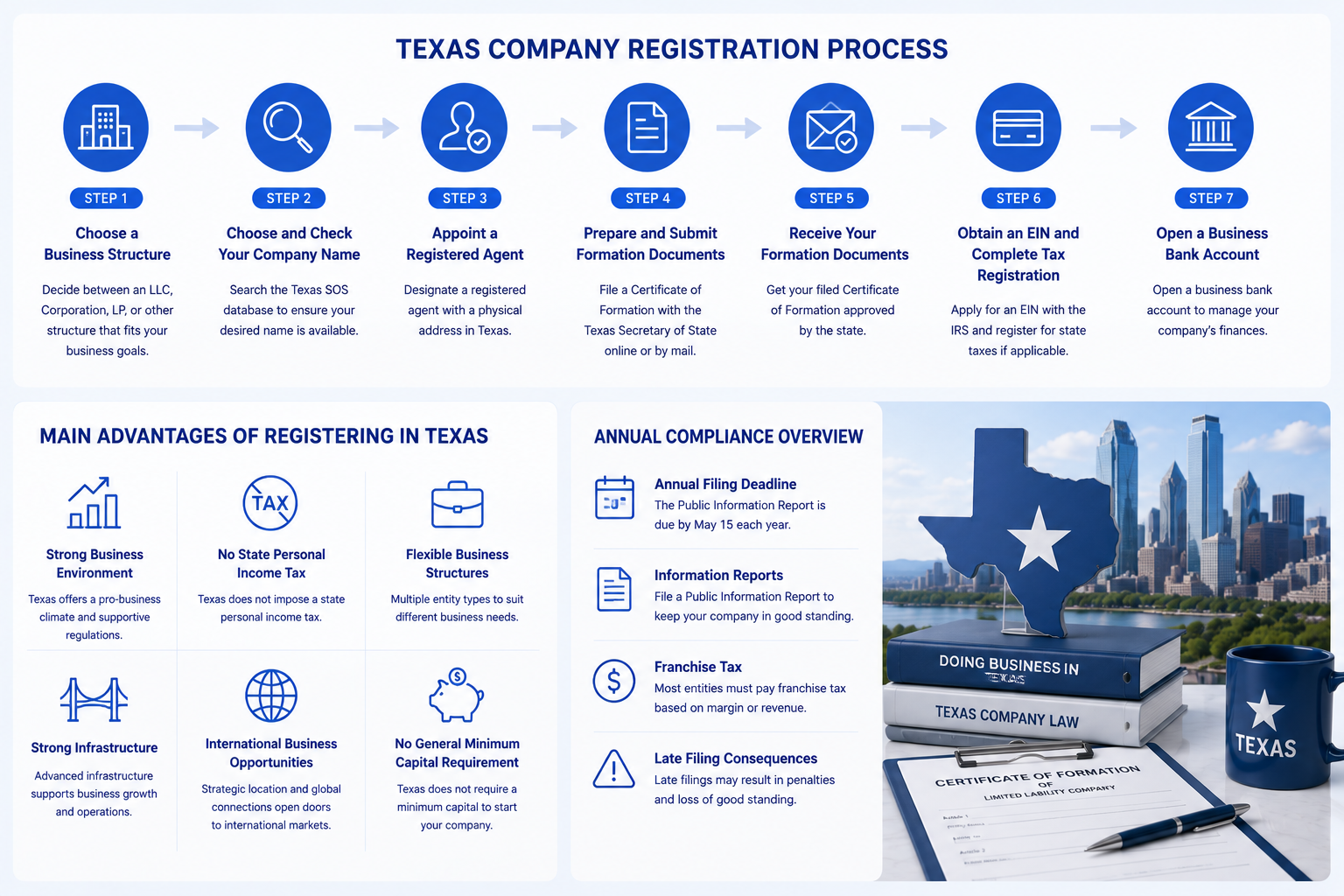
Step 1: Choose a Business Structure
First, decide which company structure is suitable for your business.
Common options include:
- Limited Liability Company (LLC)
- Corporation
- Partnership
An LLC may suit entrepreneurs who want a flexible management structure and limited liability. A corporation may be more suitable for businesses that plan to issue shares or seek outside investment. Your decision should consider your ownership structure, business plans, tax obligations, and long-term goals.
Step 2: Choose and Check Your Company Name
Next, select a suitable company name and check whether it is available. The name should comply with Texas naming rules and clearly differ from existing registered entities. Preparing alternative names can also help the registration process move forward without unnecessary delays.
Step 3: Appoint a Registered Agent
Before filing your formation documents, you need to appoint a Texas registered agent. The agent must maintain a physical address in Texas and agree to receive official documents on behalf of the company. This requirement applies to both domestic and foreign filing entities registered in Texas.
Step 4: Prepare and Submit Formation Documents
After confirming the company name and registered agent, prepare the required formation documents. You can submit the documents to the Texas Secretary of State and pay the applicable state filing fee. The information should be accurate and consistent because incorrect details may delay the registration process.
Step 5: Receive Your Formation Documents
Once the state accepts your filing, the company becomes officially registered in Texas. You should keep your formation documents and state filing records safely. You may need them later for banking, tax registration, contracts, licenses, and other business activities.
For international entrepreneurs who need assistance, Ingstart provides U.S. company registration services and can support founders with company formation, registered agent arrangements, and other business setup requirements. This can help international entrepreneurs handle the registration process more efficiently.

Step 6: Obtain an EIN and Complete Tax Registration
After completing Texas Company Registration, many businesses need to apply for an Employer Identification Number (EIN). The EIN comes from the IRS, not the Texas state government. Companies may need it for federal tax purposes, opening a U.S. business bank account, hiring employees, and other business activities.
Depending on the company's operations, you may also need to register with the Texas Comptroller or obtain additional state or local permits.
Step 7: Open a Business Bank Account
After forming the company and obtaining the necessary tax identification information, you may want to open a U.S. business bank account. Banks can have different requirements, especially for non-U.S. residents. Therefore, entrepreneurs should confirm the bank's current requirements before applying.
Texas Company Registration: Main Advantages
Strong Business Environment
Texas has a large and diverse economy. Its business environment supports companies across many industries, including technology, manufacturing, energy, logistics, and international trade. In addition, the state has major cities, international airports, and strong transportation networks.
No State Personal Income Tax
Texas does not impose a state personal income tax. However, this does not mean every business owner has no tax obligations. Federal taxes, sales taxes, employment taxes, franchise tax, and taxes in other jurisdictions may still apply depending on the company's activities.
Flexible Business Structures
Texas offers several business entity options, allowing entrepreneurs to choose a structure that matches their business needs. An LLC can provide flexible management, while a corporation may better suit companies that plan to raise capital or expand their ownership structure.
Strong Infrastructure
Texas has developed transportation and communication infrastructure. Its road, rail, air, and port networks can support businesses involved in domestic and international trade. This can be particularly useful for companies that need efficient logistics and supply chain operations.
International Business Opportunities
Texas has a strong international business presence and close trade connections with global markets. For international entrepreneurs, Texas Company Registration can provide access to a large U.S. market and support future business expansion.
No General Minimum Capital Requirement
Texas generally does not require a standard minimum paid-in capital amount to form a typical LLC or corporation. This gives startups and international entrepreneurs more flexibility when planning their initial business funding.
Texas Company Registration: Annual Compliance
Completing Texas Company Registration is only the first step. Companies must also meet ongoing tax and information filing requirements to maintain good standing.
Texas Company Registration: Annual Filing Deadline
Texas generally requires annual franchise tax filings by May 15. If May 15 falls on a weekend or holiday, the deadline moves to the next business day. The filing requirements depend on the company's revenue and tax status. For 2026, the Texas no-tax-due threshold is $2.65 million.
Texas Company Registration: Information Reports
Corporations and LLCs generally need to file a Public Information Report (PIR) each year. Other entity types may need to file an Ownership Information Report (OIR) instead. These reports help keep the company's information current with the Texas authorities. Companies with annualized total revenue at or below the no-tax-due threshold may not need to file a franchise tax report. However, they generally still need to submit the required PIR or OIR.
Texas Company Registration: Franchise Tax
Texas does not impose a traditional corporate income tax. However, many businesses may have Texas franchise tax obligations. For 2026 and 2027, the franchise tax rate is 0.375% for qualifying retail or wholesale businesses and 0.75% for other businesses, subject to the applicable rules and thresholds. The actual tax liability depends on factors such as the company's revenue, business activities, and applicable tax calculations.
Texas Company Registration: Late Filing Consequences
Companies should complete their required filings on time. Late or missing franchise tax filings can lead to penalties and additional compliance problems. The state may also take further action if the company does not resolve outstanding filing or tax issues. Therefore, international business owners should monitor their deadlines carefully and keep their company information up to date.
Texas Company Registration: What International Entrepreneurs Should Know
Texas Company Registration can be a practical option for international entrepreneurs who want to establish a U.S. business in a large and business-friendly state. However, forming the company is only the beginning. After registration, international owners may need to obtain an EIN, open a business bank account, meet tax requirements, and complete annual filings.
Therefore, before starting the process, make sure you understand the company structure, registered agent requirements, tax obligations, and long-term compliance responsibilities. With proper planning, Texas Company Registration can provide a solid foundation for building and expanding a U.S. business in 2026.
Article Recommendations
- How to Find Your SSN (Social Security Number): Practical Search and Replacement Steps
- US Bank Accounts 2026: Remote Personal & Business Banking Guide
- US Company Registration Guide: LLC vs LTD, State Selection & Foreign Profit Tax
If you still have questions, please contact our team on WhatsApp at +1 213 751 2111. We'll help you find the right solution for your business and keep your company compliant as it grows.