
Corporate Estimated Tax is an important tax obligation for many U.S. businesses. Companies that expect to owe at least $500 in federal tax may need to pay estimated tax during the year. This helps them avoid paying the full amount when they file their annual tax return.
For international entrepreneurs, these rules can be confusing. However, understanding them can help prevent penalties and cash flow problems. This guide explains who must pay, when payments are due, and how to calculate them.
Who Needs to Pay Corporate Estimated Tax?
Under Internal Revenue Code Section 6655, corporations generally must make estimated tax payments if they expect to owe at least $500 in federal tax for the year, after applicable credits.
This requirement commonly applies to:
- C corporations: These companies pay federal income tax at the corporate level.
- LLCs taxed as C corporations: These LLCs elect corporate tax treatment for federal tax purposes.
- Certain S corporations: These companies may need to pay estimated tax on specific taxes if the total reaches $500 or more.
For S corporations, these taxes include:
- Tax on built-in gains under IRC Section 1374
- Tax on excess net passive income under IRC Section 1375
- Investment credit recapture tax under IRC Section 1371(d)
However, not every U.S. business follows the same rules. An LLC taxed as a partnership generally passes its income to its owners. Those owners may have separate individual estimated tax obligations.
Before calculating Corporate Estimated Tax, confirm your company's federal tax classification. You should also identify the taxes your company expects to owe.

Corporate Estimated Tax: Quarterly Payment Deadlines
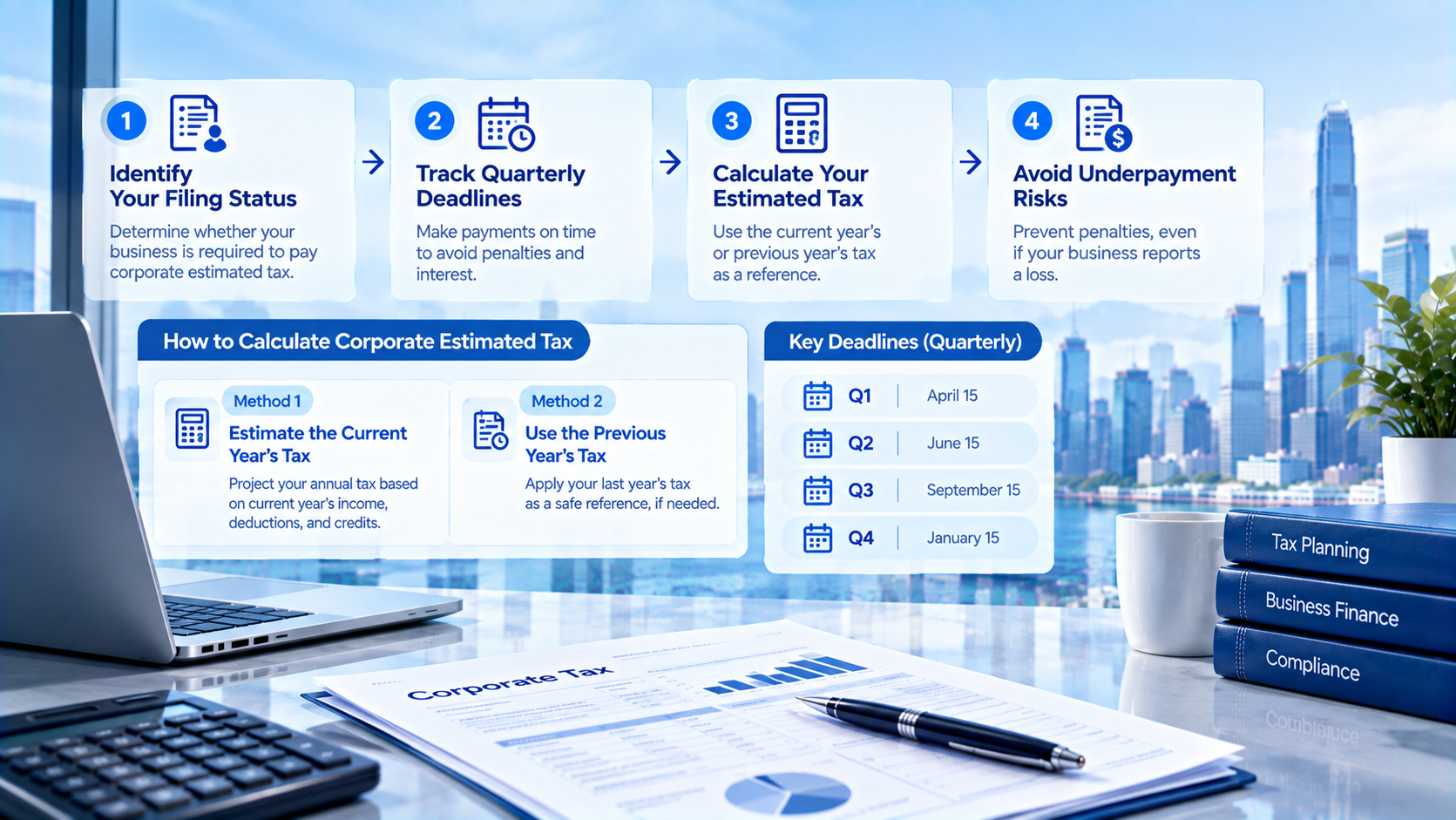
Corporations generally pay estimated tax in four installments. Each payment is due on the 15th day of the fourth, sixth, ninth, and twelfth months of the tax year.
For calendar-year corporations, the usual 2026 deadlines are:
| Installment | Payment deadline |
|---|---|
| First | April 15, 2026 |
| Second | June 15, 2026 |
| Third | September 15, 2026 |
| Fourth | December 15, 2026 |
If a deadline falls on a Saturday, Sunday, or federal holiday, it generally moves to the next business day. Companies with fiscal tax years must follow the dates that apply to their own tax years.
Importantly, an extension to file a corporate tax return does not extend estimated tax payment deadlines. Therefore, companies must plan these payments separately from their annual tax filings.
The IRS generally requires corporations to make estimated tax payments electronically. International business owners should review the available payment methods in advance. This helps ensure they can pay on time.
How to Calculate Corporate Estimated Tax
Your payment amount depends on several factors. These include your expected tax liability, previous tax returns, and the applicable installment rules.
Most corporations make four estimated payments each year. However, the calculation may become more complex when income changes significantly.
Method 1: Estimate the Current Year's Tax
First, estimate your company's taxable income for the current year. Then calculate the expected federal tax after applicable credits. Use the relevant IRS rules to determine each required installment.
This method works well when your company has reliable financial forecasts. However, revenue and expenses may change during the year. If they do, you may need to recalculate your remaining payments.
Method 2: Use the Previous Year's Tax
In many cases, corporations can use the previous year's tax liability to help determine the required payments. This approach may help them avoid an underpayment penalty.
Generally, the previous year's tax return must cover a full 12 months. It must also show a tax liability greater than zero. Large corporations face special rules and generally cannot use the previous year's tax for every installment.
Remember that the amount needed to avoid a penalty is not always the same as the final tax due for the current year. Companies cannot always choose whichever calculation produces the lowest payment.
For more details, review the IRS instructions for Form 2220. This form explains how corporations calculate underpayments and related penalties.
What Happens If You Underpay Corporate Estimated Tax?
If a company pays too little by an installment deadline, the IRS may charge an underpayment penalty under IRC Section 6655.
The penalty applies to the underpaid amount for the relevant period. The IRS calculates it using the applicable interest rate and the length of the delay. Therefore, it is not simply a fixed, one-time fine.
A company may still owe a penalty even if it pays the full tax when filing its annual return. This is because the IRS also checks whether the company made its required payments on time.
Can a Company Owe a Penalty Even If It Reports a Loss?
In some cases, yes. A company expecting a loss should not automatically assume it can avoid an underpayment penalty.
The outcome depends on the company's tax liability, previous tax return, required installments, and applicable exceptions. A previous year's tax liability alone does not mean every company with a current-year loss will owe a penalty.
For example, a corporation may avoid the penalty if it meets the required payment rules or qualifies for an exception. Companies should review the applicable IRS rules instead of relying only on their expected annual profit or loss.
International entrepreneurs who manage U.S. companies remotely should also keep financial forecasts and payment records organized. These records make tax calculations easier to review. IngStart provides U.S. company registration and ongoing compliance services to help business owners organize corporate documents and manage recurring administrative tasks.
Conclusion
Corporate Estimated Tax helps U.S. corporations pay federal taxes throughout the year. Companies that expect to owe at least $500 generally need to make quarterly payments. Certain S corporations must also pay estimated tax on specific taxes.
To reduce the risk of penalties, confirm your company's tax classification and track each payment deadline. Then calculate installments under the applicable IRS rules. If your business has seasonal income or a complex tax structure, professional tax advice can help you determine the correct payment amount.
Article Recommendations
- US Tax Forms Guide: Complete List of Common IRS Tax Forms
- US Business Tax Compliance Guide: Required Tax Filings & Compliance After Company Formation (2026)
- US Worker Classification: Employee Tax Guide
If you still have questions, please contact our team on WhatsApp at +1 213 751 2111. We'll help you find the right solution for your business and keep your company compliant as it grows.