

Introduction to Hong Kong Tax Planning
Hong Kong Tax Planning can help businesses manage tax obligations and organize cross-border operations. Hong Kong offers a stable legal system, an international business environment, and a territorial profits tax system. As a result, many international entrepreneurs choose Hong Kong for regional operations and investment structures.
However, each business has different tax needs. Trading companies, holding companies, financial businesses, and property investors must consider their income sources and activities. Therefore, this guide explains the main tax planning considerations for eight common types of Hong Kong companies.
Trading Companies
Trading companies may use Hong Kong to manage transactions between overseas suppliers, customers, and group companies. In addition, some businesses use Hong Kong entities to coordinate regional trade.
For related-party transactions, companies should apply appropriate transfer pricing methods. In particular, prices should reflect genuine business arrangements and comply with applicable rules. Businesses should also maintain contracts, invoices, shipping records, and other supporting documents.

However, companies should not shift profits to Hong Kong through artificial pricing. Tax authorities may review related-party transactions to check whether the arrangements reflect genuine commercial activities. For more information, see the Hong Kong Inland Revenue Department's transfer pricing guidance.
Trading and Service Companies
Trading and service companies may earn income from product sales, consulting, management, and other services. However, their tax position depends on the activities they perform and the source of their profits.
For example, a company that provides management services to group businesses should have a clear service agreement. The agreement should explain the work performed and the fees charged. In addition, supporting records should show that the services were actually provided.
Reasonable service fees can help a corporate group allocate costs properly. Nevertheless, the fees must reflect the services provided and meet applicable transfer pricing requirements. Simply charging a management fee does not automatically create a tax deduction or reduce the group's overall tax burden.
Intermediate Holding Companies
An intermediate holding company owns shares in other companies. It may receive dividends, hold long-term investments, and pay administrative expenses.
From an accounting perspective, this structure may be relatively straightforward. For example, typical records include bank balances, long-term investments, dividend income, amounts due from subsidiaries, and management expenses.
Nevertheless, holding companies must still maintain accurate financial records and meet their tax filing obligations. Before setting up the structure, businesses should also review the tax treatment of dividends and other investment income. This can help them understand the potential tax implications across different jurisdictions.
Finance Companies
Multinational groups may establish finance companies to manage internal funding, loans, and other financial arrangements. As a result, these entities can centralize financing activities across different markets.
However, interest income is not automatically exempt from Hong Kong profits tax. Its treatment depends on the source of the income, the company's actual activities, and the applicable tax rules.
Simply recording a transaction in Hong Kong does not determine where the profits arise. Therefore, companies should maintain loan agreements, interest calculations, payment records, and evidence of their financing activities. They should also review whether any specific exemption or other tax provision applies.
Offshore Operations
Some Hong Kong companies conduct business mainly outside Hong Kong. In these cases, the company may consider whether its profits qualify for offshore tax treatment under Hong Kong's territorial source principle.
Hong Kong generally charges profits tax on profits arising in or derived from Hong Kong. However, overseas customers or suppliers do not automatically make a company's profits offshore-sourced.
Instead, the Inland Revenue Department examines the actual operations that generate the profits. Therefore, companies should keep clear records of transactions, contracts, business decisions, and supporting documents.
A company claiming an offshore profits exemption must provide sufficient evidence to support its position. The outcome depends on the facts of each case and the applicable tax rules. Businesses can consult the IRD's official guide to the territorial source principle of taxation for further details.
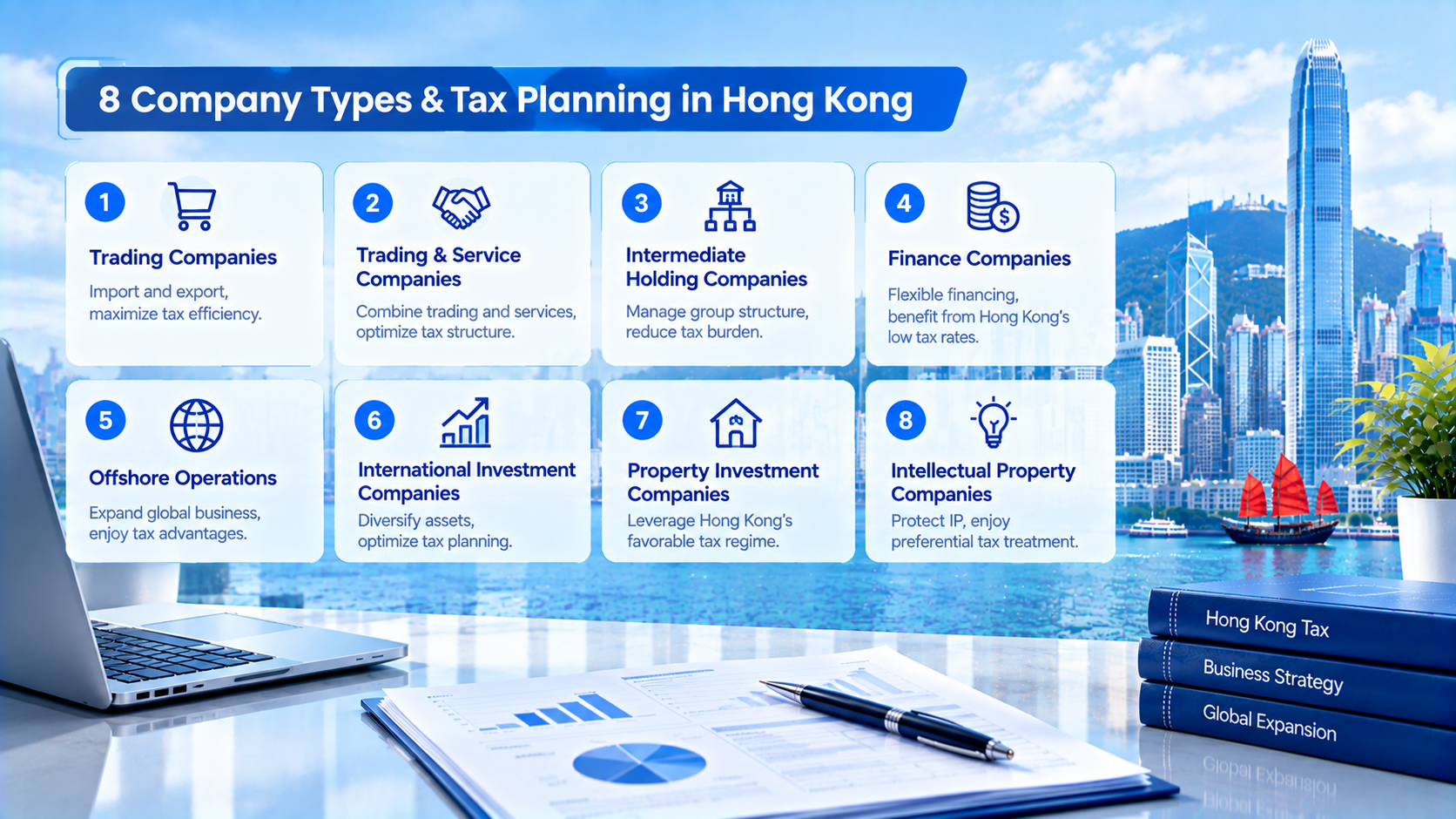
International Investment Companies
International investment companies may hold shares, bonds, and other securities. They may also invest in property or earn income from asset sales and leasing.
Hong Kong's established financial system and international connections can make it an attractive location for investment activities. In addition, a Hong Kong company may serve as a holding or investment vehicle for a wider corporate group.
However, the tax treatment depends on the type of income, the nature of the investment activities, and the applicable rules. Companies should also consider the tax consequences in the jurisdictions where their investments and subsidiaries operate. By reviewing these factors in advance, businesses can better understand their potential tax obligations.
Property Investment Companies
Property investment companies need to maintain clear records for each property. These records help the company track rental income, property expenses, management costs, and other related transactions.
To keep their accounts organized, businesses should sort supporting documents by property. Important records may include:
- Property purchase and sale agreements
- Rental agreements and rental income records
- Repair, maintenance, and management expenses
- Loan and interest records
- Administrative expenses and supporting invoices
Accurate records help businesses calculate their profits and support their tax filings. Furthermore, companies should distinguish between rental activities and property trading. The tax treatment may differ depending on the nature of the activities and the relevant facts.
Intellectual Property Companies
Intellectual property companies may own patents, trademarks, copyrights, or other intangible assets. They may also earn royalties by allowing other businesses to use these rights.
Under Hong Kong's territorial source principle, the tax treatment of royalty income depends on the applicable rules and the circumstances of each transaction. Therefore, the location of the intellectual property owner alone does not determine whether the income is taxable.
Companies should maintain licensing agreements, royalty calculations, payment records, and documents showing how the intellectual property is developed, used, or licensed. In addition, they should review the rules for intellectual property income and related-party transactions. Proper documentation can help support their tax position if the authorities request further information.
Conclusion: Hong Kong Tax Planning
Hong Kong Tax Planning depends on a company's business model, income sources, and actual operations. Trading and service companies should focus on genuine transactions and appropriate pricing. Meanwhile, holding and investment companies need accurate investment records. Finance, offshore operations, property, and intellectual property businesses must also review their specific tax rules.
For international entrepreneurs, effective planning starts with choosing a suitable company structure and maintaining reliable records. IngStart provides Hong Kong company registration and ongoing compliance services to help business owners organize corporate documents and manage recurring administrative tasks.
Most importantly, no single company structure guarantees a tax exemption. Therefore, businesses should review their circumstances carefully and seek professional tax advice when dealing with complex cross-border transactions.
Article Recommendations
- Hong Kong Company Registration: Do Individuals Need ODI Filing?
- Hong Kong Company Tax Guide 2026: Rates, Filing Process & Requirements
- Hong Kong Trademark Registration Guide: Process, Documents, and Validity
If you still have questions, please contact our team on WhatsApp at +1 213 751 2111. We'll help you find the right solution for your business and keep your company compliant as it grows.