
Hong Kong uses a territorial source principle for profits tax. In general, the Inland Revenue Department (IRD) taxes profits that arise in or come from Hong Kong. Profits sourced outside Hong Kong may fall outside the charge to Hong Kong Profits Tax. Therefore, Offshore Profits Exemption can be important for companies that earn profits from overseas business activities.
However, a company does not receive an exemption simply because it has overseas customers. The IRD looks at the actual facts of the business. It considers what the company did to earn the profits and where those activities took place.
Offshore Profits Exemption Requirements
A Hong Kong company may make an offshore profits claim when its relevant profits come from activities outside Hong Kong. The company should keep clear evidence to support its claim.
For a trading company, the IRD may examine the full transaction process. This can include the company's purchasing activities, sales activities, contract negotiations, order handling, shipping, and payment arrangements.
The following factors can help explain the business model:
- Main business activities take place outside Hong Kong.
- Customers and suppliers are mainly located outside Hong Kong.
- Key contract negotiations and signing activities take place outside Hong Kong.
- Goods do not pass through Hong Kong as part of the relevant transactions.
- The company does not rely on a Hong Kong office or local staff to carry out the key profit-making activities.
- Business records clearly show how the company earns its overseas profits.
These factors do not form a simple checklist for automatic approval. Instead, the IRD assesses the facts of each case. The location of the profit-producing activities remains an important consideration.
In addition, companies should consider whether the Foreign-Sourced Income Exemption (FSIE) regime applies. The FSIE rules cover certain foreign-sourced income received in Hong Kong by members of multinational enterprise groups. The rules can apply to foreign-sourced interest, dividends, IP income, and certain equity disposal gains.
Offshore Profits Exemption Application Documents
Before making an Offshore Profits Exemption claim, the company should organize its corporate and business records. The documents should help the IRD understand how the company operates. For a trading company, the supporting materials may include the following.
Offshore Profits Exemption: Company Information
Provide basic information about the Hong Kong company and any related overseas companies. This information may include:
- Group or company structure chart
- Actual business and office locations
- Number of employees
- Employee names and positions
- Employee responsibilities and salaries
- Details of overseas related companies
This information helps explain where the company actually carries out its business activities.
Offshore Profits Exemption: Corporate Documents
The company should also keep its main corporate documents, such as:
- Certificate of Incorporation
- Articles of Association
- Shareholders' agreement, where applicable
- Business registration information
- Other relevant company records
The exact documents depend on the company's structure and circumstances.
Offshore Profits Exemption: Business Records
Business records usually provide the most important evidence for an offshore claim. For example, a trading company may prepare:
- Sales contracts
- Purchase contracts
- Sales and purchase invoices
- Bills of lading
- Shipping documents
- Customs documents, where applicable
- Product quotations
- Product or service information
- Customer and supplier details
- Payment records
- Bank transaction records
Companies should select representative transactions that clearly show how the business operates. They should also keep documents for both sales and purchases. If the company earns profits through related-party transactions, it should prepare relevant supporting documents. A transaction flow chart can also help explain the business process. The company should explain how it finds customers and suppliers. It should also describe how it negotiates contracts and where the parties sign them.
Most importantly, keep documents that support the company's actual business activities. The IRD may request evidence during its review. Claims for offshore profits must include reasons that the taxpayer can support with evidence if requested.
Offshore Profits Exemption Application Process
The Offshore Profits Exemption process usually requires the company to make a claim through its Profits Tax Return and provide supporting information.
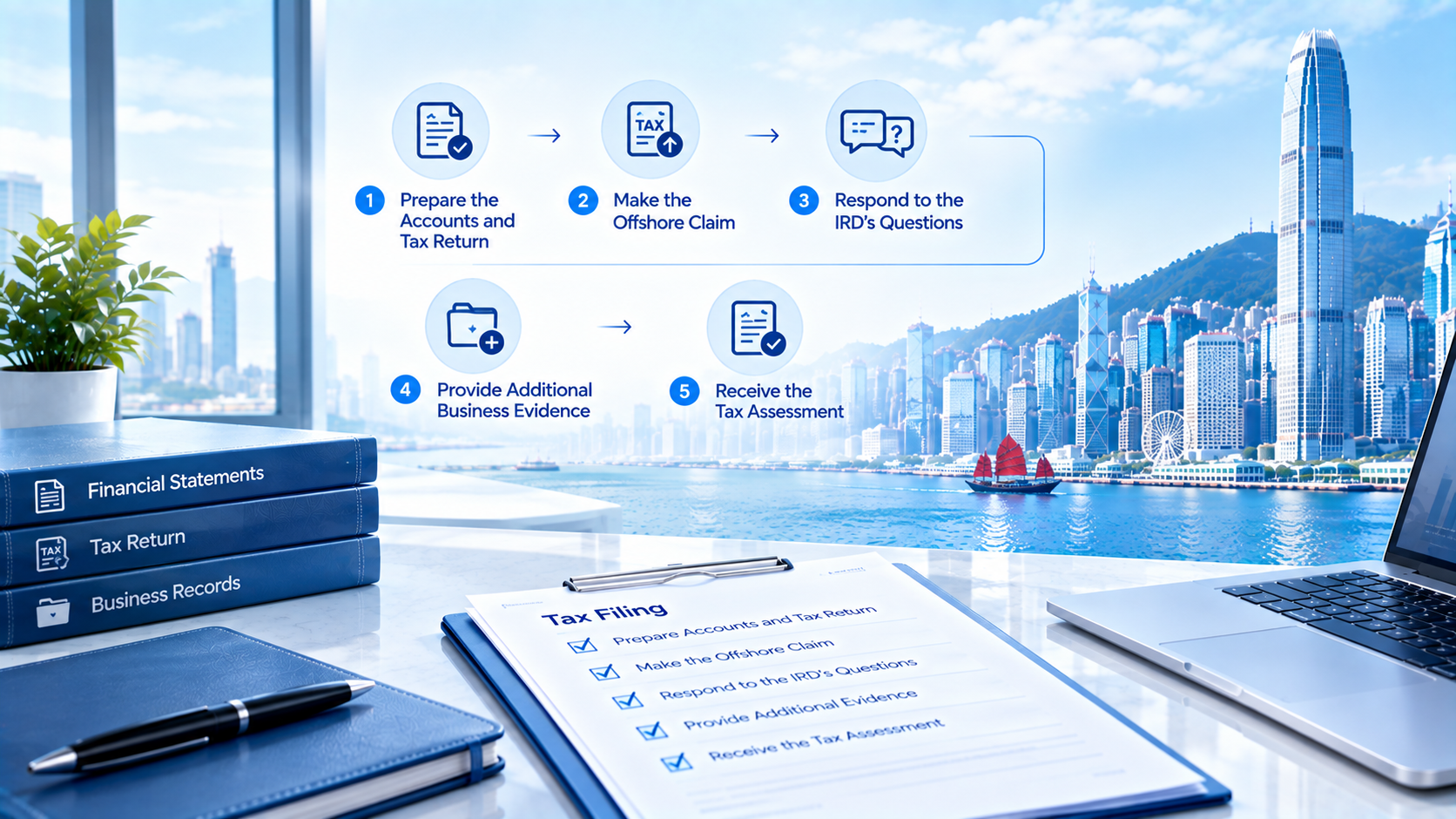
1. Prepare the Accounts and Tax Return
First, prepare the company's accounts and relevant tax documents. Hong Kong companies generally need to submit the required financial statements and supporting documents with their Profits Tax Return.
For corporations, audited financial statements generally accompany the return. However, the IRD provides certain exceptions, including for dormant companies and some companies incorporated in jurisdictions that do not require financial statement audits.
Therefore, an audit is not an automatic requirement in every possible case. The company should check the rules that apply to its own structure.
2. Make the Offshore Claim
Next, report the relevant offshore profits in the Profits Tax Return. The IRD's current BIR51 notes include a specific field for offshore profits excluded from assessable profits. The company must also provide a statement explaining why it considers the profits offshore.
The company should submit clear supporting evidence with the claim when required.
3. Respond to the IRD's Questions
After receiving the claim, the IRD may ask the company for more information. The questions can focus on the company's business activities and transaction process.
For example, the IRD may ask where the company negotiates contracts. It may also ask where employees perform key functions and how goods move between suppliers and customers. The company should answer each question clearly. Supporting documents should match the explanation.
4. Provide Additional Business Evidence
The IRD may request further records during the review. The company should therefore keep contracts, invoices, shipping records, payment records, and other relevant documents available. The review may involve more than one round of questions. For this reason, companies should respond carefully and within the requested timeframe.
International business owners may also consider professional assistance at this stage. IngStart provides Hong Kong company registration and compliance services for international businesses. Its services can also help business owners organize corporate documents and manage ongoing tax and compliance tasks.
5. Receive the Tax Assessment
After reviewing the information, the IRD will determine the applicable tax treatment based on the facts and relevant tax rules. If the IRD accepts the offshore claim, the relevant profits may fall outside Hong Kong Profits Tax. If the profits do not qualify, the company may need to pay Profits Tax under the normal rules. An offshore claim therefore does not guarantee an exemption. The company needs to demonstrate that the relevant profits meet the applicable requirements.
Offshore Profits Exemption: Important Points
An Offshore Profits Exemption claim requires more than an overseas customer or foreign bank account. The company should focus on the activities that actually generated the profits.
For international entrepreneurs, several points are especially important:
- Business substance matters: Keep evidence showing where key business activities take place.
- Transaction records matter: Contracts, invoices, shipping records, and payment documents can help explain the transaction.
- Actual operations matter: The IRD looks at the facts rather than relying only on the company's registered address.
- Tax rules can differ: Foreign-sourced passive income may fall under the FSIE regime in certain circumstances.
- Records should remain available: Keep relevant business records so the company can respond to future IRD questions.
Conclusion
Offshore Profits Exemption can be relevant to Hong Kong companies that earn profits from overseas activities. Hong Kong continues to apply the territorial source principle, but companies must support their claims with evidence.
For trading businesses, the IRD may examine the complete transaction process. This includes sales, purchases, negotiations, shipping, payments, and other profit-producing activities. Therefore, companies should keep clear business records from the beginning. They should also review the latest IRD requirements before making an offshore claim.
For international entrepreneurs, proper accounting and compliance preparation can make the process easier. When the company can clearly explain how and where it earns its profits, it can respond more effectively to the IRD's review.

Article Recommendations
- Hong Kong Tax Zero Return: Requirements, Differences and Risks
- BVI ROBO: Beneficial Ownership Guide for International Business Owners
- Hong Kong BTP: Online Tax Filing Guide for Businesses
If you still have questions, please contact our team on WhatsApp at +1 213 751 2111. We'll help you find the right solution for your business and keep your company compliant as it grows.