
Hong Kong Company Tax Guide 2026: Rates, Filing Process & Requirements
What Is Hong Kong Company Tax in 2026?
Hong Kong Company Tax is an important topic for overseas entrepreneurs who plan to set up or operate a company in Hong Kong. With its simple tax system, international business environment, and competitive tax rates, Hong Kong remains a popular choice for global businesses.
Moreover, Hong Kong follows a territorial tax system. This means companies are generally taxed only on profits generated from business activities carried out in Hong Kong according to the guidelines provided by the Inland Revenue Department (IRD).
In 2026, Hong Kong companies may need to handle different tax obligations depending on their income sources and business activities. The main taxes include profits tax, salaries tax, and property tax.
Moreover, Hong Kong follows a territorial tax system. This means companies are generally taxed only on profits generated from business activities carried out in Hong Kong. Profits that are not sourced from Hong Kong may not be subject to Hong Kong tax, depending on the specific situation.
For overseas entrepreneurs, proper tax planning can help reduce compliance risks. Professional support from companies such as Ingstart can assist with company compliance, document preparation, and coordination of tax-related procedures.
What Types of Hong Kong Company Tax Do Businesses Need to Pay?
Different businesses may have different tax responsibilities based on their operations. Therefore, companies should understand the main types of Hong Kong Company Tax before managing their annual compliance work.
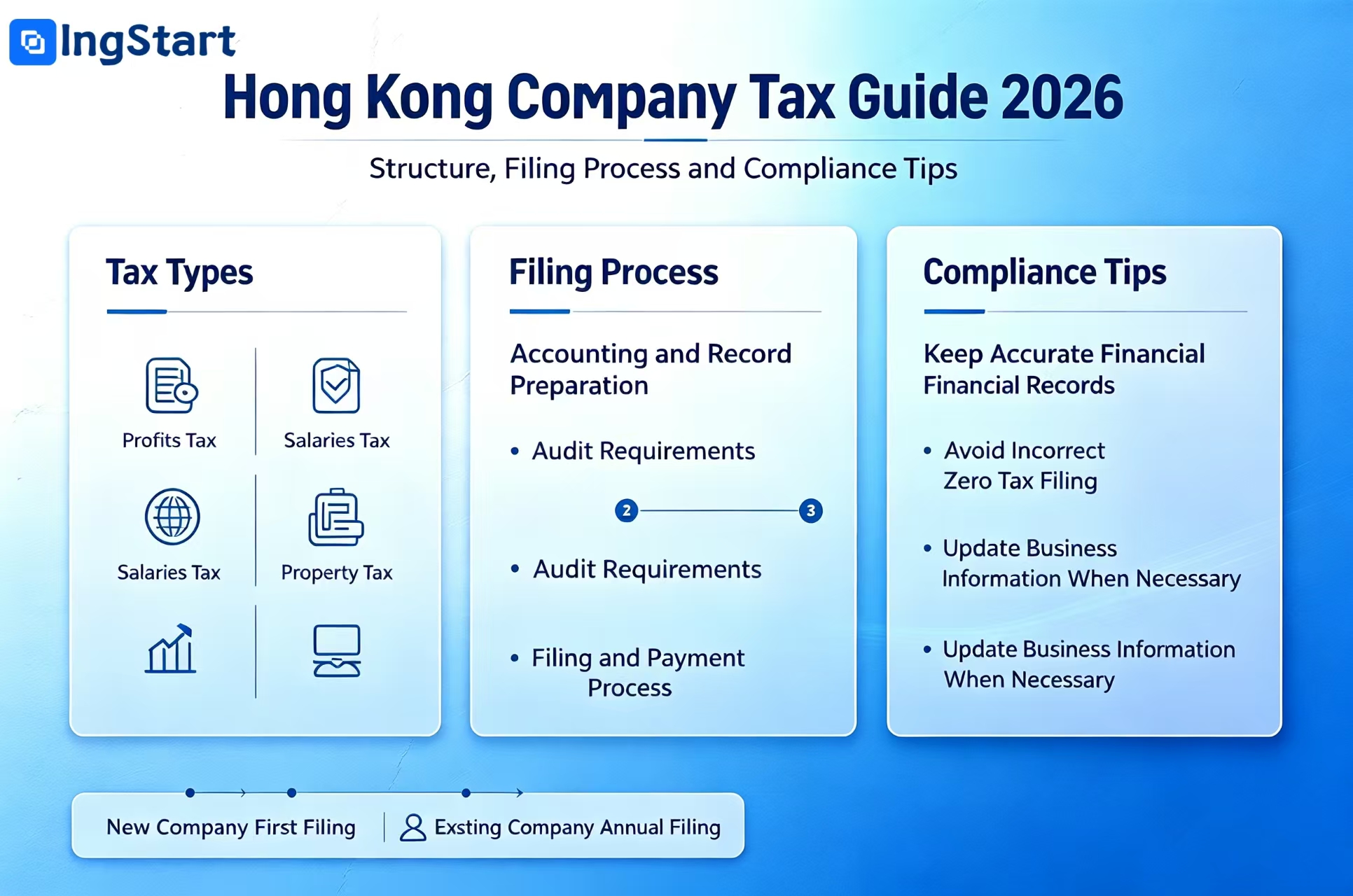
The three main tax categories include:
- Profits Tax;
- Salaries Tax;
- Property Tax.
Each tax applies to different types of income. As a result, companies should review their business activities carefully to determine which tax requirements apply.
Hong Kong Company Tax for Profits Tax
Profits Tax is the main tax that applies to companies carrying out business activities in Hong Kong.
Under Hong Kong tax rules, companies that earn profits from a trade, profession, or business conducted in Hong Kong may need to pay profits tax. However, income that does not arise from Hong Kong sources may generally not be taxable.
The current profits tax rates are:
- The first HKD 2 million of profits: 8.25%;
- Profits above HKD 2 million: 16.5%.
These rates apply to eligible Hong Kong companies under the two-tiered profits tax system.
In addition, companies should maintain complete financial records to support profit calculations and tax reporting. Accurate records can help businesses complete tax filing more efficiently and avoid unnecessary issues.
Salaries Tax Requirements for Hong Kong Companies
Salaries Tax applies to income earned from employment, positions, or pensions that arise in or are derived from Hong Kong. Whether income is subject to Salaries Tax usually depends on where the employment services are performed.
For companies with employees or directors working in Hong Kong, it is important to understand related tax responsibilities. Therefore, businesses should keep proper payroll records and review employee arrangements regularly. Moreover, maintaining accurate employment information can help companies handle tax reporting more smoothly.
Property Tax Rules for Hong Kong Businesses
Property Tax applies to rental income received by owners of properties located in Hong Kong. If a company owns Hong Kong property and receives rental income, the company may need to consider Property Tax obligations.
However, if the company rents out property as part of its business activities, the income may be treated as business income and could be subject to Profits Tax instead. Therefore, companies should review their property usage and income sources carefully to determine the correct tax treatment.
How Does Hong Kong Company Tax Filing Work?
The Hong Kong Company Tax filing process usually includes several important steps, such as accounting preparation, audit review, tax return submission, and tax payment. For overseas business owners, the filing process may seem complicated at first. However, by preparing documents early and following the correct steps, companies can complete their tax obligations more efficiently.
The main filing process usually includes:
- Preparing company accounting records;
- Reviewing financial statements;
- Completing audit procedures;
- Submitting tax returns;
- Paying assessed taxes.
Moreover, companies should not wait until the filing deadline to organize documents. Regular record management can help reduce mistakes and make the filing process smoother.
Hong Kong Company Tax Accounting and Record Preparation
Accounting preparation is the first step in completing Hong Kong Company Tax filing. Companies need to organize business records and prepare financial information based on their actual operations.
The accounting process usually includes:
- Reviewing income and expense records;
- Organizing business transaction documents;
- Preparing financial statements;
- Checking accounting information for accuracy.
These records provide the foundation for tax calculations and help companies report their financial position correctly. In addition, proper accounting records are important for long-term business management. They allow directors to understand company performance and make better decisions.
For overseas entrepreneurs, managing accounting documents in another jurisdiction can be challenging. Therefore, many international business owners choose professional corporate service providers to assist with accounting coordination and compliance preparation.
Hong Kong Company Tax Audit Requirements
Audit is an important part of the tax filing process for many Hong Kong companies. Under Hong Kong regulations, companies generally need to appoint a qualified local auditor to review their financial statements before submitting tax information.
The audit process usually involves:
- Reviewing company financial records;
- Checking accounting information;
- Preparing an audit report;
- Confirming financial statements.
The audit report helps demonstrate that the company’s financial information has been properly reviewed. However, companies should choose experienced professionals because incorrect financial records may lead to additional questions or compliance issues.
For overseas business owners who are unfamiliar with local requirements, Ingstart can provide support with company compliance management and help coordinate necessary professional services.

Hong Kong Company Tax Filing and Payment Process
After completing accounting and audit procedures, companies need to submit the required tax documents to the Hong Kong Inland Revenue Department (IRD) according to official filing requirements.
The process usually includes:
- Preparing the tax return;
- Submitting financial statements and audit reports;
- Reviewing tax assessment results;
- Completing tax payments.
After receiving the submitted documents, the tax authority will review the information and issue a tax assessment. If the company does not have taxable profits, it may receive a notice confirming that no tax payment is required. However, companies should not submit incorrect information or make long-term zero tax filings without proper reasons. Therefore, maintaining accurate financial records and following filing requirements are important parts of Hong Kong Company Tax compliance.
When Does Hong Kong Company Tax Need to Be Filed?
The filing timeline for Hong Kong Company Tax depends on whether the company is submitting tax information for the first time or completing annual filing after previous submissions. Companies should pay attention to their filing deadlines because late submission may create additional compliance issues.
Generally, the filing schedule can be divided into two situations:
- Newly established companies completing their first tax filing;
- Existing companies completing annual tax filing.
Understanding the correct timeline allows companies to prepare documents in advance and avoid unnecessary delays.
First Tax Filing Timeline for New Companies
For newly registered Hong Kong companies, the first tax filing usually follows a different timeline from later annual filings. Generally, a new company may receive its first profits tax return around 18 months after incorporation. After receiving the tax return, the company normally needs to complete the required submission within the specified period.
Therefore, newly established companies should monitor official notices carefully and prepare accounting documents before the deadline. For overseas entrepreneurs, the first tax filing can be unfamiliar. As a result, professional assistance can help new companies understand the process and complete their obligations correctly.
Annual Filing Schedule for Existing Companies
After completing the first tax filing, companies usually need to submit tax information according to the annual filing schedule.
Existing companies should:
- Review financial records regularly;
- Prepare accounting documents on time;
- Complete audit procedures when required;
- Submit tax returns before the deadline.
Moreover, companies should maintain consistent record management throughout the year instead of preparing documents only before filing.
This approach can make Hong Kong Company Tax management easier and help businesses maintain continuous compliance.
Hong Kong Company Tax Compliance Tips for Overseas Businesses
Managing Hong Kong Company Tax requires continuous attention rather than only preparing documents before the filing deadline. Therefore, overseas business owners should build a simple compliance system to keep company records accurate and tax information updated. A good tax management process can help businesses reduce mistakes, save preparation time, and maintain a healthy company status in Hong Kong.
Companies should pay attention to the following points:
- Keep financial records updated regularly;
- Prepare tax documents in advance;
- Review company information when changes occur;
- Work with qualified professionals when necessary;
- Follow Hong Kong tax filing requirements carefully.
Moreover, overseas entrepreneurs may face additional challenges because they manage their companies from another country. Therefore, having professional support can make daily compliance work easier.
Keep Accurate Financial Records
Keeping accurate financial records is one of the most important parts of Hong Kong Company Tax compliance.
Companies should maintain complete records of:
- Business income;
- Operating expenses;
- Bank transactions;
- Customer and supplier payments;
- Other business-related documents.
These records help companies prepare financial statements and support tax calculations. In addition, well-organized accounting records allow business owners to understand their company’s financial performance more clearly. This information is also useful when making future business decisions.
However, some overseas entrepreneurs may not be familiar with Hong Kong accounting practices. Therefore, working with experienced service providers can help ensure that records are properly prepared and maintained.
Avoid Incorrect Zero Tax Filing
Some companies may have no taxable profits in a particular year. In this situation, they may not need to pay tax. However, companies should not submit zero tax filings without a proper business basis. Incorrect or repeated zero tax filings may attract attention from tax authorities and could lead to further review.
Therefore, companies should always prepare tax information based on their actual business activities and financial records. Moreover, if a company’s business situation changes, it should update its tax information accordingly. Accurate reporting helps maintain long-term compliance and reduces potential risks.
Update Business Information When Necessary
Keeping company information updated is another important part of Hong Kong Company Tax management.
During business operations, company details may change, including:
- Directors;
- Shareholders;
- Business address;
- Business activities;
- Company structure.
When these changes happen, companies should review whether related information needs to be updated with the relevant authorities. In addition, updated company information helps ensure that tax documents and official communications are delivered correctly.
For overseas entrepreneurs, managing these updates remotely can sometimes be difficult. Therefore, many international business owners choose professional corporate service providers, such as Ingstart, to assist with company compliance, document management, and ongoing support.
Conclusion: Manage Hong Kong Company Tax Successfully in 2026
Hong Kong Company Tax is an important responsibility for companies operating in Hong Kong. Understanding tax types, filing procedures, deadlines, and compliance requirements can help businesses avoid unnecessary risks and maintain smooth operations.
In 2026, overseas entrepreneurs should pay attention to several key areas, including profits tax, salaries tax, property tax, accounting preparation, audit requirements, and annual tax filing.
Although managing tax obligations may seem challenging at first, proper planning can make the process much easier. Companies should keep accurate records, prepare documents early, and seek professional support when needed.
By following Hong Kong tax requirements and maintaining good compliance practices, businesses can manage Hong Kong Company Tax more effectively and build a stronger foundation for long-term growth.
Article Recommendations
- Hong Kong Company Registration Guide 2026: Steps and Requirements for Global Entrepreneurs
- Open OCBC Account Remotely: A SaaS Developer Guide (2026)
- Brand Overseas Expansion Complete Guide: How Can Enterprises Build a Sustainable Overseas Growth System?
If you still have questions, please contact our team on WhatsApp at +1 213 751 2111. We'll help you find the right solution for your business and keep your company compliant as it grows.