
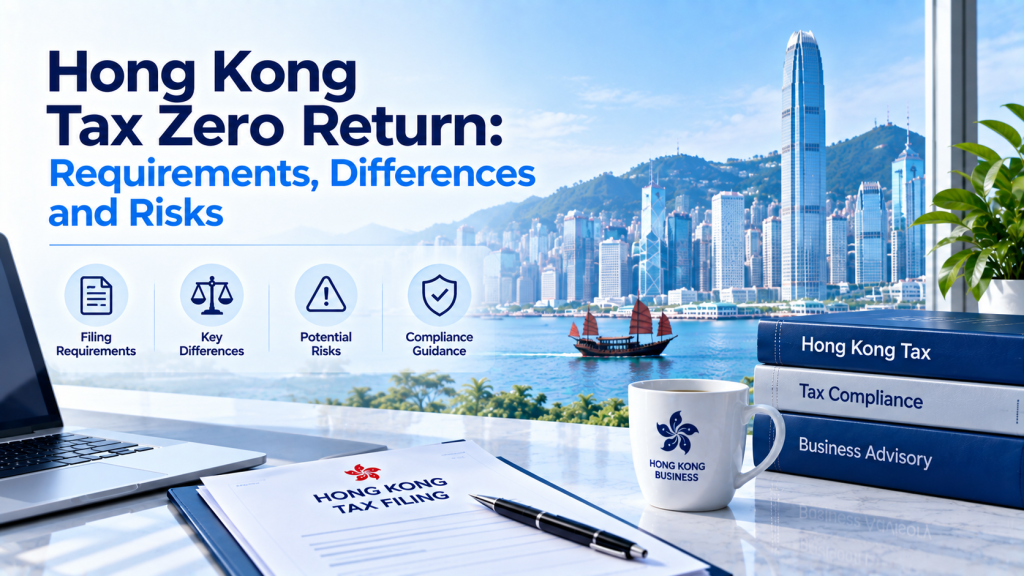
If a Hong Kong company has no assessable profits for a particular period, it may need to deal with its Profits Tax Return accordingly. A Hong Kong Tax Zero Return generally refers to a tax return showing no taxable profit or no relevant amount to report. However, simply having little business activity does not automatically mean that a company can file a zero return.
For international business owners, it is important to understand the difference between a zero tax return, an inactive business, and a formally dormant company. The company must also provide accurate information when responding to a tax return issued by the Inland Revenue Department (IRD). This guide explains the main requirements, differences, and compliance risks in 2026.
What Is a Hong Kong Tax Zero Return?
A Hong Kong Tax Zero Return is commonly used to describe a Profits Tax Return in which the company reports no assessable profits or enters zero amounts where applicable.
However, a zero tax result does not mean that the company can ignore its accounting and tax responsibilities. The IRD requires taxpayers to submit accurate returns and maintain sufficient business records where the relevant business record requirements apply. Business records generally need to be retained for at least seven years.
The company should therefore assess its actual activities before submitting a return. Having no tax payable is not the same as having no business activity.
Requirements for a Hong Kong Tax Zero Return
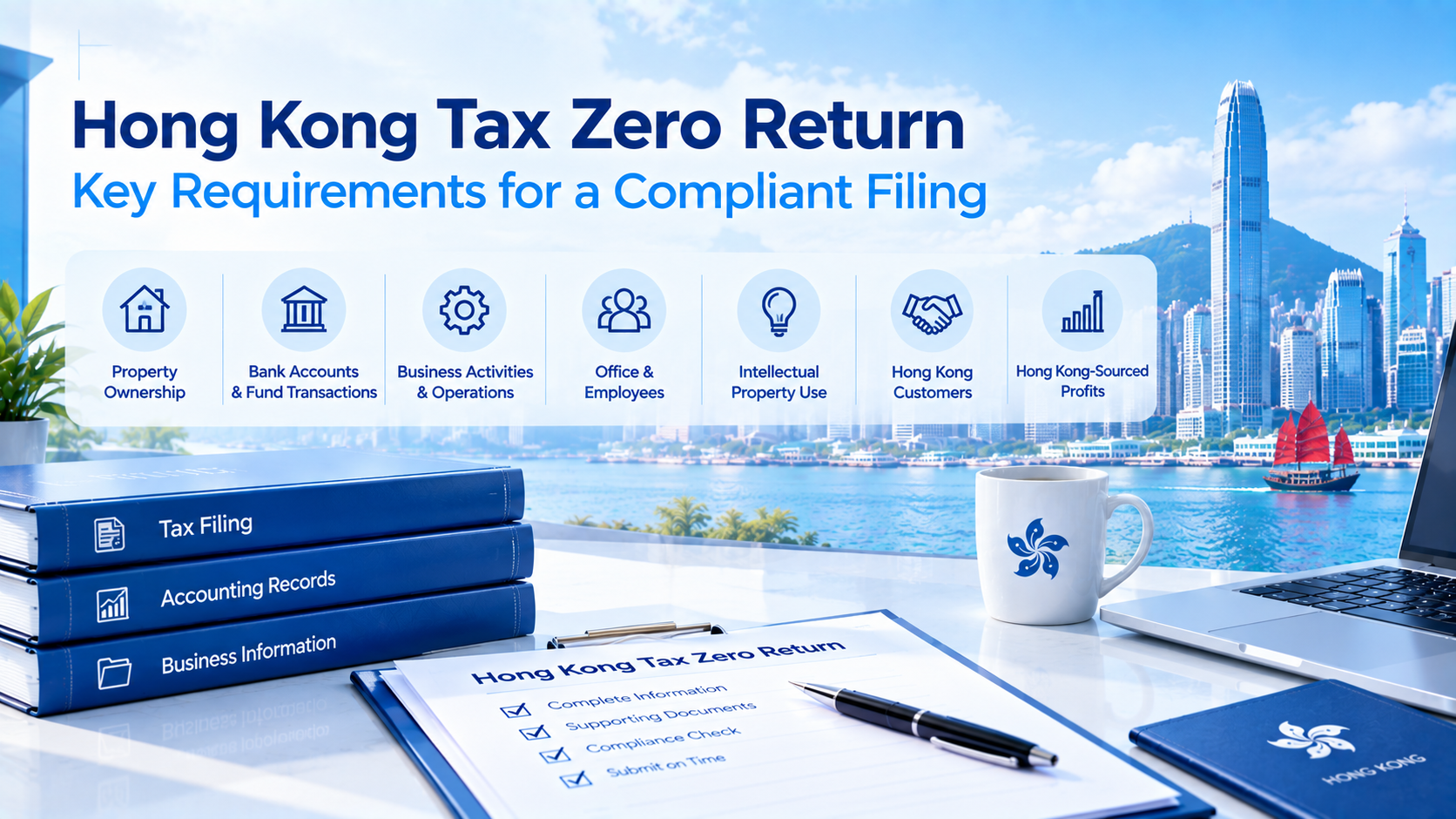
A company should review its actual business activities before treating a tax return as a zero return. The following factors may help identify whether there was genuinely no relevant business activity during the period:
Property Ownership in Hong Kong
Ownership of Hong Kong property may indicate that the company has assets or transactions that require further tax consideration. Therefore, a company should review its property position before submitting a return.

Bank Accounts and Fund Transactions
Bank activity also matters. Transfers, customer payments, supplier payments, investment transactions, or other financial movements may provide evidence of business or investment activities.
A company should not assume that an account with a low balance automatically supports a zero return. Instead, it should review the nature and purpose of each transaction.
Business Activities and Operations
Actual business activity is one of the most important factors.
A company that has issued invoices, purchased goods, provided services, received customer payments, or incurred business expenses should review those activities carefully before filing a return with zero amounts.
Office and Employees
The absence of a Hong Kong office or employees may be relevant when reviewing the company's overall activities. However, this factor alone does not determine whether the company has taxable profits or can file a zero return.
A company can conduct business without maintaining a traditional office or employing staff in Hong Kong.
Intellectual Property Use
The company should also review whether it owns, licenses, or allows the use of intellectual property such as trademarks, patents, copyrights, or other rights.
Related licensing income, expenses, or transactions may need to be reported depending on the circumstances.
Transactions With Hong Kong Customers
Business dealings with customers or suppliers should also be reviewed. Sales contracts, service agreements, purchase invoices, and payment records can help determine whether the company carried out business activities during the relevant period.
Hong Kong-Sourced Profits
The source of profits is another important issue. Hong Kong applies a territorial basis of taxation, and the tax treatment of profits depends on the specific facts and circumstances.
Consequently, international business owners should not decide whether a return should be filed as zero simply by looking at where customers or bank accounts are located.
Hong Kong Zero Return vs. Normal Tax Filing
A zero return and a return reporting taxable business activity are not simply two different filing schedules. The information submitted should reflect the company's actual circumstances.
Accounting and Audit Requirements
For corporations, audited financial statements generally need to accompany Profits Tax Returns when the relevant gross income requirements apply, subject to specific exceptions. One important exception covers companies that qualify as dormant companies under the Companies Ordinance.
Therefore, it is not accurate to assume that every company filing a zero tax return automatically has a shorter audit period or is exempt from accounting work. The company's actual activities and legal status determine which supporting documents are required.
Tax Filing Methods
A company that receives a Profits Tax Return must complete and submit the required information within the applicable deadline.
From 1 April 2026, the first phase of mandatory electronic filing for certain specified persons has taken effect. For those covered by the relevant requirements, the Profits Tax Return for corporations must be submitted electronically.
Even where the company has no amount to report for a particular item, the IRD states that the relevant field should be completed rather than simply left blank. Where applicable, the taxpayer should enter “0”.
Hong Kong Zero Return vs. Dormant Company
A Hong Kong Tax Zero Return and a dormant company are different concepts. A zero return concerns the information reported for tax purposes. Dormant status, on the other hand, is a formal company-law status under the Companies Ordinance.
What Is a Tax Zero Return?
A zero return normally describes the tax position reported in a Profits Tax Return.
The company still needs to provide truthful information based on its actual circumstances. If the company carried out transactions or generated income, simply entering zero without proper consideration may create compliance problems.
What Is a Dormant Company?
Under section 5 of the Companies Ordinance, a qualified private company can become dormant by passing a special resolution and delivering it to the Registrar of Companies for registration. The company becomes dormant from the relevant effective date stated in the resolution or from the date of delivery, depending on the circumstances.
Dormant status therefore requires a formal company-law procedure. It is not created simply because a company has stopped trading for a period of time.
Key Differences Between the Two
The main differences can be summarized as follows:
| Item | Tax Zero Return | Dormant Company |
|---|---|---|
| Main purpose | Reports the company's tax position | Changes the company's formal company-law status |
| Authority involved | Inland Revenue Department | Companies Registry |
| Application | Relates to a particular tax return | Requires the relevant dormant-company procedure |
| Business activity | Depends on the actual facts | The company must meet the legal requirements for dormant status |
| Compliance | Tax filing obligations continue as applicable | Certain company-law requirements may change after dormant status takes effect |
A dormant company can also have specific tax filing treatment. The IRD states that audited financial statements generally do not need to accompany the Profits Tax Return of a company that qualifies as dormant under the Companies Ordinance.
Risks of an Improper Hong Kong Zero Return
Submitting a zero return when the company's actual activities do not support that treatment can create tax and compliance risks.
Tax Investigation and Compliance Risks
The IRD requires taxpayers to provide accurate returns. It can take enforcement action where taxpayers fail to comply with filing, notification, or record-keeping requirements. The department's penalty policy also covers incorrect returns and other failures under the Inland Revenue Ordinance.
For this reason, business owners should keep supporting records that explain the company's financial position. Bank statements, invoices, receipts, contracts, and accounting records can be important if the IRD later asks questions.
Bank Account Closure
A company that maintains a business bank account should also ensure that its tax reporting matches its actual transactions.
Regular account activity may make an unsupported zero return difficult to explain. If a bank identifies inconsistencies during its own compliance review, it may request additional information or documents.
Therefore, companies should keep their tax records, accounting records, and banking information consistent.
Fines and Penalties
Incorrect or incomplete tax reporting can result in penalties under the Inland Revenue Ordinance.
The exact consequence depends on the nature of the non-compliance and the circumstances of the case. The IRD may use different enforcement measures, including prosecution or additional tax in appropriate cases.
Business owners should therefore avoid relying on a fixed penalty figure without checking the specific offence and current rules.
Impact on Future Business Activities
Tax compliance can also affect how easily a company manages future business activities. A company may need to explain historical transactions when dealing with banks, professional advisers, investors, or other counterparties. Well-organized records can make these reviews easier. Keeping accurate records also helps the company respond to future questions from the IRD.
How to Stay Compliant With Hong Kong Tax Filing
International business owners can reduce compliance problems by reviewing their company before filing a Profits Tax Return.
- Business review: Check whether the company actually carried out sales, services, purchases, investments, or other transactions during the relevant period.
- Banking records: Review statements and transfers so that financial activity matches the information reported in the tax return.
- Accounting documents: Keep invoices, receipts, contracts, payment records, and other relevant supporting documents.
- Tax position: Check whether the company has received tax returns, assessments, or other notices from the IRD and deal with them on time.
- Company status: Determine whether the company is simply inactive or has formally obtained dormant status under the Companies Ordinance.
- Professional support: Consider professional accounting or tax advice when the company's activities, ownership, or transactions are complex.
The IRD requires sufficient business records to be retained for at least seven years in applicable cases. Failure to keep the required records without reasonable excuse can result in a fine of up to HK$100,000.
For international businesses managing several jurisdictions, keeping company documents and recurring compliance tasks organized is also important. IngStart provides company registration and compliance services for international businesses, including corporate document management and ongoing compliance support.
Key Points About Hong Kong Zero Returns
A Hong Kong Tax Zero Return should reflect the company's actual tax position rather than simply being used because the company appears inactive.
The key points include:
- Actual activities matter: Review transactions, income, expenses, assets, and other business activities before filing.
- Zero tax does not mean zero compliance: A company may still have filing and record-keeping responsibilities even when no Profits Tax is payable.
- Dormant status is different: Formal dormant status requires the relevant procedure under the Companies Ordinance.
- Records remain important: Keep sufficient supporting documents for the required retention period.
- Electronic filing has expanded: From 1 April 2026, mandatory electronic filing applies to specified persons covered by the relevant rules.
- Accuracy is essential: Incorrect returns can result in penalties or other enforcement action.
Conclusion
A Hong Kong Tax Zero Return can be appropriate in circumstances where the company's actual tax position supports reporting zero amounts. However, business owners should not treat zero reporting as a substitute for proper tax compliance.
Before filing, review the company's transactions, bank activity, accounting records, assets, and tax position. At the same time, distinguish between a tax zero return and formal dormant-company status because they serve different purposes.
For international business owners, accurate records and timely filing remain important throughout the company's life cycle. By checking the latest IRD requirements and obtaining professional advice when necessary, companies can manage their Hong Kong tax obligations in a more structured and compliant way in 2026.
Article Recommendations
- Hong Kong CRS: Dual Tax Residency and Bank Account Guide
- How to Open a US Company Bank Account in Hong Kong in 2026
- Hong Kong BTP: Online Tax Filing Guide for Businesses
If you still have questions, please contact our team on WhatsApp at +1 213 751 2111. We'll help you find the right solution for your business and keep your company compliant as it grows.