
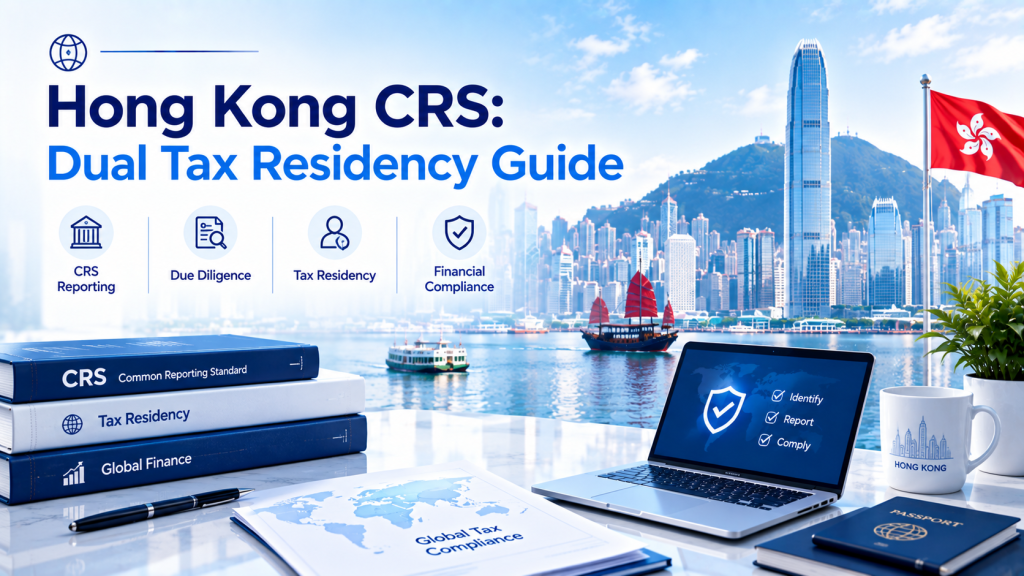
Hong Kong CRS has become an important issue for international individuals opening or maintaining Hong Kong bank accounts in 2026. In some recent cases, customers who live outside Hong Kong have been asked by banks to provide more than one tax residency when completing a CRS self-certification form.
This can be confusing, especially for people who hold a Hong Kong visa or have recently changed their place of residence. However, a Hong Kong visa, residency status, or bank account does not automatically determine your tax residency. Under the CRS framework, banks need to identify the tax jurisdictions where an account holder is actually tax resident and may ask for supporting information when the details are unclear.
For international account holders, understanding Hong Kong CRS is therefore important. The key question is not simply where you live or which passport you hold. Instead, you need to understand how tax residency rules apply to your personal circumstances.
Hong Kong CRS and Dual Tax Residency
For some international customers, the CRS self-certification form becomes the most difficult part of the account-opening process.
The form itself is usually straightforward. The more complicated question is the tax residency section. A customer may have moved to another country, obtained a Hong Kong visa, or changed their place of work, while still maintaining strong personal or financial connections with another jurisdiction. As a result, a bank may ask the customer to review or provide more than one tax residency.
This does not necessarily mean that the bank has decided that the customer has two tax residences. Under the CRS rules, the account holder has a responsibility to provide a correct self-certification, while the financial institution uses the information collected during its due diligence process to assess whether the declaration appears reasonable.

Hong Kong CRS: Why Banks Ask for More Information
Financial institutions need to identify reportable accounts under the Automatic Exchange of Financial Account Information (AEOI) framework.
Therefore, when a bank sees information that does not clearly match the customer's declared tax residency, it may ask additional questions or request an updated self-certification.
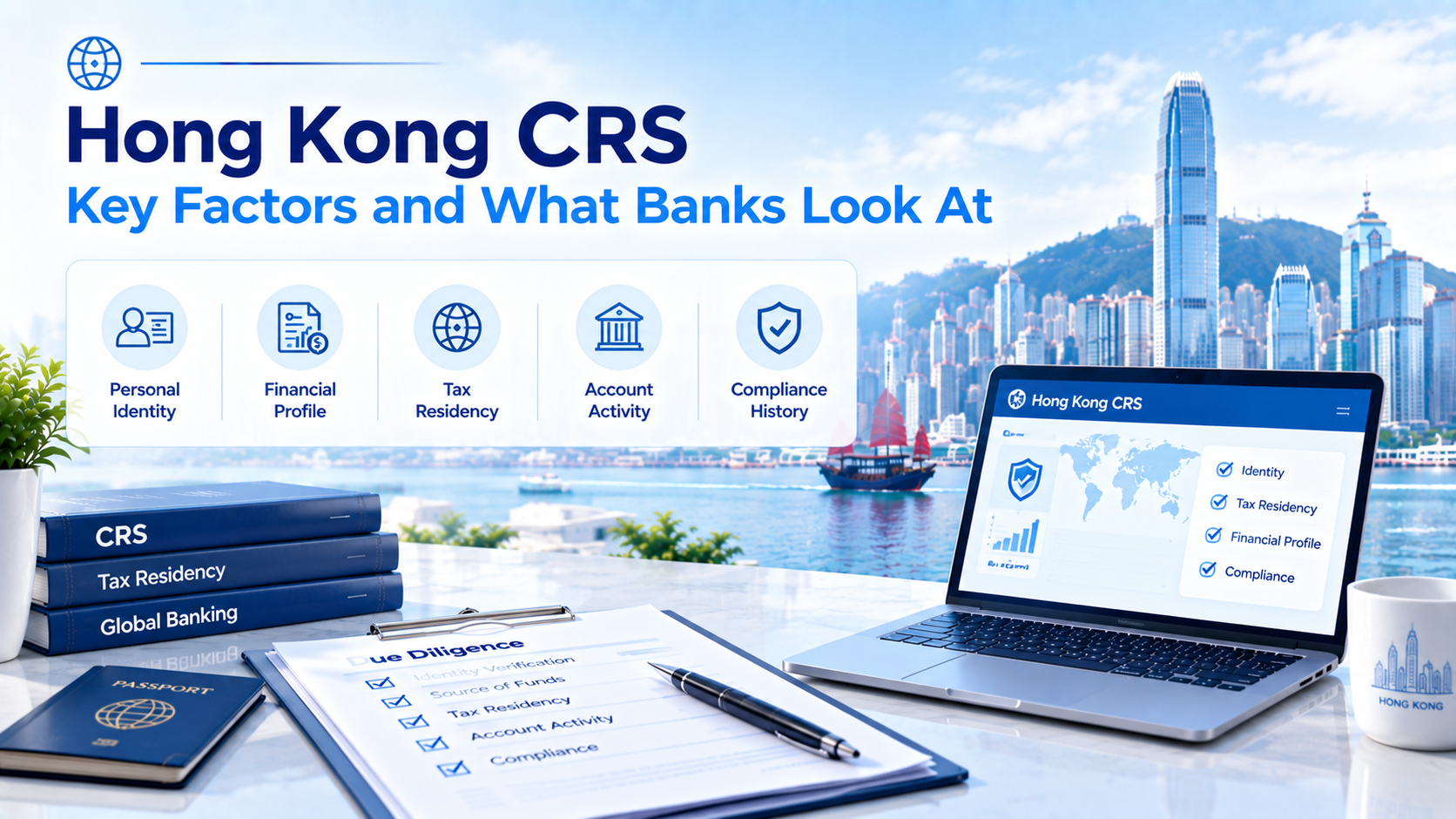
For example, a bank may review information such as:
- Passport and identity documents
- Current residential address
- Contact information
- Tax identification number
- Information provided during KYC checks
- Business or employment information
- Other documents collected during account opening
The exact review process can vary between banks. However, the basic purpose remains the same: the bank needs enough information to identify the customer's tax residency for CRS purposes.
Hong Kong CRS: What Does the Bank Actually Look At?
Many people assume that tax residency depends only on nationality or immigration status. In practice, the situation can be more complicated. For Hong Kong CRS, tax residency is determined under the rules of the relevant jurisdiction. For Hong Kong AEOI purposes, an individual may qualify as a Hong Kong tax resident if they ordinarily reside in Hong Kong or meet the relevant day-count conditions. Other jurisdictions have their own rules.
This means that holding a Hong Kong visa does not automatically make someone a Hong Kong tax resident. Likewise, moving abroad does not automatically end tax residency in another jurisdiction. The bank therefore looks at the information available to it rather than relying only on one document.
Hong Kong CRS and Identity Are Not the Same
One of the most common misunderstandings involves the difference between identity, immigration status, and tax residency.
For example, a person may:
- Hold a Hong Kong visa
- Live mainly in another country
- Receive income from an overseas business
- Maintain financial accounts in another jurisdiction
- Keep strong personal or economic connections with another country
These facts can create a more complicated tax residency situation. Therefore, international account holders should not assume that obtaining a new visa or residence permit automatically changes their CRS tax residency.
Why Hong Kong CRS May Result in Two Tax Residencies
A person can have more than one tax residency for AEOI purposes when the rules of different jurisdictions consider that person to be tax resident there.
Hong Kong's Inland Revenue Department specifically states that an individual or entity may have more than one residency for AEOI purposes. In that situation, the person should report all relevant jurisdictions of residence and the corresponding TINs, where applicable, on the self-certification.
This is an important point because a dual tax residency declaration is not automatically a problem. For example, an international entrepreneur may spend significant time in Hong Kong while continuing to meet tax residency requirements in another country. Depending on the relevant domestic rules and any applicable tax treaty, the person may need to disclose both jurisdictions.
Therefore, the right approach is not to avoid a second tax residency simply because it makes the bank application more complicated. Instead, the account holder should first determine the correct tax residency position.
Hong Kong CRS and Your Overall Financial Profile
In practice, the CRS form does not exist in isolation. When opening a bank account, financial institutions normally collect information through their KYC and due diligence procedures. The Hong Kong IRD states that financial institutions can rely on a self-certification when it passes a reasonableness test based on information obtained during account opening, including information collected through KYC procedures.
This explains why customers with similar backgrounds may receive different questions from banks. For example, one customer may have already moved their home, employment, and financial activities to a new jurisdiction. Another customer may hold a new residence permit but still maintain most of their financial and personal connections in their previous jurisdiction.
The two cases may therefore require different explanations. This does not mean that a bank can simply create a tax residency for a customer. Instead, the bank needs to assess whether the customer's self-certification makes sense based on the information available to the bank.
Hong Kong CRS: What International Account Holders Should Check
If a bank asks you to add another tax residency, do not immediately assume that the bank has made an error. First, check whether you actually remain a tax resident of that jurisdiction under its domestic rules.
You should review:
- Your actual place of residence
- The number of days you spend in each jurisdiction
- Your employment and business activities
- Your main sources of income
- The tax identification numbers
- Your existing tax residency certificates, if applicable
- Your current address and contact information
- Any relevant tax treaty or residency tie-breaker rules
These factors can help you understand whether you genuinely have one or more tax residencies.
At the same time, do not simply select an additional jurisdiction because a bank employee tells you to do so without understanding why. A CRS self-certification is a formal declaration, and knowingly or recklessly providing materially false or misleading information can lead to penalties.
CRS and Existing Bank Accounts
The issue does not only apply to new accounts. For new accounts opened from January 1, 2017, reporting financial institutions generally require a self-certification. For older accounts, a financial institution may also request a self-certification if it has doubts about the customer's tax residency.
In addition, if your circumstances change and the information on your existing self-certification becomes incorrect, you should inform the financial institution and provide an updated self-certification. The IRD generally expects an updated self-certification within 30 days after a change in circumstances that affects tax residency or makes the previous information incorrect. Therefore, changing your residence, tax residency, or other important personal circumstances should not be treated as a one-time banking issue.
Hong Kong CRS: What Is Changing in 2026?
Hong Kong is also strengthening its AEOI and CRS framework. In June 2026, Hong Kong gazetted the Inland Revenue (Amendment) (Automatic Exchange of Information) Ordinance 2026, which is scheduled to take effect on January 1, 2027. The changes include a mandatory registration requirement for reporting financial institutions.
Hong Kong also introduced proposed amendments relating to the amended CRS in 2026. Subject to the legislative process, these changes are expected to apply from January 1, 2028 and would further refine due diligence and reporting requirements, including requirements relating to tax residency self-certification.
For international account holders, the broader message is clear: CRS compliance is becoming more structured, not less. Therefore, customers should expect banks to pay close attention to tax residency information and changes in circumstances.
How IngStart Can Help With Hong Kong Banking Preparation
For international entrepreneurs, opening a Hong Kong company or bank account often involves more than preparing a passport and company documents. Tax residency, business activities, source of funds, and account usage may also affect the application process.
IngStart provides company registration and compliance services for international businesses. Its online platform can help users organize company documents, manage compliance tasks, and prepare for related business services such as bank account opening.
More importantly, international account holders should understand their own information before submitting a CRS self-certification. A well-organized application makes it easier to explain your business structure, residence, and financial activities when a bank asks for additional information.
What International Entrepreneurs Should Know About Hong Kong CRS
Hong Kong CRS is not simply a form that you complete when opening a bank account. It forms part of a broader international system for identifying tax residents and exchanging financial account information.
If a Hong Kong bank asks you to provide two tax residencies, the right response is not to panic or automatically reject the request. First, check whether you actually meet the tax residency rules of both jurisdictions.
At the same time, remember that a Hong Kong visa or residence status does not automatically determine your tax residency. Your physical presence, residence, financial circumstances, and the rules of the relevant jurisdictions all matter.
In 2026, Hong Kong is also preparing further changes to its AEOI and CRS framework. As a result, international entrepreneurs should keep their tax residency information accurate and update their bank when their circumstances change.
Conclusion
Hong Kong CRS has become increasingly important for international individuals and business owners who use Hong Kong banking services.
A request for dual tax residency does not automatically mean that the bank has made a mistake. In some cases, the customer may genuinely have tax residency in more than one jurisdiction. In other cases, the bank may simply need additional information to confirm that the customer's self-certification is reasonable.
Therefore, the safest approach is to understand your actual tax residency before completing the CRS form, keep your information consistent with your KYC documents, and update the bank when your circumstances change.
For international entrepreneurs, the key is simple: do not confuse nationality, immigration status, residence, and tax residency. Understanding the difference can make Hong Kong bank account applications much clearer and help you avoid unnecessary CRS problems.
Article Recommendations
- Hong Kong Company Tax Guide 2026: Rates, Filing Process & Requirements
- Hong Kong Company Registration Guide 2026: Steps and Requirements for Global Entrepreneurs
- Hong Kong Bank Opening Guide: National Day Holiday & Account Opening Tips
If you still have questions, please contact our team on WhatsApp at +1 213 751 2111. We'll help you find the right solution for your business and keep your company compliant as it grows.