

Hong Kong account rules are becoming stricter. These changes affect how mainland Chinese and international clients access banking and investment services. For years, opening a bank or brokerage account in Hong Kong seemed simple. Many visitors brought their identification documents to a branch and expected to open an account. Some even opened bank, investment, and brokerage accounts during the same trip.
However, the situation has changed. Recent developments have brought Hong Kong account rules into the spotlight. Three issues have drawn particular attention: rumours about criminal penalties linked to the Common Reporting Standard (CRS), tighter controls on cross-border brokerage services, and additional checks for bank investment accounts.
These developments point to a broader trend. Hong Kong remains an international financial centre, but some services now face stricter compliance requirements. International clients should understand these rules before opening accounts or moving money across borders.

1. Hong Kong Account Rules: What the CRS Rumours Really Mean
A widely shared report recently claimed that someone received six months in prison and a HK$500,000 fine. The alleged offence was providing false tax residency information on a Hong Kong bank's CRS self-certification form. The story attracted attention, but it needs reliable evidence. A court record or official announcement would help confirm the claim.
Hong Kong's Inland Revenue Department provides more specific guidance. A person who knowingly or recklessly provides materially false or misleading information in a CRS self-certification may face a Level 3 fine of HK$10,000. This penalty differs from those that may apply to other tax-related offences. See the official CRS self-certification guidance for details.
Therefore, readers should not treat the widely shared story as a confirmed criminal case without supporting public records. However, this does not mean CRS compliance is unimportant. Banks must identify customers' tax residency. They may also report relevant financial account information to tax authorities under the automatic exchange of information framework.
In practice, banks may review a customer's source of funds, account purpose, and transaction history. Providing accurate tax residency information is therefore essential. Customers should also keep supporting documents. Under today's Hong Kong account rules, a CRS form is no longer something to complete casually.
2. Brokerage Account Restrictions Are Tightening
Brokerage services have been among the first areas affected by recent regulatory action. In the past, some mainland Chinese investors used overseas brokerage apps to access Hong Kong and US stocks. They also traded exchange-traded funds (ETFs) and options. Often, the process involved downloading an app, submitting identification documents, and opening an account remotely.
However, cross-border securities services must follow the laws and licensing requirements of each relevant jurisdiction. In May 2026, Chinese regulators announced action against Futu, Tiger Brokers, and Longbridge. The action concerned alleged illegal cross-border securities, futures, and fund business activities. It forms part of a broader effort to address unlicensed services for mainland investors.
These developments have increased pressure on online brokerage platforms. Their customer onboarding procedures are also facing greater scrutiny. Some providers have restricted account opening, deposits, or trading for customers located in mainland China. The exact impact depends on the broker, the customer's circumstances, and the applicable rules.
For international investors, the key lesson is straightforward. An overseas licence does not automatically allow a firm to provide every service in every market. Before opening an account, customers should check whether the broker is authorised to serve them. They should also confirm whether local rules restrict remote account opening or trading. These requirements form an important part of the wider Hong Kong account rules landscape for cross-border investors.
3. Hong Kong Bank Investment Accounts Face More Checks
The changes are not limited to brokerage firms. On May 22, 2026, the Hong Kong Monetary Authority (HKMA) issued guidance on investment accounts for mainland Chinese clients. It required banks to strengthen controls when opening and maintaining these accounts. Banks have also introduced additional checks, including declarations about the lawful source of investment funds.
Depending on the bank and the customer's circumstances, applicants may need to explain where their funds come from. They may also need to show that the funds are held in eligible accounts and provide supporting documents. In addition, banks may check whether account activity matches the stated purpose.
These requirements highlight an important distinction between a standard deposit account and an investment account. Being eligible to open a savings account does not guarantee access to investment services. Customers may need separate approval to trade securities, buy funds or bonds, or access other investment products.
Banks may also review existing accounts. Dormant accounts and accounts with incomplete documentation may receive additional scrutiny. The same applies to accounts associated with suspected false documents. Customers should respond to bank requests promptly and keep their records up to date.
Still, the new measures do not amount to a universal ban on mainland customers opening bank accounts in Hong Kong. The HKMA has said that mainland customers can continue to apply. Banks must, however, follow the relevant controls. Individual outcomes may differ across institutions. Understanding these distinctions helps customers assess how Hong Kong account rules may affect their applications.
4. Hong Kong Account Rules: Why Source of Funds Matters
Can mainland Chinese customers still open accounts in Hong Kong? There is no single answer for every applicant. The outcome depends on the account type, the customer's background, the bank's policies, and the source of funds.
| Account type | What applicants should consider |
|---|---|
| Standard bank account | Banks may accept applications, subject to their usual checks and requirements. |
| Bank investment account | Applicants may face additional source-of-funds checks and declarations. |
| Overseas brokerage account | Licensing rules may affect account opening, deposits, or trading across borders. |
| Private banking account | Eligibility depends on asset thresholds, due diligence, and the customer's profile. |
Customers with clear records of overseas employment income, company dividends, asset sales, investment returns, trust distributions, or insurance payments may find it easier to explain their wealth. Supporting documents help banks understand how the funds were earned and transferred.
By contrast, applicants who cannot clearly explain their funding arrangements may face more questions or rejection. A bank may also request further evidence, even when the funds are lawful.
Preparation is therefore essential for international entrepreneurs and businesses. Services such as IngStart can help clients organise company registration and compliance documents. They can also track application progress and prepare for related banking procedures. However, no service provider can guarantee account approval. The final decision rests with the financial institution.
What Applicants Should Do Next
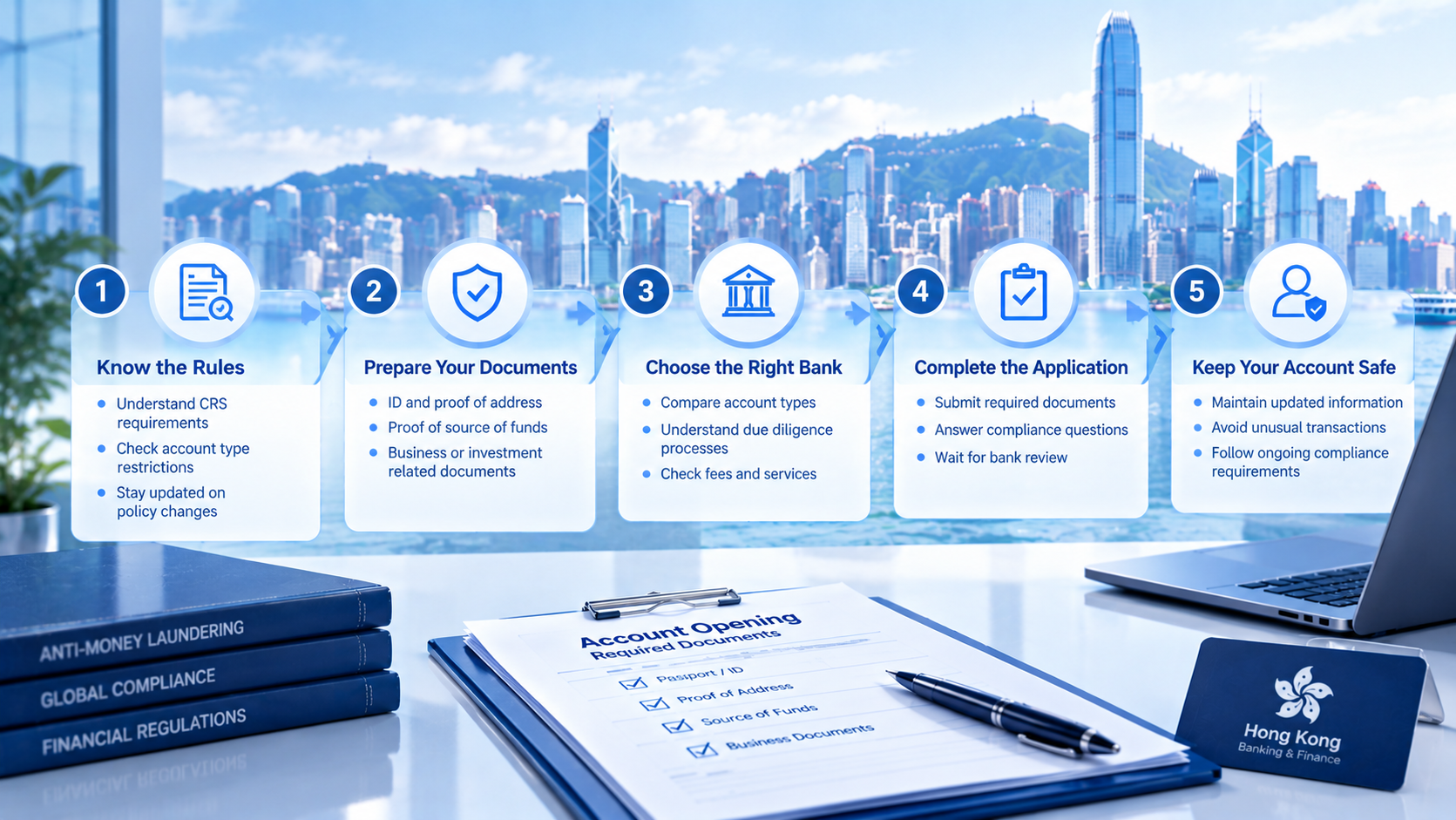
Before applying for a Hong Kong bank or investment account, take these practical steps to prepare for the current Hong Kong account rules:
- Confirm the account type. Decide whether you need a deposit, investment, or brokerage account.
- Prepare source-of-funds evidence. Keep bank statements, employment records, dividend documents, sale agreements, and investment records.
- Provide accurate tax residency information. Complete CRS self-certification forms carefully. Update them when your circumstances change.
- Check the provider's requirements. Ask which documents the bank or broker needs. Confirm whether it can serve customers with your residency and location.
- Keep records consistent. Make sure your application matches your identification documents, tax records, and financial evidence.
Conclusion
The era of easy account opening in Hong Kong is giving way to a more compliance-focused process. Stricter brokerage controls and additional checks on bank investment accounts show that financial institutions are paying closer attention to customer identity, tax residency, and the origin of funds.
However, Hong Kong remains an international financial centre. The latest Hong Kong account rules do not mean that every applicant will be rejected. Customers now need to understand the requirements, prepare reliable documents, and choose an account that suits their circumstances.
Ultimately, successful account opening requires more than valid identification. Customers must also provide a clear and credible explanation of the account's purpose and funding.
Article Recommendations
- Hong Kong CRS: Dual Tax Residency and Bank Account Guide
- Hong Kong Company Tax Guide 2026: Rates, Filing Process & Requirements
- BVI Tax Residency: Beneficial Owner CRS Guide
If you still have questions, please contact our team on WhatsApp at +1 213 751 2111. We'll help you find the right solution for your business and keep your company compliant as it grows.