
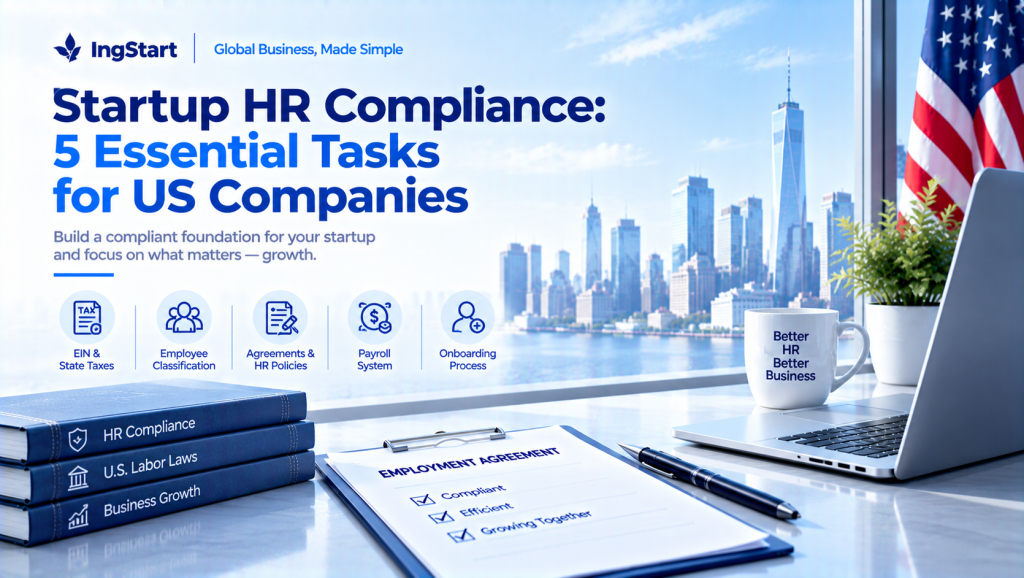
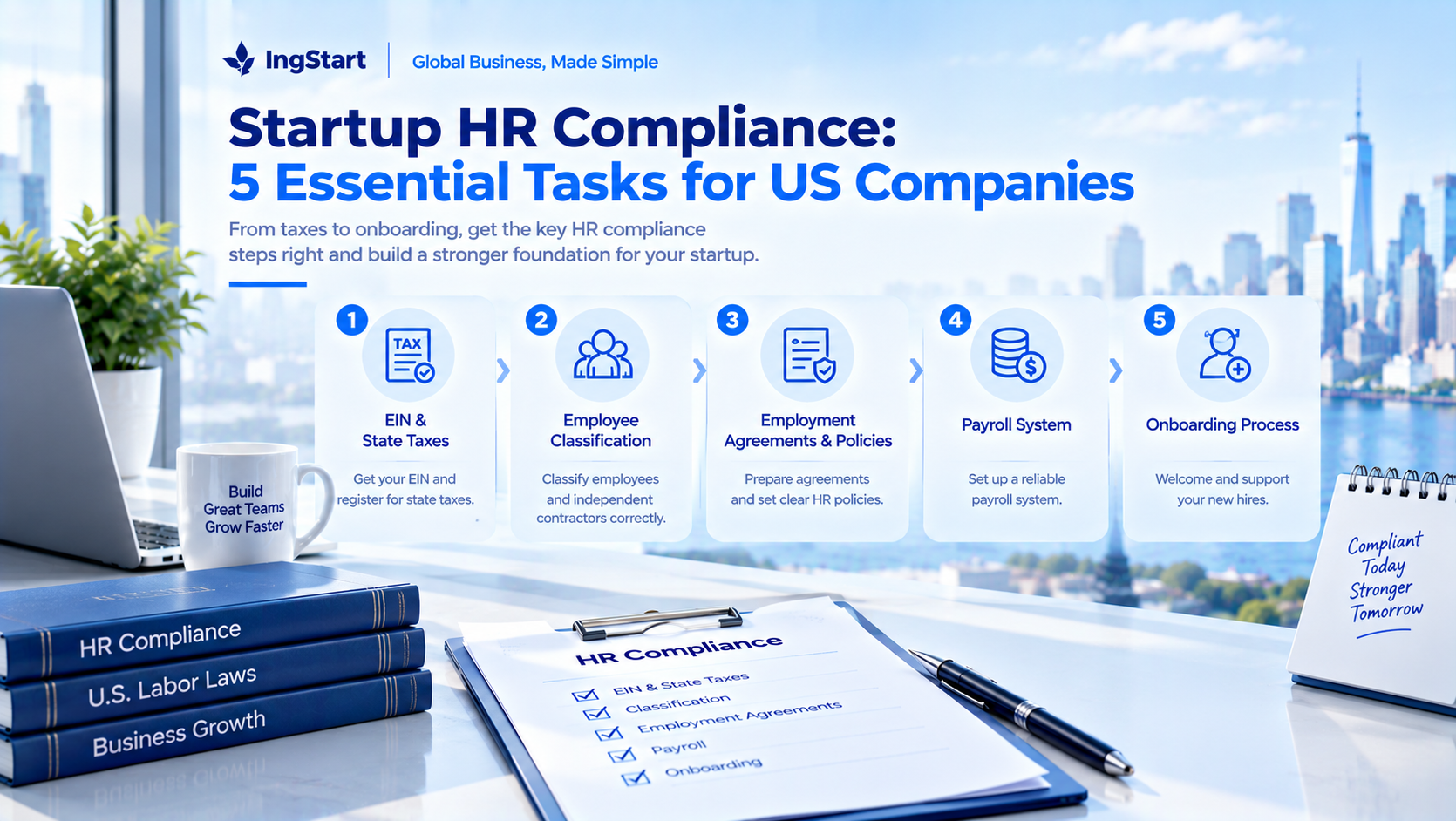
Startup HR Compliance is an important step for international entrepreneurs who plan to hire employees in the United States. Registering an LLC or C corporation creates a legal business entity, but it does not complete the requirements for employing people. Before the first employee starts work, a company needs the right tax registrations, employment documents, payroll procedures, and onboarding process.
US employment rules apply at federal, state, and local levels. Therefore, requirements can vary depending on where employees work. The following five tasks can help new businesses build a reliable HR foundation without making the process unnecessarily complicated.
1. Startup HR Compliance: Obtain an EIN and Register for State Taxes
Before hiring employees, a business should obtain an Employer Identification Number (EIN) from the Internal Revenue Service (IRS). This federal tax ID helps the company report employment taxes and meet other tax obligations. The IRS also requires businesses with employees to handle tax withholding, deposits, and reporting.
However, an EIN alone is not enough. Depending on the state and where employees work, the company may also need to register for state income tax withholding, unemployment insurance, and other employment-related taxes.
Workers' compensation insurance is another requirement to check. Most states require employers to carry coverage, although the rules and available options differ by state. Some jurisdictions also require additional disability or paid leave contributions.
Before the first payday, employers should:
- Apply for an EIN if required.
- Register with the relevant state tax and workforce agencies.
- Check workers' compensation and other required insurance.
- Confirm state and local payroll filing deadlines.
Completing these steps early can prevent registration delays and payroll problems after hiring begins.

2. Classify Employees and Independent Contractors Correctly
One of the most important Startup HR Compliance decisions is determining whether a worker is an employee or an independent contractor. The distinction affects payroll taxes, minimum wage, overtime, benefits, and other legal responsibilities.
A contract label alone does not decide a worker's status. Instead, the relevant authorities examine the actual working relationship. Depending on the law, they may consider the level of control, the worker's opportunity for profit or loss, the permanence of the relationship, and how the work fits into the business.
For example, a company may hire a freelancer for a specific project. That arrangement does not automatically make the person an independent contractor if the actual relationship meets the legal definition of employment.
What Should Employers Check?
Review the following factors before deciding how to classify a worker:
- Control over work: Who decides how, when, and where the work is performed?
- Financial independence: Does the worker operate an independent business and bear genuine business expenses or risks?
- Working relationship: Is the engagement project-based, or does the person perform an ongoing role within the company?
- Applicable legal tests: Does the relevant state use a stricter classification standard, such as an ABC test?
The rules can differ across federal tax law, federal wage law, and state employment law. In February 2026, the US Department of Labor proposed changes to its federal independent-contractor analysis. A proposed rule should not be treated as a final nationwide standard, and employers must still check the applicable requirements.
If the classification is unclear, seek advice before setting up payroll or signing the contract. Correcting a misclassification later can lead to back taxes, unpaid wages, penalties, and disputes.
3. Prepare Employment Agreements and HR Policies
A new company should establish clear written employment terms before its team grows. These documents help employees understand their responsibilities and give the employer a consistent way to manage workplace issues.
The exact documents depend on the business, the role, and the state where the employee works. Common documents include:
- Offer letters or employment agreements: State the position, duties, pay, payment schedule, benefits, and relevant confidentiality or intellectual property terms.
- Employee handbook: Explains workplace conduct, anti-discrimination and anti-harassment policies, working hours, leave, and complaint procedures.
- Remote work policy: Sets expectations for work location, communication, company equipment, and data security.
- Confidentiality and intellectual property agreements: Protect sensitive information and clarify ownership of work where appropriate.
US employment laws are not identical across states. For example, paid sick leave, final paycheck deadlines, and required notices may differ. A policy prepared for one state may not meet the requirements in another.
Therefore, avoid relying on a generic handbook without reviewing local rules. As the company expands, update its documents to reflect new locations, employee roles, and legal requirements.
4. Set Up a Reliable Payroll System
Payroll involves more than transferring money to employees. Employers must calculate wages correctly, withhold applicable taxes, make required tax deposits, and submit the relevant reports.
For many startups, a payroll service can reduce manual work and help manage recurring deadlines. Businesses may compare providers such as Gusto, ADP, or Paychex based on their size, locations, budget, and payroll needs.
Essential Payroll Setup Steps
Collect the required employee forms. Employees generally complete Form W-4 to provide information used for federal income tax withholding. Employers must also complete Form I-9 to verify identity and employment authorization. These forms serve different purposes and should not be treated as interchangeable. <Cite refs={["turn371938search0","turn259931search25"]}/>
Set a clear pay schedule. Choose a payroll frequency that complies with the applicable state rules. Then confirm the payment method, payroll cut-off dates, and procedures for handling corrections.
Review wage and overtime rules. Check federal, state, and local minimum wage requirements, as well as overtime rules for covered employees. Also review paid leave and other required benefits that may affect payroll.
Meet tax deadlines. Employers may need to deposit federal income tax withholding, Social Security and Medicare taxes, and federal unemployment taxes. State and local obligations may apply as well.
Keep payroll records organized and restrict access to sensitive employee information. A consistent process can help the company pay employees accurately and reduce the risk of missed filings.
5. Build a Standardized Employee Onboarding Process
A good onboarding process helps new employees settle into their roles and ensures that important compliance tasks are not missed. Rather than handling every hire differently, startups should establish a repeatable process.
Before the Employee Starts
Prepare the offer letter, confirm the agreed pay and start date, and arrange the equipment and system access the employee needs. Where applicable, complete background checks only in accordance with the relevant laws and consent requirements.
On the First Day
Introduce the employee to the team, explain the main responsibilities, and provide access to workplace policies. The employee should also complete the required employment paperwork on time.
For Form I-9, the employee generally completes Section 1 no later than the first day of employment. The employer must complete Section 2 within three business days after the employee starts work. If the job will last fewer than three business days, Section 2 must be completed by the first day.
Employers should use the current accepted form edition and follow the applicable document examination rules. Remote hiring does not automatically remove these obligations.
During the First 90 Days
Schedule regular check-ins, provide role-specific training, and agree on clear goals for the first month, second month, and third month. These conversations help managers identify problems early and give employees a clearer path to success.
For international entrepreneurs setting up their first US team, IngStart provides company registration and ongoing compliance support. Organizing corporate records and administrative tasks early can help founders focus on building their teams while keeping business obligations in view.
Conclusion
Startup HR Compliance begins before a company hires its first employee. Obtaining the right tax registrations, classifying workers correctly, preparing employment documents, setting up payroll, and standardizing onboarding can help a new business avoid common mistakes.
Because US employment requirements vary by state and locality, there is no single checklist that covers every company. Employers should confirm the rules that apply to each employee's work location and review official guidance when requirements change. With a clear process in place, startups can build their US teams on a stronger and more sustainable foundation.
Article Recommendations
- U.S. Employee Insurance: A Compliance Guide for Global Businesses
- US Labor Laws: 2026 Minimum Wage and Paid Leave Guide
- Multi-State HR Compliance: A US Guide for Employers
If you still have questions, please contact our team on WhatsApp at +1 213 751 2111. We'll help you find the right solution for your business and keep your company compliant as it grows.