
U.S. Employee Insurance and Employer Responsibilities
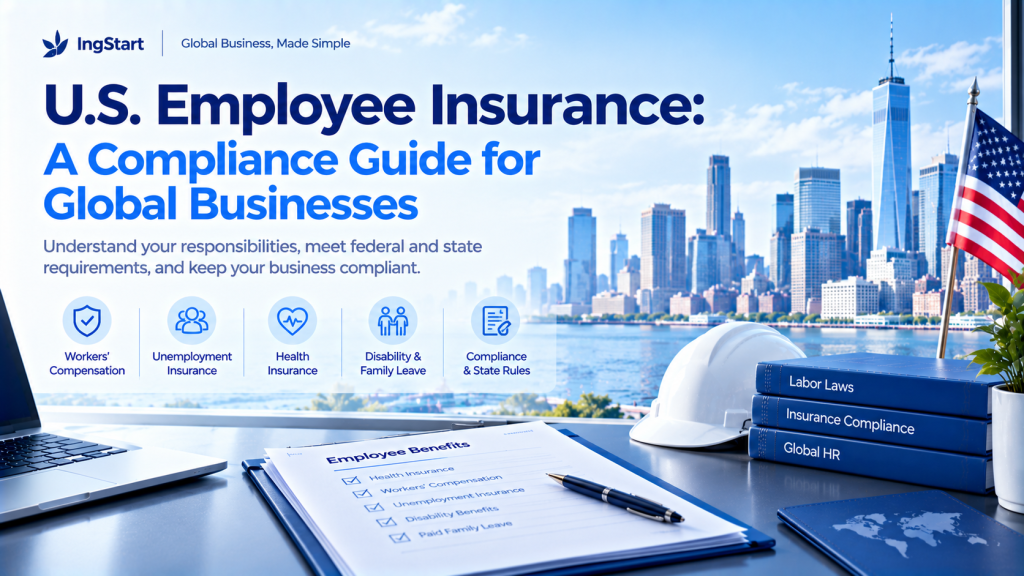
U.S. Employee Insurance is an important compliance issue for international businesses hiring employees in the United States. Many overseas companies now operate in the U.S. through e-commerce, software development, AI services, international trade, and other business activities. As their teams grow, employers need to understand the insurance rules that apply to their employees.
Unlike countries with a single national social insurance system, the United States divides many employee insurance requirements between federal and state authorities. Therefore, the rules depend on factors such as the employee’s work location, the company’s size, and the type of employment. A company’s state of registration does not automatically determine its insurance obligations.
For international business owners, employee compliance involves more than obtaining an Employer Identification Number (EIN) and running payroll. Employers may also need to register for state payroll taxes, obtain workers’ compensation insurance, pay unemployment taxes, and provide certain state-mandated benefits.
Federal Requirements for U.S. Employee Insurance
At the federal level, employers must meet several tax and reporting obligations. However, not every federal requirement involves purchasing a commercial insurance policy.
Common obligations include:
| Requirement | What employers need to know |
|---|---|
| Social Security Tax | Funds retirement, disability, and survivor benefits. Employers and employees generally each pay a share through payroll taxes. |
| Medicare Tax | Helps fund Medicare, the federal health insurance program for eligible older adults and certain other individuals. Employers and employees generally each pay a share. |
| Federal Unemployment Tax (FUTA) | Helps fund the federal-state unemployment system. Employers generally pay this tax, subject to applicable rules and credits. |
| Affordable Care Act (ACA) | Applicable Large Employers (ALEs), generally those averaging at least 50 full-time employees and full-time equivalents, may need to offer qualifying health coverage and meet related reporting requirements. |
Social Security and Medicare taxes are generally grouped under the Federal Insurance Contributions Act (FICA). In addition, certain high-income employees may owe Additional Medicare Tax, which employers must withhold when the applicable threshold is reached.
The ACA rules also require careful attention. Smaller employers are not generally subject to the federal employer shared responsibility mandate, although other coverage requirements or state laws may apply. For details, employers should review the current guidance from the IRS and the U.S. Department of Labor.

State-Mandated U.S. Employee Insurance
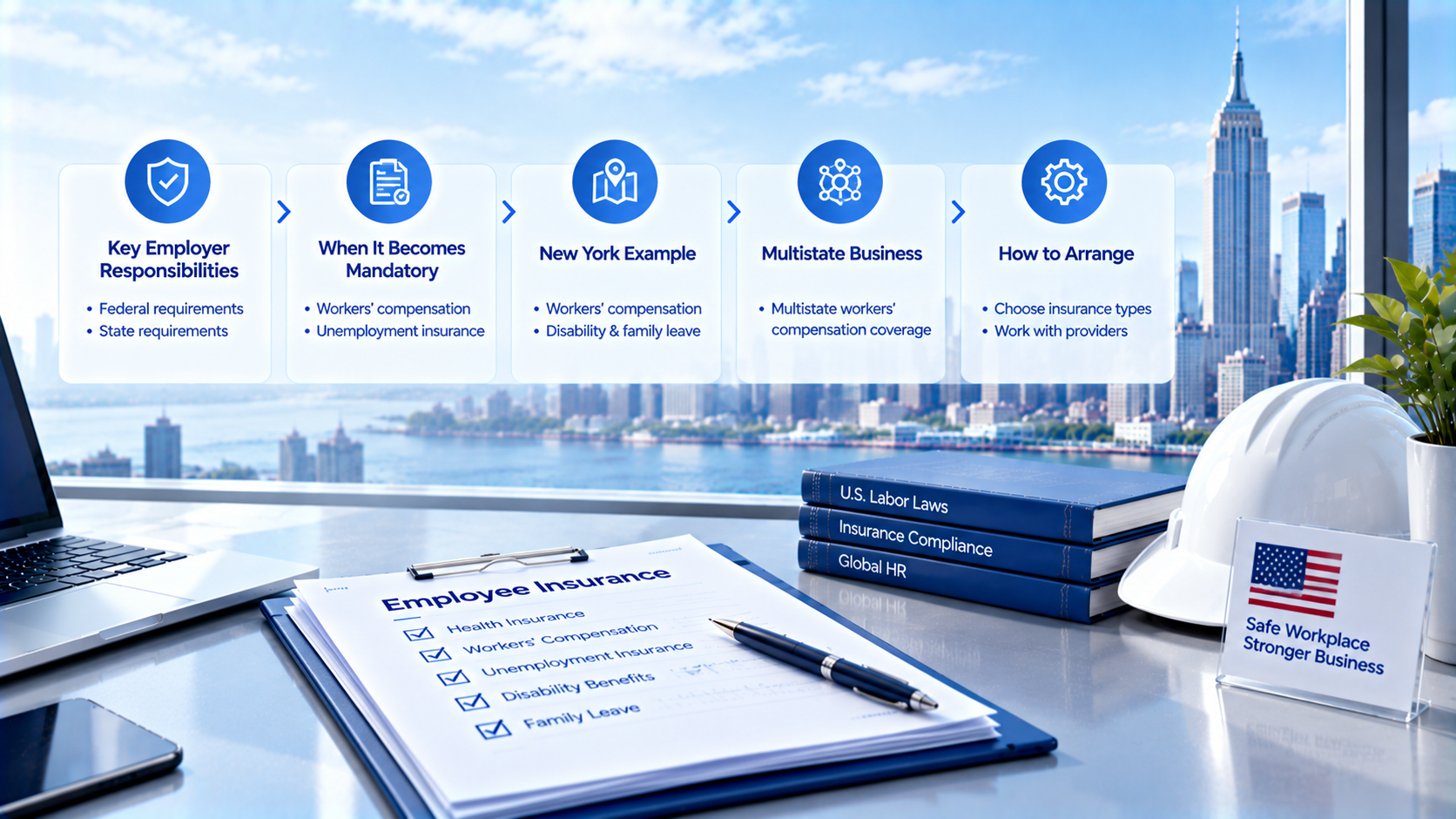
Many practical insurance requirements arise at the state level. Depending on the employee’s work location, an employer may need to arrange the following coverage or benefits.
Workers’ Compensation
Workers’ compensation generally covers qualifying work-related injuries and occupational illnesses. Benefits may include medical care, wage replacement, rehabilitation, and compensation for certain long-term disabilities.
Most states require many employers to carry workers’ compensation coverage, but the rules differ. Some states provide exemptions for certain business owners or employment arrangements. Therefore, employers should confirm the applicable requirements before an employee starts work.
Failure to obtain required coverage can lead to penalties and leave the company responsible for costs associated with workplace injuries.
State Unemployment Insurance (SUI/SUTA)
State unemployment insurance provides temporary benefits to eligible workers who lose their jobs under qualifying circumstances. Employers generally fund the system through state unemployment taxes.
However, registration thresholds, tax rates, wage limits, and filing schedules vary by state. Some states trigger an employer’s obligations based on wages paid, the number of employees, or the duration of employment. If a business fails to register when required, it may owe unpaid taxes, interest, and penalties.
Paid Family Leave (PFL)
Some states operate paid family leave programs. These programs may provide eligible employees with partial wage replacement when they take qualifying leave, such as caring for a family member or bonding with a new child.
The rules vary by state. In some programs, employees contribute through payroll deductions, while employers must handle registration, reporting, or payment obligations.
Disability Insurance
Certain states also require disability benefits coverage for eligible employees who cannot work because of a non-work-related illness, injury, or other qualifying condition. This coverage differs from workers’ compensation, which generally applies to work-related injuries and illnesses.
For example, New York requires many covered employers to provide statutory disability benefits and paid family leave coverage. Employers should check the applicable state rules rather than assuming that one policy satisfies every requirement.
When Does U.S. Employee Insurance Become Mandatory?
The requirements for U.S. Employee Insurance do not all begin at the same time. An employer may need workers’ compensation coverage before an employee starts work, while state unemployment insurance obligations may depend on wages, employment duration, or other thresholds.
Consequently, employers should assess each requirement separately instead of relying on a single employee-count rule.
Workers’ Compensation Requirements
Workers’ compensation is one of the most important requirements to check before hiring. Many states require coverage as soon as a business employs a worker who falls within the state’s definition of an employee. However, exemptions and coverage rules differ.
Industries such as construction, manufacturing, and warehousing may face additional risks and more complex coverage needs. Employers should also review how the state treats part-time workers, remote employees, temporary staff, and company owners.
State Unemployment Insurance Requirements
State unemployment insurance obligations may begin once an employer meets a particular wage threshold, employs workers for a specified period, or satisfies another state-defined condition.
Therefore, a business should check its registration and reporting obligations in every state where it employs workers. It should also confirm whether it needs a state payroll tax account before running payroll.
U.S. Employee Insurance: The Example of New York
New York is a useful example because it requires several types of employee protection. Businesses with employees working in New York may need to arrange workers’ compensation, disability benefits, and paid family leave coverage.
Workers’ Compensation in New York
New York generally requires employers to obtain workers’ compensation coverage for employees who fall within the state’s coverage rules. This requirement may apply even when the company is incorporated in another state.
For example, a company registered in Delaware may still need New York workers’ compensation coverage if it employs a worker who performs covered work in New York. Employers should confirm the specific rules for remote, part-time, and other employment arrangements.
Disability Benefits and Paid Family Leave
New York also requires most covered employers to provide statutory disability benefits and paid family leave coverage. These programs serve different purposes:
- Disability Benefits (DBL): Provides eligible employees with partial wage replacement for qualifying non-work-related injuries or illnesses.
- Paid Family Leave (PFL): Provides eligible employees with paid leave benefits for qualifying family-related reasons, such as caring for a family member or bonding with a new child.
Employers commonly obtain this coverage through an authorized insurance carrier, subject to applicable rules. New York also permits certain qualifying employers to self-insure with approval.
In addition, employers may be permitted to collect employee contributions for some benefits through payroll deductions. However, the applicable rates, limits, and procedures can change. Businesses should check the latest information from the New York Workers’ Compensation Board before setting up payroll.
U.S. Employee Insurance for Multistate Businesses
Remote work has made multistate employment more common. However, hiring employees in different states can create additional compliance responsibilities.
In many cases, the employee’s actual work location is a key factor in determining the applicable insurance and payroll requirements. A company should not assume that its state of incorporation controls every employment obligation.
For example, a Texas company with an employee working remotely from New York may need to register for relevant New York payroll taxes, pay state unemployment taxes, obtain required insurance, and follow applicable New York employment laws.
Similarly, a business with employees in several states should review each state’s rules for workers’ compensation, unemployment insurance, paid leave, and other benefits.
Multistate Workers’ Compensation Coverage
A multistate workers’ compensation policy may help cover employees working in different states. However, employers should confirm that the policy properly lists or covers every state where coverage is required.
A policy purchased in the company’s registration state does not automatically guarantee coverage for employees in every other state. As a result, businesses should tell their insurer where employees actually work and update their policy when the workforce expands into a new state.
How to Arrange U.S. Employee Insurance
For international employers, the practical challenge is often knowing when to arrange coverage and which information to prepare. In general, insurance setup should take place before employees begin work whenever the applicable rules require coverage at that stage.
The following steps provide a useful starting point:
- Confirm the employee’s work location. Identify the state where each employee will perform their work, including remote work.
- Review the applicable requirements. Check federal obligations and state rules for workers’ compensation, unemployment insurance, disability benefits, and paid leave.
- Register for payroll accounts. Obtain the required federal and state tax registrations before handling payroll, where applicable.
- Prepare business and payroll information. Insurers and government agencies may request the company’s EIN, business details, industry classification, employee information, and estimated payroll.
- Arrange the required coverage. Contact an authorized insurer or relevant state program and confirm the effective date.
- Maintain records and review changes. Keep policy documents, payroll records, tax filings, and renewal information organized. Reassess requirements whenever the business hires in a new state.
Insurance costs and eligibility depend on factors such as industry, payroll, employee roles, claims history, and state rules. Therefore, employers should provide accurate information when applying for coverage and review their policies regularly.
For overseas entrepreneurs managing U.S. company formation alongside payroll and compliance, IngStart offers company registration and related business support, including tax-related services and ongoing compliance assistance. Organizing these administrative tasks early can help business owners prepare for hiring and reduce avoidable delays.
Conclusion
U.S. Employee Insurance compliance involves several separate responsibilities. Federal payroll taxes and ACA rules apply in specific circumstances, while workers’ compensation, unemployment insurance, disability benefits, and paid leave often depend on state law.
For international businesses, the employee’s actual work location is especially important. A company may need to meet the requirements of a state where it has employees, even if it is registered elsewhere.
Before hiring, employers should identify the relevant obligations, register for the required accounts, arrange insurance coverage, and maintain accurate payroll records. Because requirements vary by state and may change, businesses should confirm the current rules with the relevant government agencies or qualified professionals.
Article Recommendations
- US Tax Forms Guide: Complete List of Common IRS Tax Forms
- LLC Tax Classification: Understanding the Main U.S. Tax Options
- US Company Annual Report: What Happens If You File Late?
If you still have questions, please contact our team on WhatsApp at +1 213 751 2111. We'll help you find the right solution for your business and keep your company compliant as it grows.