
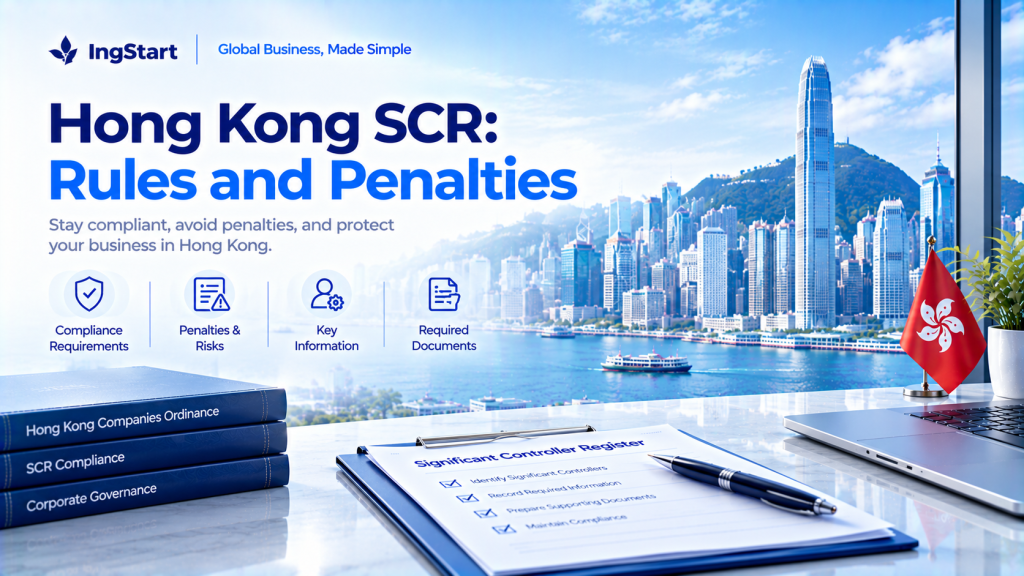
Hong Kong SCR compliance is an important responsibility for companies incorporated in Hong Kong. SCR stands for Significant Controllers Register. Under Hong Kong's Companies Ordinance, most locally incorporated companies must identify their significant controllers and maintain an accurate register, with listed companies generally exempt.
The register is not open to unrestricted public searches. Instead, authorized law enforcement officers can inspect it when required by law. For international entrepreneurs, understanding Hong Kong SCR requirements is essential because failing to maintain the register can lead to fines and other legal consequences.
What Is Hong Kong SCR?
The Significant Controllers Register was introduced under the Companies (Amendment) Ordinance 2018 and came into effect on March 1, 2018. Its purpose is to improve corporate ownership transparency by identifying the individuals and legal entities that have significant control over a company.
Under the rules, applicable companies must take reasonable steps to identify their significant controllers and maintain the required information in an SCR. The register must be kept at the company's registered office or another place in Hong Kong, as permitted by law.
Importantly, companies generally do not need to submit the SCR to the Companies Registry for registration. However, they must keep it available for inspection by authorized law enforcement officers.
According to the Hong Kong Companies Registry, the requirements apply to locally incorporated companies and companies re-domiciled to Hong Kong, except listed companies. Registered non-Hong Kong companies are generally not required to maintain an SCR under this specific regime.

What Happens If You Do Not Maintain Hong Kong SCR?
Failing to meet Hong Kong SCR requirements can result in criminal penalties. Therefore, companies should not treat the register as an optional administrative document.
1. Fines for Non-Compliance
A company that fails to comply with its SCR obligations, together with every responsible person in the relevant circumstances, may commit a criminal offence.
According to the Companies Registry's guidance, the penalty can include:
- Fine: Up to HK$25,000.
- Additional daily fine: HK$700 for each day the relevant offence continues, where applicable.
The exact consequences depend on the nature of the breach and the applicable legal provisions. Therefore, companies should address missing or incomplete registers promptly rather than wait for an inspection.
2. Penalties for False Information
Providing false information in corporate records can create more serious legal risks.
Under the relevant provisions of Hong Kong law, making a false statement may constitute a separate offence. Depending on the offence and circumstances, the consequences can include a fine of up to HK$300,000 and imprisonment for up to two years.
For this reason, companies should verify the information recorded in the SCR before completing or updating it. Guessing a beneficial owner's details or knowingly providing inaccurate information can create unnecessary legal exposure.
3. Compliance and Business Risks
Non-compliance can also create practical difficulties for the company.
For example, banks, professional service providers, and business partners may review a company's ownership information during due diligence. If the company's records are incomplete or inconsistent, additional questions may arise.
Although an SCR breach does not automatically mean that a bank will close an account or reject a transaction, maintaining accurate corporate records can help reduce avoidable compliance issues.
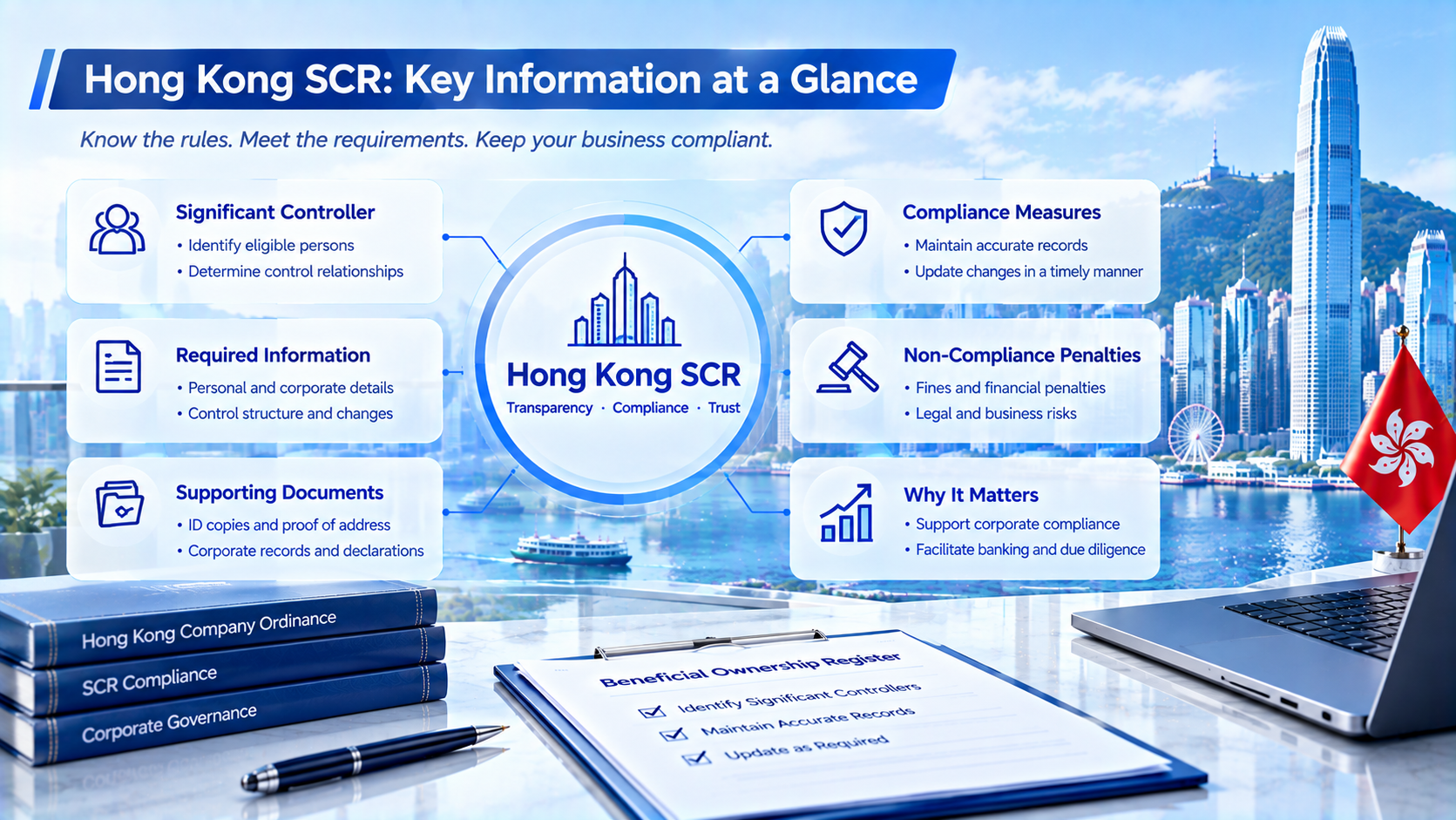
Why Is Hong Kong SCR Important?
The purpose of Hong Kong SCR extends beyond avoiding penalties. It also helps companies maintain transparent ownership records and meet their legal responsibilities.
Support Corporate Compliance
First, identifying significant controllers helps a company understand who ultimately owns or controls it. This is particularly important when the ownership structure includes multiple shareholders or corporate entities.
In addition, maintaining an accurate register helps the company respond to lawful requests from authorized officers.
Support Banking and Due Diligence
Financial institutions may review ownership structures and beneficial ownership information as part of their customer due diligence procedures. Therefore, keeping the SCR consistent with company records can make it easier to explain the company's ownership structure when questions arise.
Understand the Difference Between SCR and CRS
SCR and CRS are separate compliance frameworks.
The SCR identifies significant controllers under Hong Kong company law. By contrast, the Common Reporting Standard (CRS) concerns the reporting and exchange of certain financial account information for tax purposes.
Although both frameworks relate to transparency, maintaining an SCR does not automatically trigger a CRS information exchange. Companies and individuals should assess their obligations under each framework separately.
Hong Kong SCR: Who Qualifies as a Significant Controller?
A company must assess its ownership and control structure to determine who qualifies as a significant controller. A person or entity may qualify if at least one of the following conditions is met.
- Share ownership: Directly or indirectly holding more than 25% of the company's issued shares, or the relevant capital or profit rights if the company has no share capital.
- Voting rights: Directly or indirectly holding more than 25% of the company's voting rights.
- Board appointment rights: Having the right to appoint or remove a majority of the company's directors.
- Significant influence or control: Having the right to exercise, or actually exercising, significant influence or control over the company.
- Control through a trust or firm: Having the right to exercise, or actually exercising, significant influence or control over a trust or a firm that is not a legal person, where its trustees or members satisfy one of the first four conditions in relation to the company.
These conditions mean that companies should consider both direct ownership and indirect control.
For example, an overseas company may be a direct shareholder of a Hong Kong company. If an individual ultimately controls the overseas company and meets the relevant criteria, both the corporate shareholder and the individual may need to be recorded as significant controllers.
Hong Kong SCR: What Information Must Be Recorded?
The SCR must contain the required particulars of each significant controller and the contact details of the company's designated representative.
Depending on whether the controller is an individual or a legal entity, the information generally includes:
- Individual's name
- Correspondence address
- Hong Kong identity card number or, where applicable, passport number and issuing country
- Legal entity's name, legal form, registration number, place of incorporation, and registered office address
- Date on which the person or entity became a significant controller
- Nature of control over the company
- Designated representative's name and contact details
Companies should also review their shareholder records, constitutional documents, and relevant agreements when identifying significant controllers. If the company has no significant controller after taking all reasonable steps, it must record that fact as required by the rules. It should not simply leave the register blank.
Hong Kong SCR: What Documents Should You Prepare?
Preparing the relevant company and ownership information can make SCR compliance easier.
Depending on the company's structure, useful documents may include:
- Certificate of Incorporation and company registration details
- Current register of members
- Directors' and shareholders' information
- Identification documents for relevant individuals
- Company registration documents for corporate shareholders
- Shareholding percentages and ownership charts
- Shareholder agreements or other documents showing control rights
- Details of the designated representative
If the company has changed its directors, shareholders, or ownership structure, the records should reflect the current position.
Companies must also appoint at least one designated representative to assist law enforcement officers with matters relating to the SCR. The representative must meet the eligibility requirements under Hong Kong law. Eligible persons include certain Hong Kong-resident company members, directors or employees, as well as qualifying accounting professionals, legal professionals, and licensed trust or company service providers.
For detailed requirements, refer to the Companies Registry's SCR FAQ.
How to Maintain Hong Kong SCR Compliance
To manage Hong Kong SCR requirements effectively, companies should follow a consistent process.
- Review the ownership structure. Identify direct and indirect shareholders, voting rights, and other control arrangements.
- Determine the significant controllers. Apply the legal criteria to each relevant person or entity.
- Collect the required information. Obtain identification details, addresses, ownership information, and supporting documents.
- Prepare and maintain the register. Record the required particulars and keep the SCR at the registered office or another permitted location in Hong Kong.
- Appoint a designated representative. Make sure the appointed person meets the statutory requirements.
- Update the register when necessary. Review changes in ownership or control and complete the required updates.
- Keep supporting records organized. Retain relevant documents so the company can respond to lawful requests and compliance reviews.
For international entrepreneurs who manage their Hong Kong companies from overseas, these tasks can be harder to coordinate. IngStart provides company registration and ongoing compliance support for international businesses, helping owners organize corporate documents and manage recurring administrative requirements.
Conclusion
Hong Kong SCR is a statutory requirement for most locally incorporated Hong Kong companies, except listed companies. Businesses must identify their significant controllers, maintain the required information, and make the register available to authorized law enforcement officers when required.
Failure to comply can lead to fines, additional daily penalties, or other legal consequences. Providing false information can also result in separate penalties.
Therefore, company owners should review their ownership structures, prepare accurate records, appoint an eligible designated representative, and update the SCR when circumstances change. By maintaining proper records and addressing compliance requirements promptly, international entrepreneurs can reduce legal risks and keep their Hong Kong companies better prepared for regulatory and banking reviews.
Article Recommendations
- Hong Kong Company Registration: Do Individuals Need ODI Filing?
- Hong Kong Company Tax Guide 2026: Rates, Filing Process & Requirements
- Hong Kong CRS: Dual Tax Residency and Bank Account Guide
If you still have questions, please contact our team on WhatsApp at +1 213 751 2111. We'll help you find the right solution for your business and keep your company compliant as it grows.