
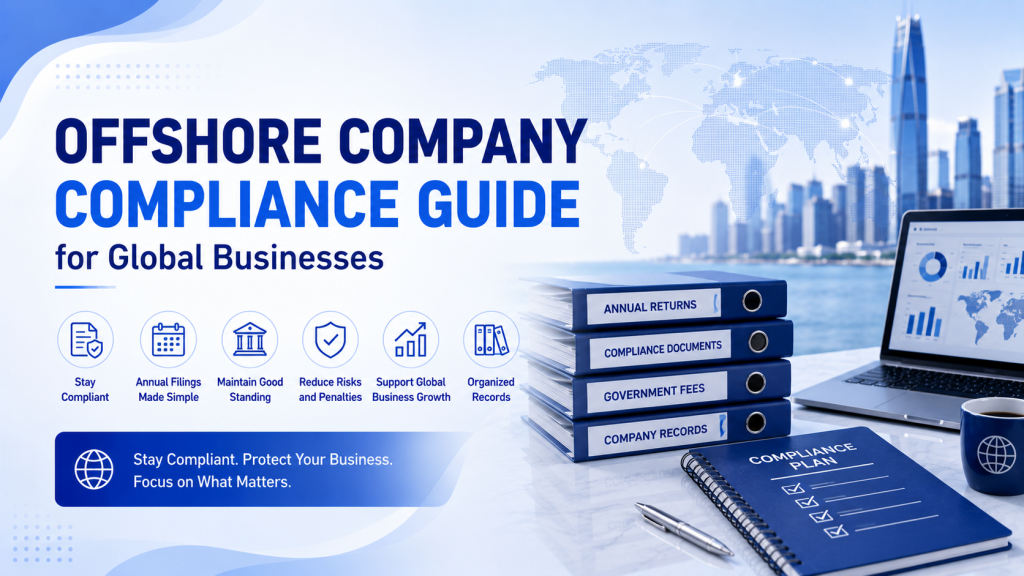
What Is Offshore Company Compliance?
Offshore Company Compliance refers to the ongoing legal and administrative requirements that an offshore or overseas company must meet after incorporation. These requirements may include annual returns, government fees, accounting records, tax filings, registered office maintenance, and updates to company information.
For international entrepreneurs, company formation is only the first step. After incorporation, keeping the company in good standing is equally important. Although the exact requirements vary by jurisdiction, most companies need to complete certain annual or periodic compliance tasks to maintain their legal status.
Therefore, understanding Offshore Company Compliance can help business owners avoid unnecessary penalties and keep their companies ready for banking, investment, and international business activities.
Offshore Company Compliance Requirements
The exact requirements depend on the jurisdiction, company type, and business activities. However, several compliance tasks are common across many international jurisdictions.
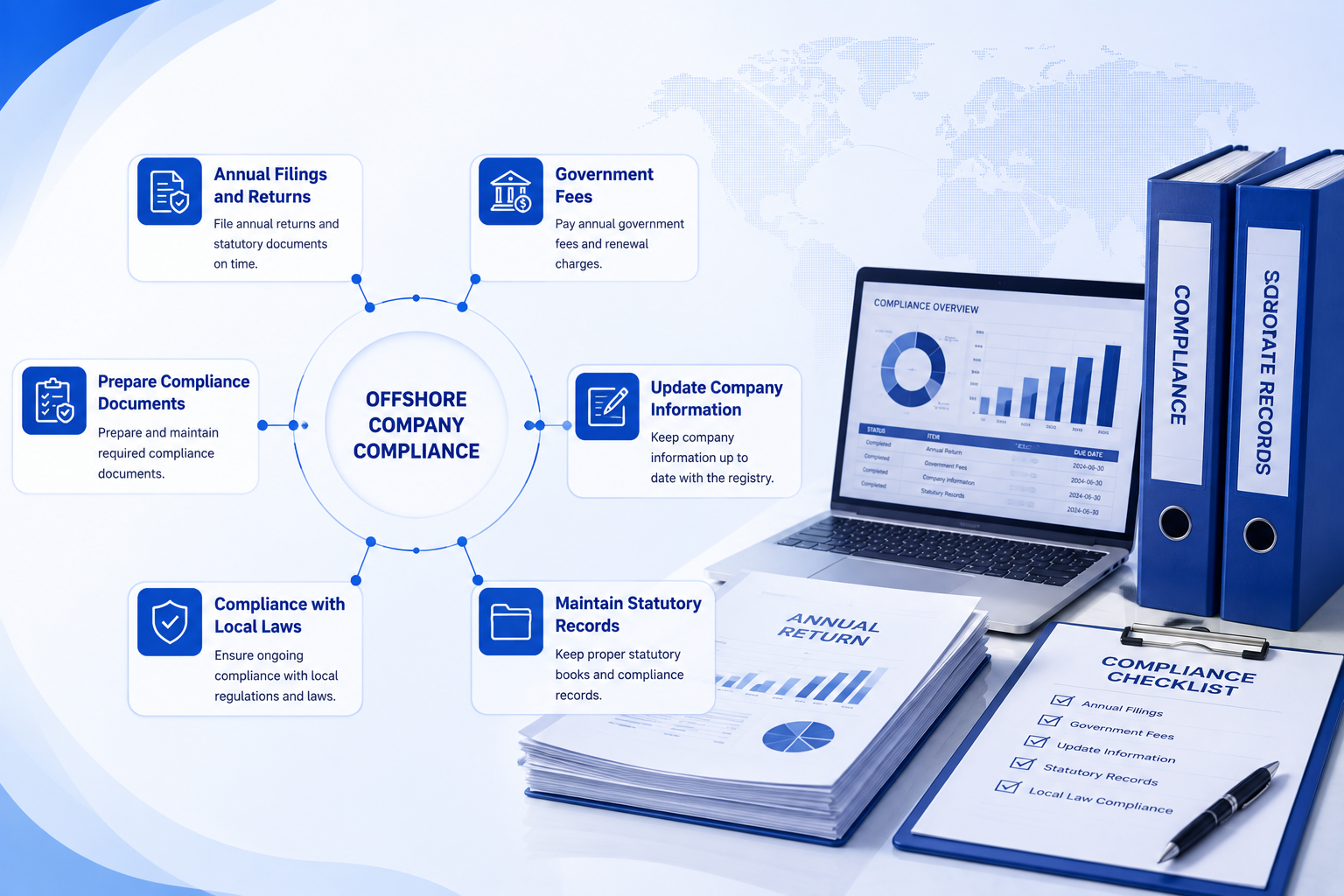
Prepare Offshore Company Compliance Documents
Before completing an annual filing, the company may need to prepare corporate and financial information. Common documents can include:
- Certificate of incorporation or registration
- Company information and registered office details
- Details of directors and shareholders
- Beneficial ownership information
- Accounting or financial records
- Previous annual return or filing records
- Government filing forms
- Identification documents, where required
Not every jurisdiction requires all of these documents. Therefore, companies should check the specific requirements of their registration jurisdiction before submitting an annual filing.

Complete Annual Returns and Filings
Many jurisdictions require companies to submit an annual return or similar corporate filing. The filing normally confirms that the company continues to exist and provides updated information about its directors, shareholders, registered address, or other corporate details.
For example, a Hong Kong private company generally needs to file an annual return within 42 days after the anniversary of its incorporation. A registered non-Hong Kong company in Hong Kong also has an annual return requirement. It generally needs to file within 42 days after each anniversary of its registration in Hong Kong.
Pay Annual Government Fees
Annual government fees are another important part of Offshore Company Compliance. These fees may cover annual registration, government filing, franchise taxes, or other statutory charges. The amount and payment deadline depend on the jurisdiction and company type. For example, Delaware domestic corporations generally need to file their annual report and pay franchise tax by March 1 each year. Late filing can result in a penalty and interest.
Update Company Information
Companies should also review their corporate information during the annual compliance process. If the company has changed its registered address, directors, shareholders, company secretary, or other key information, the relevant authority may require an additional filing. Keeping corporate records accurate can also make future banking, investment, and due diligence processes easier.
Offshore Company Compliance Process
Although the procedure differs between jurisdictions, a typical Offshore Company Compliance process can follow these steps.
1. Check the Annual Filing Deadline
First, confirm the company's annual return date and other compliance deadlines. Do not assume that every offshore company follows the same calendar. Some jurisdictions calculate deadlines based on the incorporation date, while others use a fixed annual date or a financial reporting period.
2. Review Company Information
Next, review the company's current information, including:
- Registered office
- Directors
- Shareholders
- Company secretary
- Beneficial owners
- Business activities
- Corporate structure
If any information has changed, determine whether an additional filing is necessary.
3. Prepare the Required Documents
After reviewing the company information, prepare the required forms and supporting documents. Depending on the jurisdiction, the company may also need accounting records, financial statements, identification documents, or other supporting materials.
4. Submit the Annual Filing
Once the documents are ready, submit the required annual return or compliance filing to the relevant government authority. Many jurisdictions now provide online filing services, which can make the process faster and easier.
5. Pay the Required Fees
After or during the filing process, pay the applicable government fees. Companies should keep proof of payment and filing confirmations for their corporate records.
6. Keep Compliance Records
Finally, retain copies of the submitted forms, payment receipts, government confirmations, and updated corporate documents. Maintaining these records can help the company respond more efficiently to future bank reviews, due diligence requests, or regulatory checks.
Why Offshore Company Compliance Matters
Offshore Company Compliance is not simply an administrative task. It helps protect the company's legal status and supports its long-term operations.
Maintain Good Standing
Regular filings and fee payments help a company maintain its status with the relevant corporate registry. A company that fails to meet its obligations may eventually lose its good standing or face administrative action, depending on local law.
Support Business Banking
Banks may request corporate documents and evidence that a company remains active and compliant. Therefore, keeping annual filings and company records up to date can make future banking reviews easier.
Protect International Business Operations
A company that remains in good standing can generally continue using its corporate structure for contracts, investments, international trade, and other business activities. As a result, proper Offshore Company Compliance can support rather than interrupt long-term business plans.
What Happens If Offshore Company Compliance Is Late?
Missing a compliance deadline can create different consequences depending on the jurisdiction.
Late Filing Fees and Penalties
The most common consequence is an additional late filing fee or government penalty. For example, Hong Kong private companies face substantially higher registration fees when annual returns are filed late. The current late fees increase according to how long the filing remains outstanding. For registered non-Hong Kong companies in Hong Kong, late annual return fees can range from HK$1,200 to HK$4,800, depending on the delay.
Loss of Good Standing
If compliance problems continue, the company may lose its good standing or become subject to further administrative action. The exact consequences depend on local company law, so businesses should deal with overdue filings as soon as possible.
Company Deregistration
In some jurisdictions, prolonged non-compliance can eventually lead to company strike-off or deregistration. Once a company loses its legal status, restoring the company may require additional procedures and costs.
Business and Banking Difficulties
Compliance problems can also create practical difficulties. For example, banks, investors, payment providers, or business partners may request updated corporate documents before continuing a relationship with the company. Therefore, keeping the company compliant can reduce unnecessary delays.
Offshore Company Compliance for Different Jurisdictions
The requirements for Offshore Company Compliance vary significantly between jurisdictions. As a result, international entrepreneurs should not rely on a single general annual compliance schedule.
Hong Kong
Hong Kong companies have clear annual return requirements. A local private company generally needs to submit its annual return within 42 days after the anniversary of its incorporation. The filing confirms key corporate information, including details such as the registered office, shareholders, directors, and company secretary.
United States
For US companies, compliance depends heavily on the state of incorporation and the company's tax classification. For example, Delaware corporations generally need to file an annual report and pay franchise tax by March 1. However, an annual state filing and a federal tax filing are different obligations. Therefore, US company owners should review both state and federal requirements.
British Virgin Islands
BVI companies also need to meet ongoing corporate and regulatory obligations after incorporation. Depending on the company's structure and activities, requirements may include maintaining corporate records, beneficial ownership information, and financial records. Because requirements can change, businesses should confirm the latest obligations with the relevant authority or a qualified professional.
Cayman Islands
Cayman Islands companies may also have annual filing and fee requirements. The exact obligations depend on the company type and its activities. Therefore, owners should review the requirements applicable to their specific Cayman entity rather than assuming that every company follows the same process.
How to Manage Offshore Company Compliance
For international business owners, managing compliance across different jurisdictions can become difficult, particularly when several companies have different filing dates.
A practical approach is to create a compliance calendar that records:
- Annual return deadlines
- Government fees
- Tax filing dates
- Accounting deadlines
- Registered agent or secretary renewals
- Changes in directors or shareholders
- Beneficial ownership updates
In addition, companies should keep all corporate documents in one organized system.
For entrepreneurs who want a more centralized solution, IngStart provides online company registration and ongoing corporate services for international businesses. Its platform can support company registration, annual compliance, tax-related services, banking support, compliance reminders, and company document management, helping business owners manage multiple administrative tasks more efficiently.
Offshore Company Compliance Checklist
Before completing the annual compliance process, companies can review the following checklist:
- Check the annual filing deadline.
- Review directors and shareholders.
- Confirm the registered office address.
- Review beneficial ownership information.
- Prepare required corporate documents.
- Prepare accounting or financial information when required.
- Submit the annual return or relevant filing.
- Pay government fees on time.
- Keep filing confirmations and payment records.
- Check whether additional tax filings are required.
This simple checklist can help international entrepreneurs reduce the risk of missing important compliance deadlines.
Final Thoughts on Offshore Company Compliance
Offshore Company Compliance is an essential part of maintaining an international company after incorporation. Although the exact requirements vary by jurisdiction, annual returns, government fees, company information updates, and tax-related obligations are common areas that businesses need to monitor.
More importantly, company owners should not assume that a company has no compliance obligations simply because it has limited business activity. Even an inactive or low-activity company may still need to complete certain statutory filings or pay annual fees.
Therefore, international entrepreneurs should keep a clear compliance calendar and review their obligations regularly. With proper planning and timely filing, Offshore Company Compliance can help protect the company's legal status and support stable international business operations.
Article Recommendations
- How Offshore Company Registration Works for Businesses
- C-Corp Holding LLC: How to Legally Reduce US Business Taxes in 2026
- EIN Application Guide: How to Apply for an EIN in 2026
If you still have questions, please contact our team on WhatsApp at +1 213 751 2111. We'll help you find the right solution for your business and keep your company compliant as it grows.