
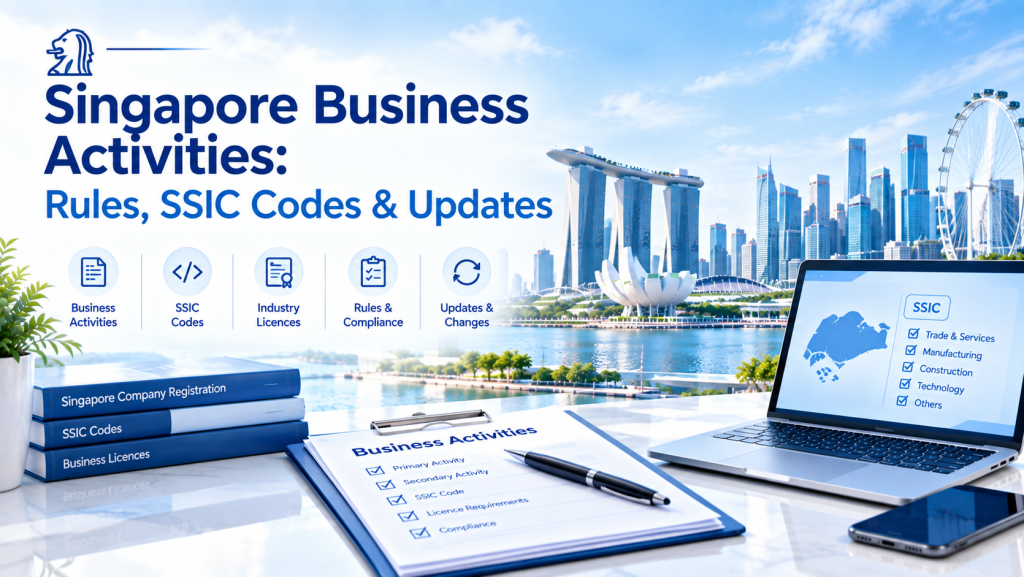
If you plan to register a company in Singapore, choosing the right Singapore Business Activities is an important part of the registration process. Your selected business activities describe what your company does and help determine the Singapore Standard Industrial Classification (SSIC) codes recorded with ACRA.
In 2026, companies should select business activities that accurately reflect their actual operations. ACRA requires registered entities to use five-digit SSIC codes for their primary business activity and, where applicable, their secondary business activity. Singapore also moved to SSIC 2025 codes in May 2026, so businesses should make sure their current classification still accurately describes what they do.
What Are Singapore Business Activities?
Singapore Business Activities refer to the activities that a company carries out as part of its business operations. During the registration process, a company selects the SSIC codes that best describe its activities. The SSIC system is Singapore's official classification system for business activities.
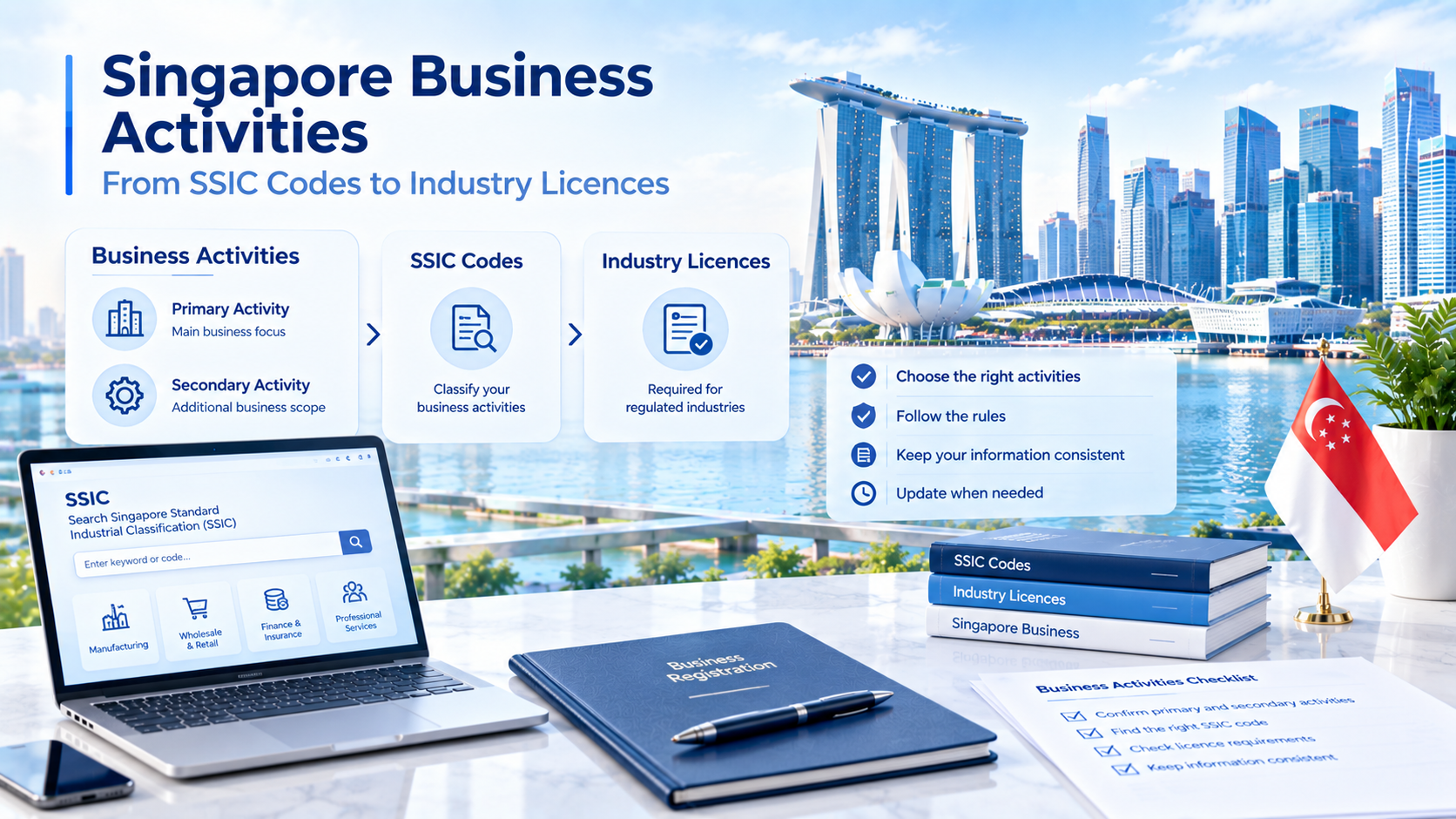
In general, a company selects one primary business activity. It may also select one secondary business activity where applicable. These activities should accurately reflect the company's actual business model rather than simply covering every possible future plan.

Primary and Secondary Singapore Business Activities
Singapore's current registration system focuses mainly on primary and secondary business activities.
Primary Business Activity
The primary business activity represents the company's main line of business. In most cases, it should describe the activity that best reflects how the company actually operates. For example, a company that mainly provides software development services should choose an SSIC code that accurately matches that activity. Choosing the right primary activity is important because government agencies may use this information for administrative and regulatory purposes.
Secondary Business Activity
A company may also select a secondary business activity if it carries out another significant activity. For example, a business may primarily provide consulting services while also engaging in a separate and clearly defined secondary activity. The secondary activity should still reflect the company's actual or intended operations. ACRA allows businesses to select a primary activity and, where applicable, a secondary activity when completing the registration process.
Choosing the Right SSIC Code
Each registered business activity uses a five-digit SSIC code. When reserving a business name through Bizfile, applicants can search for the appropriate code by entering relevant industry keywords. They can then select the SSIC code that best matches the intended activity.
This step should not be treated as a simple formality. An inaccurate SSIC code may create problems when the company's business information is reviewed by government agencies or when the company applies for industry-specific approvals. Therefore, it is better to select the code that most closely describes the company's real business activities.
Singapore Business Activities and Industry Licences
Choosing Singapore Business Activities during company registration does not automatically give a company permission to operate in every industry. Some sectors require additional licences, permits, registrations, or approvals. Therefore, a company should check the requirements that apply to its specific activities before starting operations.
For example, businesses in regulated sectors may need approval from the relevant government authority. The exact requirements depend on the industry and the nature of the activity. As a result, selecting an SSIC code and obtaining an industry licence are two separate steps.
Important Rules for Singapore Business Activities
When choosing or updating Singapore Business Activities, companies should keep several points in mind.
Choose Activities That Match Your Business
The primary and secondary activities should accurately reflect what the company actually does. Avoid choosing unrelated activities simply because the company may want to enter those markets in the future. If the business later changes, the company can update its information with ACRA.
Keep Your Business Information Consistent
The company's registered business activities should remain consistent with its actual operations and other regulatory information.
For example, if a company's primary business activity changes, the company should review whether it also needs to update information held by other relevant government agencies. IRAS states that changes to a company's principal activity require separate notification to both ACRA and IRAS.
Check Whether a Licence Is Required
Some business activities are subject to additional regulations. Therefore, before starting a new activity, check whether the company needs a licence, permit, or other approval. Registering a company with ACRA does not remove the need to comply with industry-specific requirements.
How to Update Singapore Business Activities
A company's operations may change over time. For example, a consulting company may expand into technology services, or a trading company may begin offering additional services. When this happens, the company should review its registered Singapore Business Activities and update them if they no longer accurately reflect its operations.
ACRA requires registered entities to report changes to their business activities within the applicable filing period. For local companies, ACRA generally requires updates within 14 days of the change. Businesses can update their primary and secondary activities through the entity information section in Bizfile. If a business needs to add additional activities beyond the standard primary and secondary entries, ACRA provides a separate filing process for additional business activities.
Tips Before Selecting Singapore Business Activities
Before registering your company, it is useful to spend some time reviewing the available SSIC codes.
You should:
- Clearly identify your main business activity.
- Select the SSIC code that best matches your operations.
- Add a secondary activity only when it is relevant.
- Check whether the activity requires a licence or permit.
- Update the information when the business changes.
For entrepreneurs who are unfamiliar with Singapore's registration system, choosing the correct business activity at the beginning can make the company setup process easier. Ingstart can also assist with Singapore company registration and related business compliance services, helping entrepreneurs prepare the required company information before registration.
Conclusion
Understanding Singapore Business Activities is an important part of setting up and managing a company in Singapore. In 2026, companies generally classify their operations using SSIC codes and select a primary business activity, with a secondary activity where applicable. Companies should choose activities that accurately reflect their operations and update the information when their business changes.
At the same time, company registration does not automatically replace industry-specific licensing requirements. Before starting a regulated activity, businesses should check whether additional permits or approvals are necessary.
By selecting accurate SSIC codes and keeping company information up to date, you can build a clearer and more compliant foundation for operating your Singapore company.
Article Recommendations
- Singapore Company Registration Types Guide for Foreign Entrepreneurs
- Singapore Business License Guide: Requirements & Application Process
- Singapore Business Bank Account Opening Guide
If you still have questions, please contact our team on WhatsApp at +1 213 751 2111. We'll help you find the right solution for your business and keep your company compliant as it grows.