
Singapore has become a popular destination for international entrepreneurs because of its stable business environment, strong infrastructure, and well-developed corporate system. However, before starting a business, you need to understand the different Singapore Company Registration options available in 2026.
Singapore offers several business structures, including private companies, public companies, limited liability partnerships, sole proprietorships, and other partnership structures. Each option has different requirements, liability protections, management structures, and compliance obligations.
For foreign entrepreneurs, choosing the right structure is especially important. Therefore, this guide explains the main Singapore Company Registration types and highlights the key issues that overseas investors should consider before setting up a business in Singapore.
Singapore Company Registration Types You Should Know
When choosing a business structure in Singapore, you should consider factors such as liability protection, ownership, management, taxation, operating flexibility, and future growth.
According to the Accounting and Corporate Regulatory Authority (ACRA), the main business structures include sole proprietorships, partnerships, limited partnerships, limited liability partnerships, and companies. A company, such as a private limited company, provides separate legal personality and limited liability, while a sole proprietorship does not create a separate legal entity.
For most international businesses, however, a private limited company is usually the most relevant structure to consider.
Private Limited Company (Pte Ltd)
A Private Limited Company, commonly known as a Pte Ltd, is one of the most popular choices for businesses conducting commercial activities in Singapore.
Definition and Key Features
A Pte Ltd is a separate legal entity from its shareholders. Therefore, the company can own assets, enter into contracts, and take on liabilities in its own name. Shareholders generally have limited liability, which means their personal assets are separated from the company's debts and obligations.
This structure is suitable for many types of businesses, particularly small and medium-sized enterprises, startups, family businesses, trading companies, technology companies, and professional service businesses.
Suitable Business Activities
A Singapore private limited company can generally conduct a wide range of lawful business activities. Common examples include:
- International trading
- E-commerce
- Technology and software
- Consulting
- Education
- Professional services
- Marketing and digital services
- Import and export
However, certain industries require additional licenses or regulatory approvals. Therefore, you should check the applicable industry requirements before starting operations.
Singapore Company Registration Requirements for Pte Ltd
A Singapore company must have at least one shareholder and at least one director. At least one director must meet Singapore's local residency requirements. The company must also appoint a company secretary within six months of incorporation.
In addition, the company needs a Singapore registered office address and must maintain the required company records and registers.
The basic incorporation fee for a local company is currently S$315, including the S$15 name application fee and S$300 incorporation fee.
For foreign entrepreneurs, the local director requirement is particularly important. If you live outside Singapore and want to establish a company, you may need to arrange a suitable local resident director structure.
Public Company
A Public Company is another type of Singapore company. It is generally designed for businesses with a larger shareholder base and more extensive capital-raising requirements.
Definition and Key Features
A public company is a separate legal entity, and shareholders generally benefit from limited liability. Unlike a private company, a public company can have more than 50 shareholders.
Some public companies may also seek to list their shares on the Singapore Exchange (SGX). However, incorporation as a public company does not automatically mean that the company is publicly listed.
Businesses considering an IPO must meet additional listing and regulatory requirements.
Suitable Business Activities
Public companies may be suitable for larger businesses that require substantial capital or plan to attract a broad investor base.
Typical industries may include:
- Manufacturing
- Technology
- Financial services
- Infrastructure
- Large-scale trading
- Other capital-intensive businesses
However, the decision to establish a public company should depend on the company's financing and long-term growth strategy rather than simply its industry.
Registration and Compliance Requirements
Public companies are subject to more extensive corporate governance and reporting requirements than many private companies.
Depending on the company's circumstances, additional requirements may apply to financial reporting, audits, shareholder meetings, directors, and securities regulations.
Therefore, businesses planning to raise capital from the public should obtain professional legal and corporate advice before choosing this structure.

Limited Liability Partnership (LLP)
A Limited Liability Partnership (LLP) combines some characteristics of a partnership with the legal protection of a separate entity.
Definition and Key Features
An LLP is a separate legal entity from its partners. Partners generally have limited liability for business debts arising from the actions of other partners. However, a partner can remain personally liable for their own wrongful acts.
This structure provides more flexibility than a traditional company while still offering liability protection.
An LLP must have at least two partners, and there is no maximum number of partners. Its partners can include individuals and certain corporate entities.
Suitable Business Activities
LLPs are often suitable for businesses operated by multiple professionals or partners, including:
- Legal services
- Accounting
- Consulting
- Design
- Professional services
- Other partner-based businesses
The structure can be attractive when partners want to share management and profits while maintaining a separate legal entity.
Singapore Company Registration Requirements for LLPs
Every LLP must have at least one manager who meets Singapore's local residency requirements. Foreigners living overseas must engage a corporate service provider and appoint a local manager who meets the applicable requirements.
After registration, an LLP must maintain accounting records and required registers and file annual declarations.
Therefore, although an LLP can be more flexible than a company, it still has ongoing compliance responsibilities.
Sole Proprietorship
A Sole Proprietorship is the simplest business structure in Singapore. It is owned by a single proprietor and does not create a separate legal entity.
Definition and Key Features
Because the business and owner are legally connected, the owner has unlimited liability for the business's debts and losses. In other words, personal assets may be exposed if the business cannot meet its obligations.
The structure is relatively simple to establish and may have lower administrative requirements than a company.
Suitable Business Activities
A sole proprietorship can be suitable for small businesses and individual entrepreneurs, such as:
- Retail businesses
- Independent consulting
- Small online businesses
- Creative services
- Handicrafts
- Freelance activities
However, the unlimited liability can make this structure less attractive for businesses with significant financial or operational risks.
Singapore Company Registration Requirements for Sole Proprietorships
Foreigners who live overseas can register a sole proprietorship through a corporate service provider and must appoint at least one authorised representative who meets the local residency requirements.
If a foreign entrepreneur plans to move to Singapore and personally operate the business, additional immigration and work authorization requirements may apply.
Which Singapore Company Registration Type Is Best for Foreigners?
For overseas entrepreneurs, the most appropriate structure depends on the nature and goals of the business.
In general:
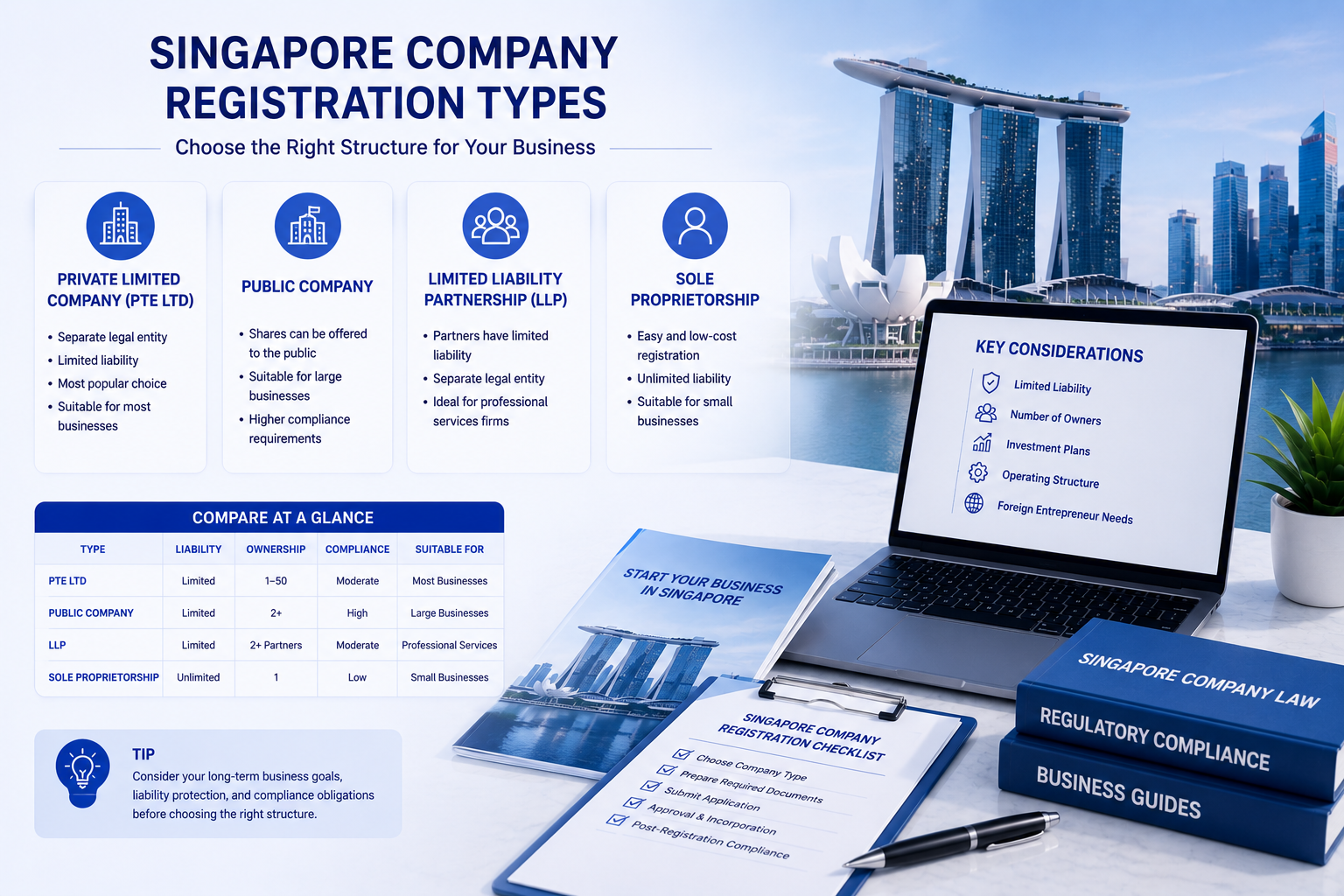
| Business Structure | Separate Legal Entity | Liability | Common Use |
|---|---|---|---|
| Pte Ltd | Yes | Limited | SMEs, startups, international businesses |
| Public Company | Yes | Limited | Larger businesses and capital raising |
| LLP | Yes | Generally limited | Professional and partner-based businesses |
| Sole Proprietorship | No | Unlimited | Small individual businesses |
For many international entrepreneurs, a Pte Ltd is often the most practical option because it provides limited liability, a separate legal identity, and a structure that can support business expansion.
However, this does not mean a Pte Ltd is suitable for every business. You should also consider the number of owners, management structure, financing needs, industry regulations, taxation, and future expansion plans.
Special Considerations for Foreigners Registering a Singapore Company
Foreign entrepreneurs can establish businesses in Singapore, but they need to pay attention to several additional requirements.
Foreign Ownership Restrictions
Singapore generally allows foreign investors to own shares in Singapore companies. However, certain regulated industries may have additional ownership, licensing, or approval requirements.
For example, sectors such as banking, media, and certain regulated professional services may be subject to specific rules.
Therefore, foreign investors should not assume that every industry has identical ownership requirements. Before investing, check whether the proposed business activity is regulated and whether additional approvals apply.
Local Director and Representative Requirements
One of the most important considerations for foreign entrepreneurs is Singapore's local residency requirement.
A Singapore company must have at least one director who meets the local residency rules. A company must also appoint a company secretary within six months after incorporation. The company secretary must meet the applicable local residency requirements and cannot be the same person as the sole director.
For foreigners who do not live in Singapore, this requirement should be considered before beginning the Singapore Company Registration process.
Corporate Service Provider Requirements
Foreign businesses and overseas entrepreneurs may need to engage a registered corporate service provider (CSP) for Singapore registration. ACRA states that foreign businesses must engage a CSP to register their business in Singapore.
A suitable CSP can assist with incorporation documents, local requirements, registered office arrangements, and ongoing corporate compliance.
Business Licenses and Permits
Company incorporation does not automatically give a business permission to conduct every type of commercial activity.
Certain industries require additional licenses or approvals. Depending on your business model, you may need to check requirements for financial services, food businesses, education, professional services, transportation, or other regulated activities.
Therefore, foreign entrepreneurs should identify the required licenses before starting operations.
Tax Considerations
Tax considerations can also affect the choice of business structure and investment arrangement.
For example, a Singapore private limited company is taxed as a company, while profits from some partnership structures may be taxed at the partner level. A sole proprietorship is also not separately taxed as a company; its profits are generally taxed at the owner's applicable personal income tax rates.
Because the tax treatment depends on the structure and circumstances, foreign investors should consider professional tax advice when designing their investment structure.
How to Choose the Right Singapore Company Registration Type
Choosing the right structure at the beginning can help reduce future restructuring and compliance costs.
Before starting Singapore Company Registration, consider the following questions:
1. Do You Need Limited Liability?
If protecting personal assets is important, a company or LLP may be more suitable than a sole proprietorship.
2. How Many Owners Will the Business Have?
A sole proprietorship is designed for one owner, while an LLP and other partnership structures are designed for multiple partners. A company can also have multiple shareholders.
3. Do You Plan to Raise Investment?
If you expect to bring in investors or expand your business significantly, a company structure may provide greater flexibility.
4. Do You Need a Simple Operating Structure?
If the business is small and low-risk, a sole proprietorship may be easier to manage. However, you should weigh this simplicity against unlimited personal liability.
5. Are You a Foreign Entrepreneur?
If you live outside Singapore, you should consider local director, local manager, authorised representative, and corporate service provider requirements before registration.
Singapore Company Registration and Ongoing Compliance
Registering a business is only the first step. After incorporation, Singapore companies must continue meeting corporate and regulatory requirements.
For example, companies generally need to maintain accurate information about directors, shareholders, and other relevant persons. ACRA also requires companies to maintain applicable registers, including the Register of Registrable Controllers (RORC), unless an exemption applies.
Companies also need to keep their corporate information updated and complete required annual filings. Certain changes must be reported to ACRA within specific deadlines.
For international entrepreneurs, managing these requirements alongside banking, tax, accounting, and annual compliance can become time-consuming. IngStart provides one-stop services for overseas entrepreneurs, covering Singapore company registration, corporate compliance, banking support, tax-related services, and other business administration needs. This allows business owners to manage more of their international business operations through one platform.
Final Thoughts on Singapore Company Registration
Understanding the different Singapore Company Registration types is an important first step for any entrepreneur planning to establish a business in Singapore.
A Pte Ltd is often a practical choice for international businesses because it provides a separate legal entity and limited liability. A public company may be more suitable for larger businesses with broader capital-raising plans. Meanwhile, an LLP can work well for professional or partner-based businesses, while a sole proprietorship may suit small individual businesses with relatively simple operations.
For foreign entrepreneurs, however, the choice should not be based only on registration costs. You should also consider local director requirements, ownership restrictions, licenses, taxation, ongoing compliance, and your long-term business plans.
By selecting the right structure at the beginning, you can build a stronger foundation for your Singapore business and make future expansion easier.
Article Recommendations
- Singapore Company Annual Filing Guide 2026: Requirements, Documents & Compliance Tips
- Singapore Company Tax Guide 2026: Rates, Rules & Compliance Requirements
- Singapore Company Registration Guide 2026: Requirements, Process & Tips for Global Entrepreneurs
If you still have questions, please contact our team on WhatsApp at +1 213 751 2111. We'll help you find the right solution for your business and keep your company compliant as it grows.