
Thinking about building a future in the United States? The EB-3 Visa Requirements may be worth exploring if you want to obtain permanent residence through employment. Unlike some immigration pathways, EB-3 does not focus only on people with advanced degrees or exceptional achievements. It also covers skilled workers and certain other workers who qualify for eligible US jobs.
However, there is an important detail: you generally cannot apply for an EB-3 visa on your own. A qualifying US employer must offer you a job and sponsor your application. This guide explains the basics, the three applicant categories, and what international workers should know before getting started.
What Is the EB-3 Visa?
The EB-3 visa is the Employment-Based Third Preference category of US employment-based immigration. It allows eligible foreign workers to seek US permanent residence through a qualifying job offer from a US employer.
The main purpose of this category is to help employers fill positions when they cannot find enough qualified and available US workers under the applicable labor certification process.
Compared with some other employment-based categories, EB-3 covers a wider range of jobs. Applicants may qualify as skilled workers, professionals, or other workers, depending on the position and their qualifications.
Nevertheless, meeting the basic EB-3 Visa Requirements does not guarantee approval. Applicants must qualify for the relevant category, and the employer must complete the required sponsorship procedures. In addition, annual visa limits and country-based demand can affect how long applicants wait.

Who Can Apply for an EB-3 Visa?
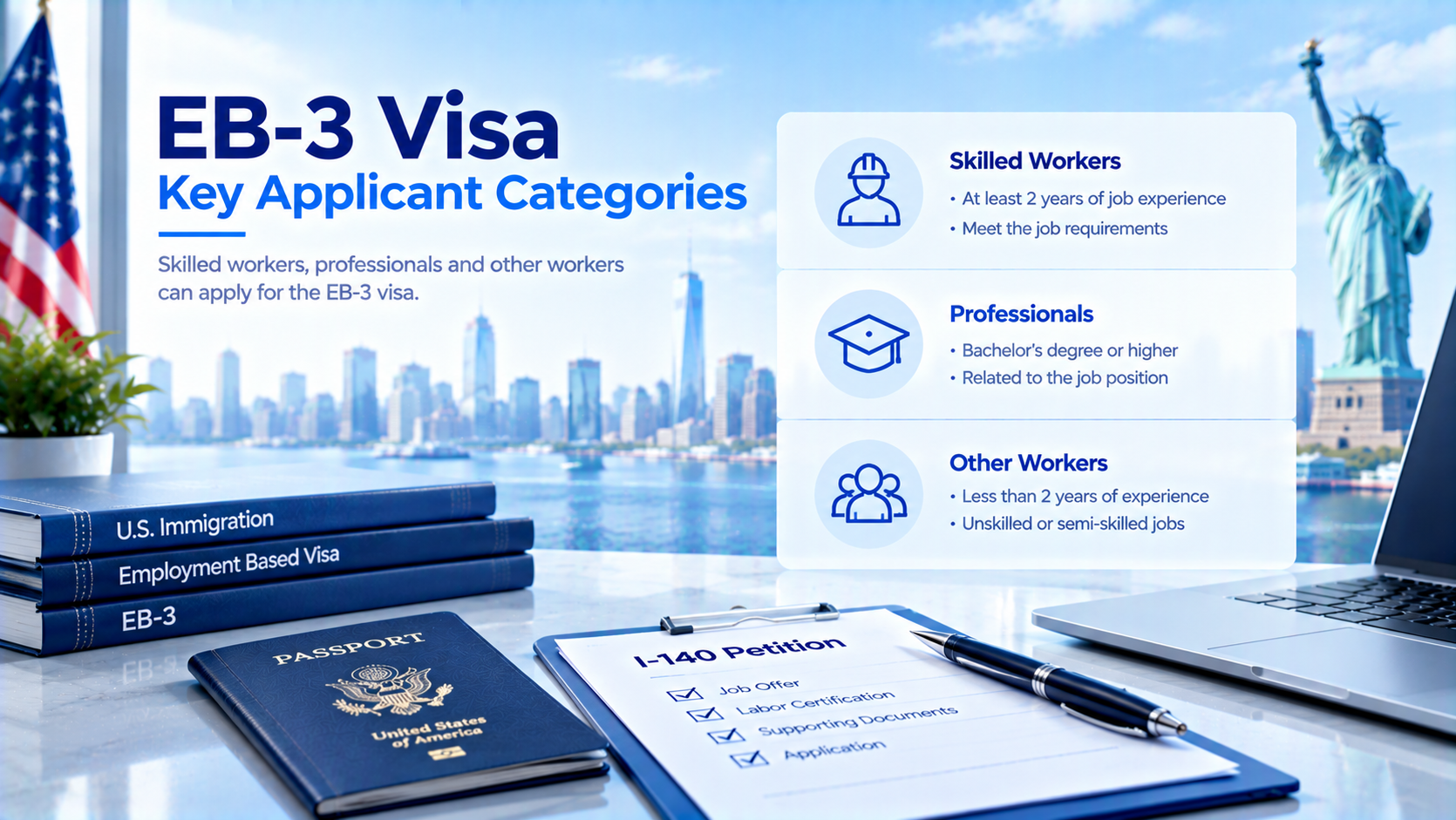
The EB-3 category has three main subcategories. Each has different eligibility rules, but all generally require a permanent, full-time job offer from a US employer willing to sponsor the applicant.
1. Skilled Workers
Skilled workers must have at least two years of relevant work experience or training. The job itself must require at least two years of experience or training, and it cannot be a temporary or seasonal position.
For example, a company may sponsor an experienced technician or another qualified worker for a position that requires specific practical skills.
Applicants must also show that they meet the job requirements stated in the employer's application.
2. Professionals
Professionals must hold a US bachelor's degree or a foreign degree equivalent to a US bachelor's degree. The offered position must require that level of education, and the applicant must meet the job's stated requirements.
For instance, a role that requires a bachelor's degree in a relevant field may qualify under this category if the employer and applicant meet the applicable rules.
A degree alone is not enough. The job must qualify as a professional position, and the applicant must have the required credentials.
3. Other Workers
The Other Workers category covers certain jobs that require less than two years of experience or training. These positions must be permanent and full-time, rather than temporary or seasonal.
Depending on the employer's needs, examples may include certain entry-level service or support roles. However, a particular job does not qualify automatically just because it requires little experience.
This subcategory has a separate annual visa limit, so applicants may face longer waits depending on visa availability.
Why Do Applicants Consider the EB-3 Visa?
For many international workers, the main attraction of EB-3 is the opportunity to pursue permanent residence through employment without necessarily needing an advanced degree or a large investment.
However, the benefits depend on the applicant's category, job offer, and individual circumstances.
A Wider Range of Employment Opportunities
Unlike some employment-based immigration categories that focus on exceptional ability or advanced qualifications, EB-3 includes several types of workers.
Therefore, applicants with relevant experience, a qualifying bachelor's degree, or the qualifications needed for certain other jobs may have a route to permanent residence through a sponsoring employer.
A Pathway to US Permanent Residence
Successful applicants can obtain lawful permanent resident status, commonly known as a green card. This status generally allows them to live and work in the United States, subject to applicable laws and requirements.
However, the process is not automatic. Applicants must qualify for the relevant category, complete the required procedures, and wait until an immigrant visa is available.
Potential Benefits for Eligible Family Members
An eligible principal applicant's spouse and unmarried children under 21 may also qualify for derivative immigration benefits, subject to the applicable rules.
If they obtain permanent resident status, they can generally live and study in the United States. Work authorization and other benefits depend on their immigration status and applicable requirements.
Families should also consider timing. Visa availability and age-related rules can affect whether a child remains eligible during a lengthy application process.
The Role of the EB-3 Visa in US Immigration
The EB-3 category helps US employers recruit foreign workers for positions that meet the relevant requirements. It covers a range of occupations, from skilled roles to certain jobs that require less experience or training.
At the same time, the process includes safeguards for the US labor market. In many cases, employers must first obtain labor certification from the US Department of Labor. This process generally requires them to test the relevant labor market and meet applicable recruitment and wage rules.
As a result, the EB-3 Visa Requirements involve more than the applicant's personal qualifications. The employer, offered position, labor certification, and immigrant visa availability all play important roles.
Why Is Employer Sponsorship Essential?
One of the most important things to understand is that EB-3 is generally an employer-sponsored immigration category. Applicants cannot simply submit a personal application without a qualifying job offer and the required employer petition.
The process commonly involves several stages:
- Job offer: A US employer offers a qualifying permanent, full-time position.
- Prevailing wage and recruitment: The employer follows the applicable Department of Labor procedures.
- Labor certification: Where required, the employer obtains approval through the labor certification process.
- Form I-140 petition: The employer files an immigrant petition with US Citizenship and Immigration Services (USCIS).
- Visa availability and final processing: The applicant proceeds when eligible under the Visa Bulletin and completes the required immigrant visa or adjustment of status procedures.
The exact process depends on the case. Some steps may also involve additional documentation or review.
For international applicants, it is therefore important to understand the job offer and employer's sponsorship responsibilities before making major plans. IngStart provides international business registration and compliance services that can help business owners organize their US business administration.
What Should International Applicants Know Before Applying?
Before pursuing an EB-3 case, applicants should confirm that the offered job matches the relevant category and that the employer is prepared to complete the required procedures.
They should also understand that visa numbers are limited. Waiting times vary according to the category, the applicant's country of chargeability, and demand for available visas. The US Department of State's monthly Visa Bulletin provides information on visa availability.
Finally, applicants should be cautious about claims that promise guaranteed approval, a fixed processing time, or a green card without a genuine qualifying job and proper sponsorship. Each case depends on its facts and the applicable immigration rules.
Conclusion
The EB-3 Visa Requirements cover three main groups: skilled workers, professionals, and other workers. This makes EB-3 relevant to a broader range of international applicants than some other employment-based immigration categories.
However, eligibility depends on both the worker and the offered position. A qualifying US employer must generally provide sponsorship, complete the required labor certification process where applicable, and file the immigrant petition. Applicants must also account for visa limits and possible waiting periods.
Understanding these basics is the first step toward deciding whether EB-3 fits your plans. The next step is to review the detailed application process, employer obligations, and visa availability before proceeding.
Article Recommendations
- U.S. Employee Insurance: A Compliance Guide for Global Businesses
- US Worker Classification: Employee Tax Guide
- Multi-State HR Compliance: A US Guide for Employers
If you still have questions, please contact our team on WhatsApp at +1 213 751 2111. We'll help you find the right solution for your business and keep your company compliant as it grows.