
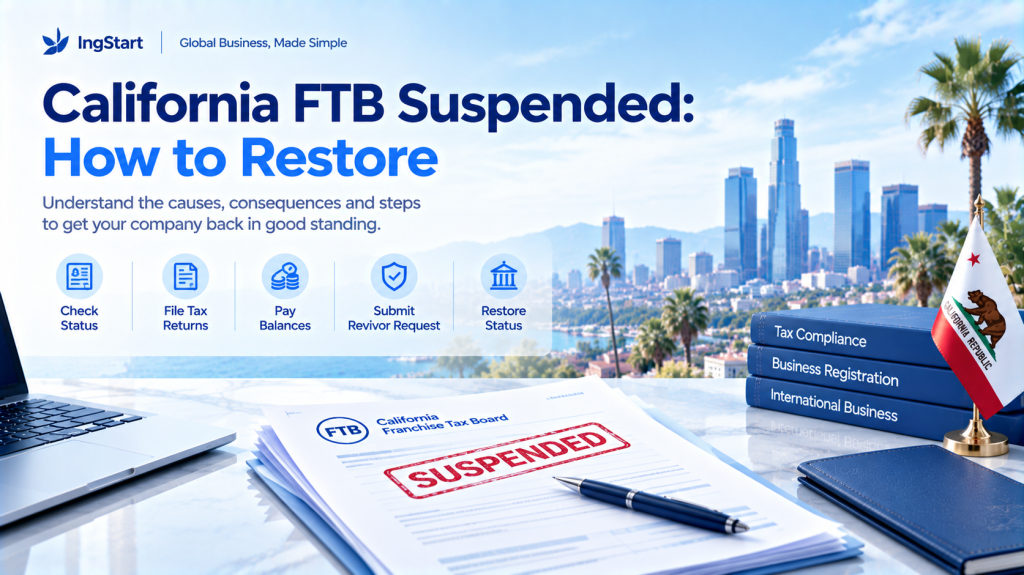
For international business owners, California FTB Suspended status can create serious problems when a company fails to meet California tax requirements. A company may become suspended after failing to file required tax returns or pay taxes, penalties, fees, or interest.
However, FTB Suspended does not mean the same thing as voluntary dissolution. Instead, the company loses its rights, powers, and privileges to do business in California while the suspension remains in effect. In many cases, the business can apply for a Certificate of Revivor after it completes the required tax filings and payments.
For international entrepreneurs who manage U.S. companies from overseas, understanding the California FTB Suspended process can help prevent further penalties and make restoration easier.
What Is California FTB Suspended?
A California business may have obligations to both the Franchise Tax Board (FTB) and the California Secretary of State (SOS). These two agencies handle different parts of company compliance.

An FTB Suspended status generally results from failure to meet California tax requirements, such as filing a required return or paying taxes, penalties, fees, or interest. By contrast, an SOS Suspended status can result from failing to file the required Statement of Information. A company can also be suspended by both agencies at the same time.
Therefore, business owners should first determine whether the company has an FTB suspension, an SOS suspension, or both. The restoration process can depend on which compliance issues remain outstanding.
Common Causes of California FTB Suspended Status
In many cases, a company becomes suspended because its owners did not keep up with California tax filings or payments. For international business owners, this can happen when U.S. tax obligations are managed remotely and state notices are overlooked.
The most common causes include:
- Failure to file California tax returns
A company may become suspended when it does not file required state tax returns. Business owners should not assume that a company with little or no activity automatically has no filing obligations. The exact requirements depend on the entity type and tax situation. - Failure to pay franchise or annual taxes
Many corporations subject to California franchise tax must pay the $800 minimum franchise tax. The requirement can apply even when the company is inactive or operates at a loss, although specific exceptions exist. - Missing FTB notices
An outdated mailing address can make it easier to miss tax notices, payment requests, or other compliance correspondence. As a result, an unresolved issue may continue until the company discovers the suspension during a bank review, financing process, or corporate change.
California FTB Suspended: What Are the Consequences?
A California FTB Suspended company is not in good standing and loses important rights, powers, and privileges in California.
1. Restrictions on Business Activities
A suspended business cannot legally conduct business in California. In addition, its contracts may become voidable or unenforceable unless the business obtains applicable relief.
Therefore, continuing normal operations without addressing the suspension can create additional legal and commercial risks.
2. Problems With Corporate Changes
A suspended business may face restrictions when it tries to make corporate changes or complete other state filings. For example, a suspended entity cannot simply proceed with voluntary dissolution or other termination procedures until it satisfies the applicable FTB requirements.
As a result, restoring the company's good standing often becomes an important first step before handling other corporate matters.
3. Financing and Due Diligence Risks
Banks, investors, and business partners may review a company's state status during due diligence.
If the company appears as suspended, the status can raise questions about its tax compliance and ability to operate. Consequently, an unresolved suspension may create delays when the company applies for financing, opens certain accounts, or prepares for a transaction.
California FTB Suspended: How to Restore the Company
Many business owners assume that paying the outstanding tax is enough to restore the company. However, the FTB's current guidance requires more than payment alone.
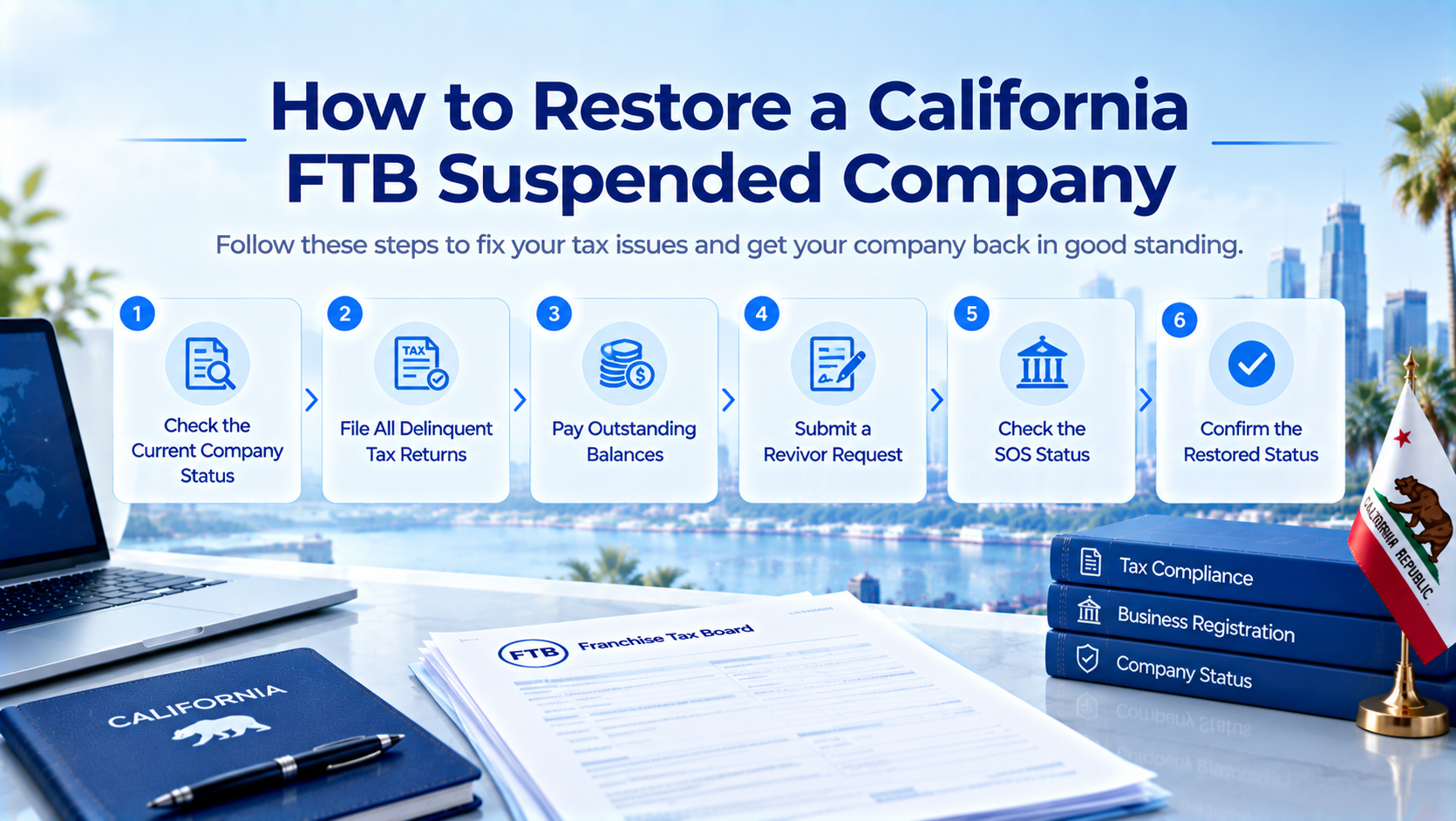
To revive an eligible suspended or forfeited business, the company generally needs to:
- Check the current company status
First, confirm whether the company is FTB Suspended, SOS Suspended, or suspended by both agencies. You should also identify which tax returns and payments remain outstanding. - File all delinquent tax returns
The company must generally file all past-due tax returns required by the FTB. This step is important even when the company had limited business activity, because filing requirements depend on the entity and tax circumstances. - Pay outstanding balances
Next, the company must generally pay its past-due tax balances, including applicable penalties, fees, and interest. The FTB states that these amounts form part of the requirements for revivor. - Submit a revivor request
After addressing the outstanding tax issues, the company must submit the applicable revivor request. For example, corporations generally use Form FTB 3557 BC, while LLCs generally use Form FTB 3557 LLC. The FTB also provides an online revivor process. - Check the SOS status
The company must also be in good standing with the Secretary of State to complete the revivor process. If the company has a separate SOS compliance problem, that issue may need to be resolved as well. - Confirm the restored status
Once the revivor process is completed, check the company's status again through the California business records. This helps confirm that the entity has returned to good standing before it resumes important corporate activities.
What Documents May Be Needed?
The exact documents depend on the entity type and the reason for suspension. However, the restoration process may involve:
- Past-due California tax returns
- Evidence of tax payments
- Applicable penalties, fees, and interest payments
- Certificate of Revivor application
- Corporate information and authorization documents
- Statement of Information or other SOS filings, if required
The FTB currently lists separate revivor forms for corporations and LLCs. Therefore, business owners should confirm the correct form before submitting their application.
California FTB Suspended: Important Points for International Owners
For non-U.S. business owners, the main challenge is often not the filing itself but identifying every outstanding requirement.
For example, an overseas owner may have formed a California company but later stopped monitoring U.S. tax notices. The company could then accumulate unpaid balances or missing returns without the owner realizing that its status has changed.
Therefore, before paying a random amount or submitting only one missing return, check the company's complete FTB account and SOS record. This approach can help identify the full compliance problem before starting the restoration process.
If you manage several U.S. companies from overseas, IngStart can also provide company registration, tax-related services, banking support, and ongoing compliance assistance. Centralizing these administrative tasks can make it easier to track state obligations and respond to compliance issues.
California FTB Suspended: How to Avoid Future Problems
After restoring the company, business owners should avoid returning to the same situation.
A simple compliance routine can include:
- Track California tax filing deadlines.
- Monitor FTB and SOS correspondence.
- Keep the company's mailing and contact information updated.
- Check annual tax and filing obligations based on the entity type.
- Pay required taxes and fees before their deadlines.
- Review the company's status periodically.
For international businesses, maintaining a clear U.S. compliance calendar is especially useful. It can reduce the risk of missing a state tax deadline simply because the owner operates outside the United States.
Conclusion
A California FTB Suspended status can seriously affect a company's ability to operate in California. However, it is not the same as a voluntary dissolution, and eligible businesses can generally seek restoration through the FTB revivor process.
The basic process is to identify the reason for suspension, file all required delinquent returns, pay outstanding balances and applicable penalties or interest, submit the appropriate revivor request, and resolve any separate SOS issues.
For international business owners, acting quickly is important. The longer a suspension remains unresolved, the more difficult it can become to manage tax, banking, financing, and corporate compliance matters. In addition, California can administratively terminate certain entities after prolonged FTB suspension, so owners should not treat a suspended status as a minor administrative issue.
Article Recommendations
- U.S. California Company Registration: Complete Guide for LLC & C Corp
- LLC Tax Classification: Understanding the Main U.S. Tax Options
- US Company Annual Report: What Happens If You File Late?
If you still have questions, please contact our team on WhatsApp at +1 213 751 2111. We'll help you find the right solution for your business and keep your company compliant as it grows.