

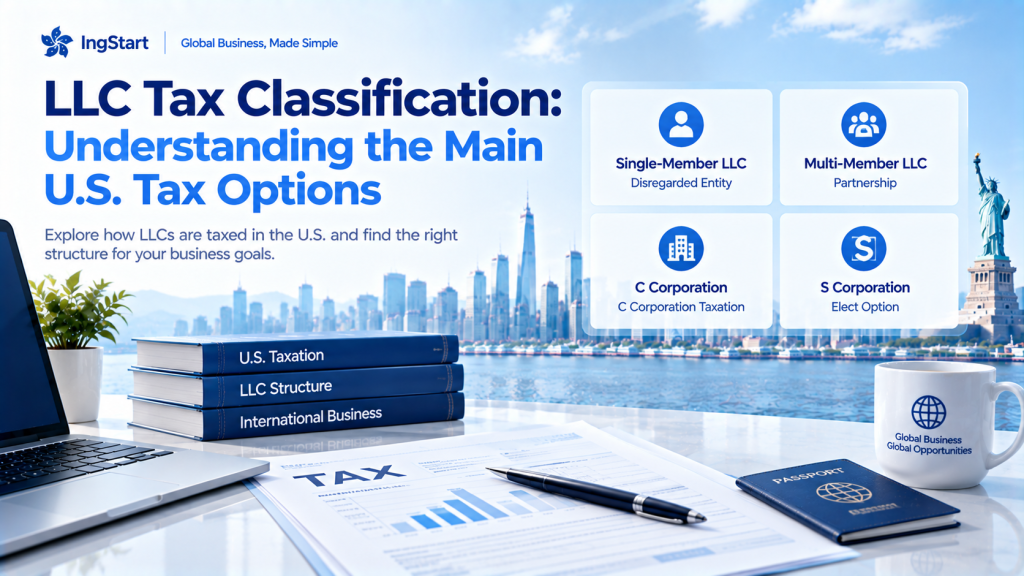
When forming a U.S. LLC, many international business owners first consider the state, registration process, and annual costs. However, another important question soon comes up: which LLC Tax Classification should the company use for U.S. federal tax purposes?
Unlike a corporation, an LLC does not have one fixed federal tax classification. Instead, the IRS generally uses the number of members and any tax election to determine its classification. A domestic LLC with one member generally defaults to a disregarded entity. A domestic LLC with two or more members generally defaults to a partnership. An LLC can also elect corporate tax treatment.
This choice affects how the business reports income and how profits reach the owners. It can also affect federal tax and withholding obligations. These issues become especially important for international owners. Most importantly, a tax classification does not change the LLC's legal form under state law. The company remains an LLC under state law, even if it chooses corporate tax treatment.
What Is LLC Tax Classification?
LLC Tax Classification describes how the IRS treats an LLC for federal tax purposes.
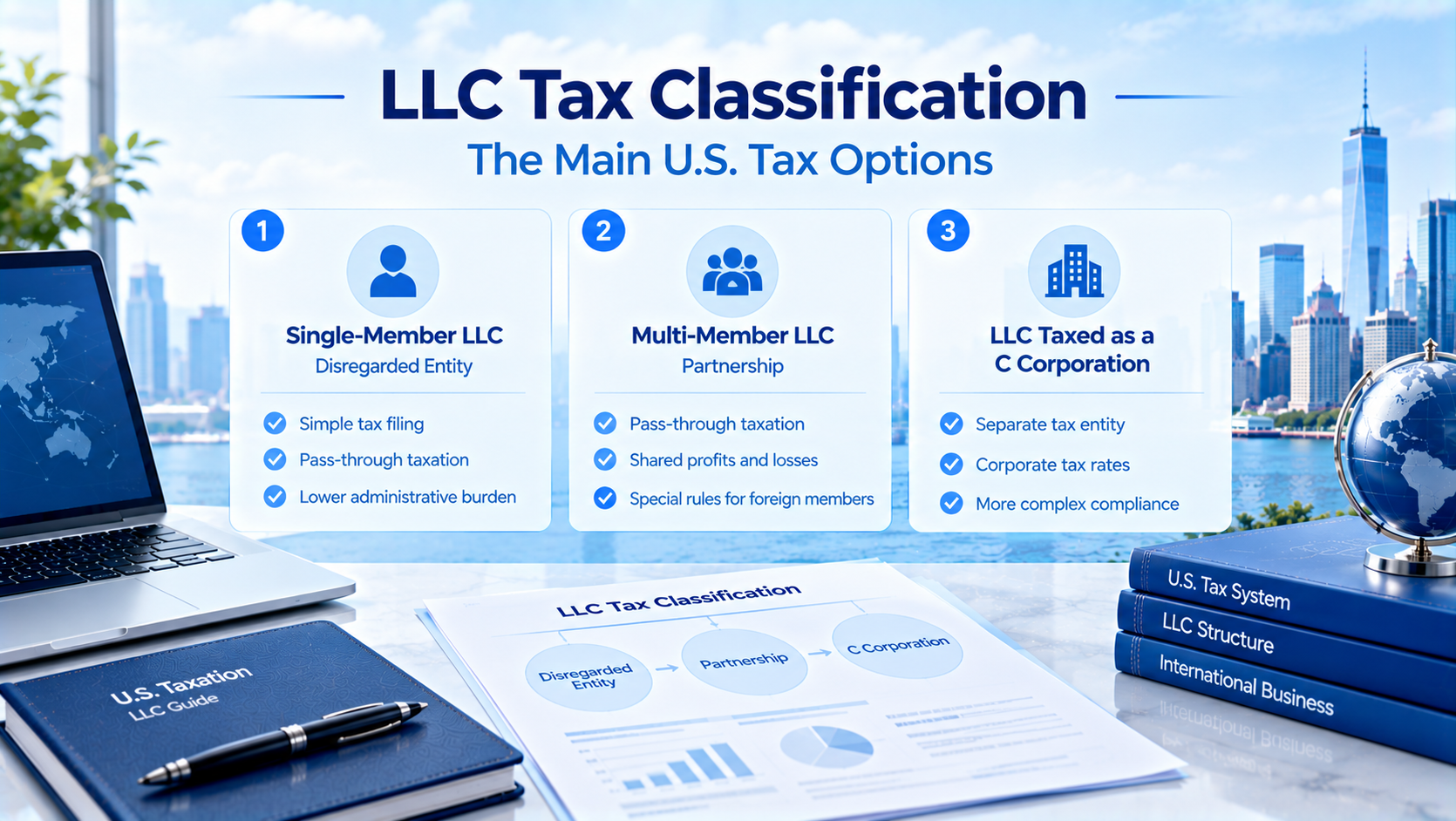
For a domestic LLC, the main structures in this guide are:
- Single-Member LLC – Disregarded Entity
- Multi-Member LLC – Partnership
- LLC Taxed as a C Corporation
The default classification mainly depends on the number of members. However, an eligible LLC can elect a different federal tax classification. Several factors may affect the decision. These include ownership, business activities, expected profits, distributions, reinvestment plans, and the owners' tax status. For that reason, business owners should look beyond the LLC's state of registration when choosing a tax classification.

1. Single-Member LLC: Disregarded Entity
A Single-Member LLC generally uses Disregarded Entity status by default. This applies when the owner does not elect corporate tax treatment.
For federal income tax purposes, the IRS generally does not treat the LLC as separate from its owner. Instead, the owner reports the LLC's activities on the applicable federal tax return. This is one of the most common forms of LLC Tax Classification for businesses with one owner.
How Does a Disregarded Entity File Taxes?
An individual owner generally reports the LLC's income and expenses on their federal tax return. The LLC usually does not file a separate federal income tax return for its business income. However, this does not mean that the LLC has no U.S. reporting duties. Foreign-owned single-member LLCs may have additional federal information-reporting requirements. The exact requirements depend on the ownership structure and transactions.
State rules can also differ. For example, a California LLC may still need to file California Form 568 and meet applicable California tax requirements. As a result, international owners should review both federal and state rules. Federal disregarded-entity treatment does not remove every filing obligation.
Advantages and Potential Issues
This LLC Tax Classification offers a relatively simple federal income tax structure. Business income generally flows to the owner instead of facing a separate corporate income tax. However, higher profits can increase the owner's taxable income. Foreign owners may also face additional U.S. tax and reporting rules. The exact treatment depends on the LLC's income and business activities.
2. Multi-Member LLC: Partnership
A domestic LLC with two or more members generally defaults to Partnership treatment. This applies when the LLC does not elect another classification. This is another common LLC Tax Classification for businesses with multiple owners. It can also apply to family businesses, joint ventures, and investment structures.
How Does Partnership Taxation Work?
A partnership generally files Form 1065, U.S. Return of Partnership Income. The form reports the company's income, deductions, gains, losses, and other tax information. The LLC generally does not pay federal income tax as a separate entity in the same way as a C corporation. Instead, tax items flow through to the members.
Each member generally receives a Schedule K-1. The K-1 reports that member's share of relevant income, deductions, credits, and other tax items. Members then use their K-1 information when preparing their own tax returns. The partnership return shows the company's overall results, while each K-1 shows the amount allocated to the relevant member.
Important Rules for Foreign Members
International owners need to pay close attention to partnership withholding rules. If a partnership has foreign members and earns income effectively connected with a U.S. trade or business, IRC Section 1446 may apply. The partnership may need to withhold tax on effectively connected taxable income allocated to foreign partners.
This rule can apply even when the foreign partner does not receive a cash distribution during the tax year. Therefore, a foreign-owned multi-member LLC requires more than a simple pass-through analysis. Owners should review U.S. withholding and filing requirements before choosing this LLC Tax Classification.
3. LLC Taxed as a C Corporation
An LLC can also elect to receive corporate tax treatment for federal purposes. An eligible LLC generally makes this election by filing Form 8832, Entity Classification Election. After the election takes effect, the LLC generally follows corporate tax rules and files Form 1120, U.S. Corporation Income Tax Return. This creates a different LLC Tax Classification from the default disregarded-entity or partnership treatment.
How Does C Corporation Taxation Work?
With C corporation treatment, the company becomes a separate federal income taxpayer. For tax years beginning after December 31, 2017, the federal corporate income tax rate is generally 21%. The company pays tax on its taxable income. If it later distributes after-tax profits as dividends, the shareholders may also owe tax on those dividends. This is commonly known as double taxation.
For example:
Company profit → Corporate income tax → After-tax profit → Dividend to shareholder → Possible shareholder-level tax
State taxes follow separate rules. For example, a California LLC that chooses corporate tax treatment may have different California filing requirements from an LLC that keeps its default federal classification.
Potential Advantages and Disadvantages
C corporation treatment may suit businesses that plan to keep profits in the company for reinvestment. It may also fit some companies that expect to seek outside investment. However, this structure can create additional tax and compliance work. Business owners should also consider the tax cost of future dividend payments. Therefore, a high profit level alone does not mean that C corporation treatment will produce a lower overall tax burden.
Can an LLC Elect S Corporation Status?
An eligible LLC can also elect S Corporation status by filing Form 2553. However, international owners need to understand the eligibility rules. The IRS does not allow an S corporation to have nonresident alien shareholders. Therefore, an LLC owned by a nonresident alien generally cannot elect S corporation status. S corporation treatment can therefore matter for some U.S.-owned businesses. However, it generally does not provide an option for an LLC owned by a nonresident alien.
LLC Tax Classification: How to Choose the Right Structure
After reviewing the main options, many business owners ask which LLC Tax Classification fits their situation. There is no universal answer. The appropriate structure depends on ownership, business activities, profit levels, distributions, and long-term plans.
Default Single-Member or Partnership Treatment
Default treatment may suit businesses that want a relatively straightforward federal tax structure. For instance, a business may choose to keep its default classification when profits will flow through to the owners. This approach may also make sense when the company has no specific reason to create a separate corporate tax structure. International owners should still review U.S. withholding, reporting, and tax-residency issues before making the decision.
C Corporation Treatment
C corporation treatment may suit a company that plans to retain significant profits for reinvestment. It may also fit a business that expects to pursue certain forms of external investment. Still, the federal corporate tax rate should not drive the decision by itself. Owners should also review dividend taxation, state taxes, compliance costs, ownership structure, and future business plans. The same profit level can lead to different tax results. The outcome depends on how the company earns, retains, and distributes its income.
LLC Tax Classification and International Business Owners
For non-U.S. entrepreneurs, choosing an LLC Tax Classification can involve additional issues. U.S. federal tax rules may interact with the owner's country of residence and the company's business activities.
A foreign owner may need to consider:
- The LLC's U.S. trade or business activities
- The connection between its income and the United States
- Applicable U.S. withholding requirements
- The owner's need for an SSN or ITIN
- Additional information returns that may be required
- State-level tax rules that may apply
- Relevant tax treaty provisions and their effect on the final tax position
For a foreign-owned partnership with U.S. effectively connected income, Section 1446 withholding may apply to the foreign owner's share of taxable income. As a result, international entrepreneurs should review the complete tax structure. The number of LLC members alone does not determine the best option.
For entrepreneurs setting up a U.S. company from overseas, IngStart provides U.S. company registration and related business services. These services include tax-related support, banking assistance, and ongoing compliance services. Organizing ownership and tax information early can also make later compliance work easier.
LLC Tax Classification: Important Election Rules
An LLC that wants to change its default federal tax classification may need to file an election with the IRS. For example, an LLC choosing C corporation treatment generally uses Form 8832. The election has specific timing rules. The effective date generally cannot be more than 75 days before the filing date or more than 12 months after that date.
The timing of later changes also matters. In general, an LLC that changes its classification by election cannot make another classification election for 60 months, subject to certain exceptions. Therefore, owners should not treat a tax election as a short-term choice for one tax year.
Conclusion
LLC Tax Classification determines how the IRS treats an LLC for federal tax purposes. A single-member LLC generally defaults to Disregarded Entity treatment. A domestic multi-member LLC generally defaults to Partnership treatment. An eligible LLC can also elect C Corporation treatment. S Corporation treatment is available only when the LLC and its shareholders meet the required eligibility rules.
For international business owners, one point is especially important: tax classification does not change the LLC's legal status under state law. Instead, it changes how the IRS treats the business for federal tax purposes.
Before choosing an LLC Tax Classification, owners should review their ownership, U.S. business activities, expected profits, distributions, state taxes, withholding, reporting duties, and long-term plans. For complex cross-border structures, professional U.S. tax advice can also help reduce the risk of costly mistakes.
Article Recommendations
- US Tax Forms Guide: Complete List of Common IRS Tax Forms
- W-7 Form Guide for ITIN Applications: How to Apply for or Renew an ITIN
- SSN EIN ITIN Difference: Do You Need an SSN, EIN, or ITIN?
If you still have questions, please contact our team on WhatsApp at +1 213 751 2111. We'll help you find the right solution for your business and keep your company compliant as it grows.