
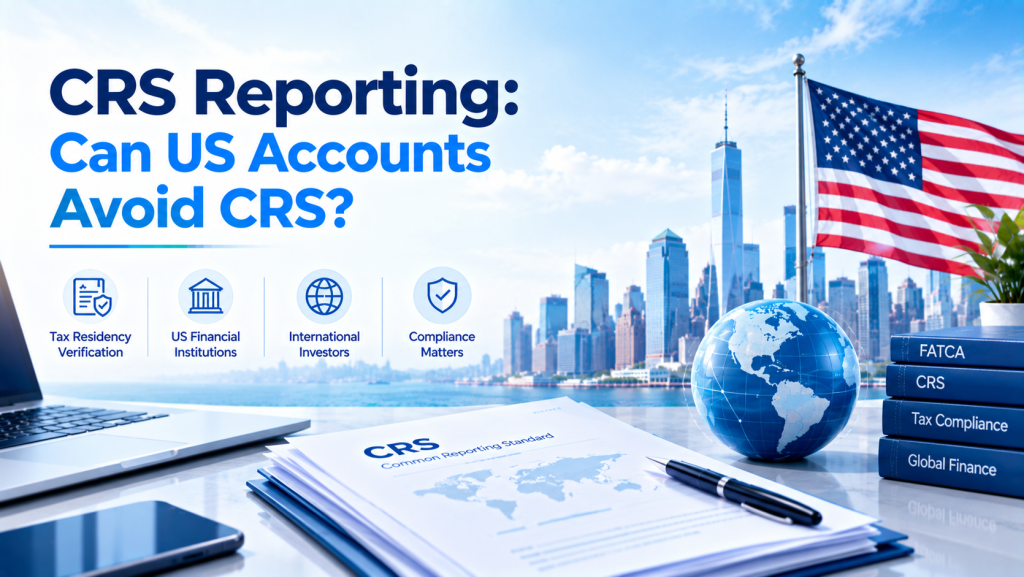
CRS Reporting is an important issue for international investors and business owners who hold financial accounts in different countries. One common question is whether opening an account in the United States can keep an account outside the CRS reporting system.
The answer requires a clear distinction between CRS Reporting, FATCA, tax residency, and financial institution due diligence. The United States follows FATCA rather than the OECD's CRS framework. However, this does not mean that U.S. banks and brokers ignore tax residency or customer information.

Therefore, opening a U.S. account should not be treated as a general solution for avoiding tax information reporting.
CRS Reporting and Tax Residency Verification
Consider a common situation involving an international investment account. A client may live in Hong Kong and use a Hong Kong residential or business address. However, the client may declare another jurisdiction, such as the British Virgin Islands (BVI), as their tax residence.
When the address and declared tax residence do not match, a financial institution may request additional information or an explanation. This is not unusual. Financial institutions need to understand where their customers are tax residents because tax residency can determine reporting and withholding obligations.
For example, Interactive Brokers states that customers must provide information about their primary tax residency. Its application process also collects residential address, tax residency country, and tax identification information. Therefore, the key issue is not simply where the account is opened. Instead, the financial institution needs to establish whether the customer's tax information is consistent and properly documented.
Does a US Account Avoid CRS?
The United States and the CRS system should be understood separately. The Common Reporting Standard (CRS) was developed by the OECD. Under the CRS framework, participating jurisdictions obtain financial account information from local financial institutions and exchange relevant information with other jurisdictions on an annual basis.
The United States uses a different framework called FATCA, or the Foreign Account Tax Compliance Act. FATCA focuses primarily on identifying and reporting certain accounts and assets connected to U.S. taxpayers. Foreign financial institutions may have reporting obligations to the IRS under FATCA.
As a result, these two systems should not be treated as the same thing. A U.S. account may not sit within the OECD CRS exchange framework in the same way as an account in a CRS-participating jurisdiction. However, this does not mean that the account is outside all tax reporting, KYC, or compliance requirements.
In simple terms:
- CRS and FATCA are different reporting frameworks.
- The United States uses FATCA rather than the OECD CRS framework.
- U.S. financial institutions still collect tax and identity information.
- Financial institutions may have reporting and withholding obligations.
- Tax residency remains important when opening and maintaining an account.
Therefore, CRS Reporting should not be confused with overall financial account compliance.
Why US Brokers Still Ask About Tax Residency
A common misunderstanding is that a U.S.-based broker will not ask about tax residency because the United States does not use CRS. In practice, this assumption is too broad. Interactive Brokers states that tax residency determines where it must report tax information and when tax withholding may apply. It also requires non-U.S. persons and entities to complete the appropriate IRS Form W-8 when they open an account.
Its account application materials also request information such as residential address, tax residency, tax identification number, source of funds, and other customer information. This means that an international customer may still need to explain an unusual combination of residence, address, citizenship, and tax residency. For example, if a customer lives in one jurisdiction but claims tax residence in another, the financial institution may need additional information to understand the situation. The important point is that tax residency verification comes before any question about whether information is exchanged under CRS.
CRS Reporting and US Financial Institutions
International investors should also understand that a U.S. financial institution may operate across several regulatory systems. A large financial group may have entities, branches, or regulated operations in different jurisdictions. Each entity can have different legal and reporting obligations.
Interactive Brokers, for example, states that it operates in multiple jurisdictions and must comply with U.S. and other countries' laws relating to withholding and reporting. This creates an important distinction.
Opening an account with a U.S. entity does not necessarily mean that every interaction with the financial group follows only U.S. rules. The specific entity providing the service, the customer's residence, and the account structure can all matter. Therefore, international investors should look at the actual account provider and applicable legal requirements rather than relying only on the location of the brand's headquarters.
What Changes for International Investors?
The development of global tax transparency has changed how financial institutions approach customer information.
In the past, some investors focused heavily on finding a jurisdiction with fewer information exchanges. Today, financial institutions place much greater emphasis on whether customer information is complete and consistent.
For example, the following information may need to make sense together:
- Residential address
- Tax residence
- Tax identification number
- Citizenship
- Source of funds
- Account ownership
- Beneficial ownership
- Business activities
A mismatch does not automatically mean that a customer has done anything wrong. However, it may lead to additional questions or documentation requests.
This is why international investors should focus on having a consistent and supportable tax profile, rather than simply looking for a jurisdiction that is outside one particular reporting framework.
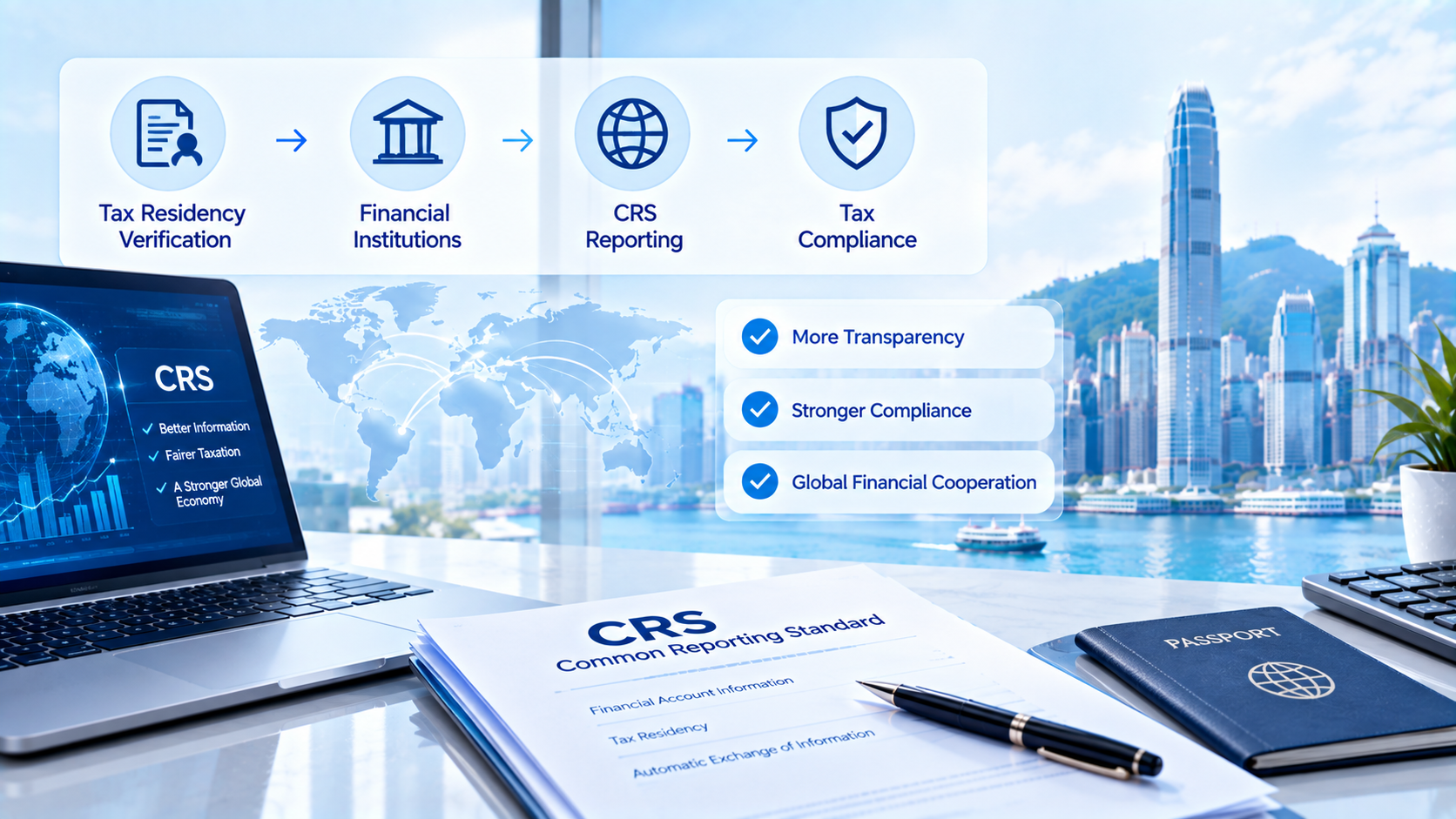
Compliance Is More Important Than Account Location
The key lesson is that financial account planning cannot rely only on account location.
A U.S. account may follow a different information-reporting framework from an account in a CRS jurisdiction. However, FATCA, KYC, anti-money laundering rules, tax forms, and other regulatory requirements can still apply.
Moreover, the IRS requires certain U.S. financial institutions and withholding agents to follow specific rules when they deal with foreign persons and entities. The applicable requirements can include documentation, withholding, and reporting obligations.
Therefore, an account outside the CRS network should not automatically be described as an account with no reporting requirements.
Building a Sustainable International Structure
For international entrepreneurs and investors, the goal should not simply be to find a financial institution that asks fewer questions. Instead, a sustainable structure should use information that the business or investor can clearly explain and support.
The following areas are particularly important:
- Tax residency should match the individual's or entity's actual position.
- Residential and business addresses should remain accurate.
- The owner should properly document the source of funds.
- Beneficial ownership should remain clear.
- Tax forms should contain consistent information.
- Corporate structures should have a genuine business purpose.
- Banking and investment arrangements should match the actual business or investment activities.
This approach can make account opening and future compliance reviews more manageable.
For international entrepreneurs who need help coordinating company registration, banking, tax-related services, and ongoing compliance, IngStart provides integrated support for international businesses. Its services can help organize corporate information and manage related administrative requirements across different jurisdictions.
Conclusion
CRS Reporting and FATCA are different systems, but neither should be confused with the broader compliance requirements of international financial institutions.
The United States does not simply operate as a place where international investors can ignore tax residency, KYC, or reporting requirements. U.S. financial institutions still collect tax information and may have obligations under FATCA and other applicable rules.
Therefore, opening a U.S. account should not be viewed as an automatic way to avoid tax information reporting. For international investors, the more sustainable approach is to ensure that tax residency, addresses, ownership, source of funds, and account information remain accurate and consistent.
Ultimately, the important question is not only where the account is located, but also whether the overall financial and tax structure can be properly explained and supported.
Article Recommendations
- Hong Kong CRS: Dual Tax Residency and Bank Account Guide
- BVI Tax Residency: Beneficial Owner CRS Guide
- BVI ROBO: Beneficial Ownership Guide for International Business Owners
If you still have questions, please contact our team on WhatsApp at +1 213 751 2111. We'll help you find the right solution for your business and keep your company compliant as it grows.