
Hong Kong is a major international trading and financial center. Its location, logistics network, and business environment make it attractive for companies engaged in cross-border e-commerce. Hong Kong E-commerce can help international businesses manage sourcing, shipping, payments, and sales across different markets.
For business owners outside the United States, a Hong Kong company can also serve as a trading and logistics hub between Asian suppliers and overseas customers. Therefore, this guide explains the main advantages of Hong Kong E-commerce and how a Hong Kong company can be used in a cross-border e-commerce business.
Hong Kong E-commerce: Main Advantages
A Hong Kong company can support cross-border e-commerce in several ways. In particular, its location and international business environment can help companies manage products, payments, and overseas transactions more efficiently.
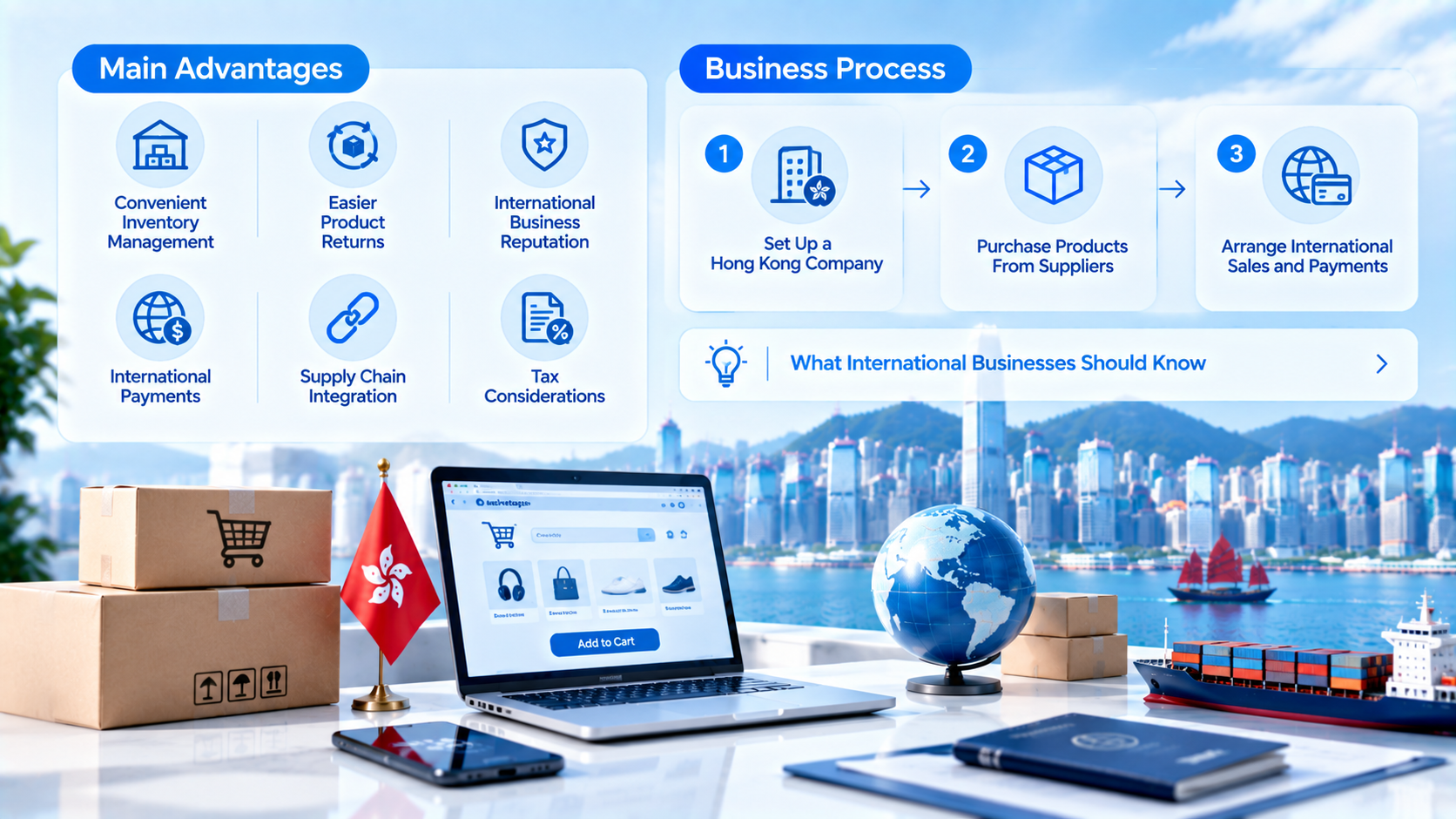
Hong Kong E-commerce: Convenient Inventory Management
Hong Kong is a free port with an international logistics network. In general, most goods entering or leaving Hong Kong are not subject to customs tariffs, although certain goods can be subject to specific duties or controls.
This can make Hong Kong useful for businesses that need to move products between Asian suppliers and overseas markets. Its proximity to major manufacturing and logistics centers in southern China can also make inventory planning more convenient.
As a result, Hong Kong E-commerce businesses can use Hong Kong as a regional logistics and distribution point while maintaining access to international shipping routes.

Hong Kong E-commerce: Easier Product Returns
Returns are a common issue in cross-border e-commerce. Sending a returned product back to its original country can increase shipping time and costs.
For this reason, some businesses use Hong Kong as a return and consolidation location. Overseas customers can return products to a Hong Kong logistics facility, while suppliers can send replacement products to the same location.
This approach can make the return process easier to manage, especially when a business serves customers in several markets.
Hong Kong E-commerce: International Business Reputation
Hong Kong has a strong international business presence. Companies from different countries are familiar with Hong Kong as a global trading and financial center.
Therefore, using a Hong Kong company can provide an internationally recognizable corporate structure when working with overseas suppliers, service providers, and business partners.
However, a Hong Kong registration does not automatically guarantee trust or business opportunities. Companies should still build a reliable business profile and maintain proper corporate records.
Hong Kong E-commerce: International Payments
Cross-border e-commerce businesses often need to receive and make payments in different currencies. Hong Kong's international banking system supports a wide range of cross-border financial activities.
Businesses can use suitable corporate bank accounts to receive customer payments and pay suppliers or service providers. Foreign currency transactions and exchange services can also help companies manage international payments.
However, banking access and transaction services depend on the bank, account type, business activities, and compliance requirements. Companies should therefore confirm the applicable banking conditions before starting operations.
Hong Kong E-commerce: Supply Chain Integration
Another advantage of Hong Kong E-commerce is the ability to connect suppliers, logistics providers, warehouses, and overseas customers.
A business can use Hong Kong as a regional trading or distribution point. Products can then be consolidated, stored, and shipped according to customer orders.
This structure can make inventory management easier. It may also help businesses coordinate different parts of the supply chain and control logistics costs.
Hong Kong E-commerce: Tax Considerations
Hong Kong has a relatively simple tax system compared with many other international business locations. Its main direct taxes include Profits Tax and Salaries Tax.
Hong Kong also does not generally impose customs tariffs on ordinary imports and exports because it operates as a free port. However, certain goods may be subject to duties or specific regulatory requirements.
At the same time, companies should not assume that using a Hong Kong company automatically eliminates tax obligations in other countries. Tax treatment can depend on where the business is managed, where sales take place, and where income is sourced.
Therefore, international e-commerce businesses should review both Hong Kong tax rules and the tax requirements of their target markets.
Hong Kong E-commerce: Business Process
Using a Hong Kong company for cross-border e-commerce usually involves several stages. The exact structure depends on the products, suppliers, customers, logistics arrangements, and payment channels.
Step 1: Set Up a Hong Kong Company
The first step is to establish a Hong Kong company that can conduct the intended trading activities.
After incorporation, the company can enter into commercial agreements with suppliers and overseas customers. It can also apply for suitable business banking and payment services based on its business model.
For international entrepreneurs, IngStart provides Hong Kong company registration and related business services. These services can help business owners manage company registration, banking support, tax matters, and ongoing compliance from one platform.
Step 2: Purchase Products From Suppliers
Next, the Hong Kong company can purchase products from manufacturers or suppliers.
For example, the company may sign a purchase agreement with an overseas or Asian supplier. The supplier then prepares the goods according to the agreed terms and shipping arrangements.
Depending on the transaction structure, the goods may be shipped to Hong Kong first or sent directly to the target market. The company should keep contracts, invoices, shipping documents, and payment records for its business and tax records.
Step 3: Arrange International Sales and Payments
Once the products reach the target market, overseas customers can complete their purchases through the company's e-commerce channels.
The business then receives payments through its selected payment provider or corporate bank account. The company can use its funds to pay suppliers, logistics providers, and other business expenses.
After covering the relevant costs, the remaining amount represents the company's business income, subject to the applicable tax and accounting rules.
Hong Kong E-commerce: What International Businesses Should Know
Hong Kong E-commerce can provide a practical structure for businesses that need to connect Asian suppliers with international customers. Its location, logistics network, international banking environment, and free-port status can support different parts of a cross-border e-commerce operation.
However, setting up a Hong Kong company is only one part of the process. Businesses should also consider product regulations, payment services, customs requirements, tax obligations, and the rules of their target markets.
With proper planning, a Hong Kong company can serve as a useful trading, logistics, and payment hub for international e-commerce operations.
Article Recommendations
- Hong Kong Company Registration Guide 2026: Steps and Requirements for Global Entrepreneurs
- How to Open a US Company Bank Account in Hong Kong in 2026
- Hong Kong Company Tax Guide 2026: Rates, Filing Process & Requirements
If you still have questions, please contact our team on WhatsApp at +1 213 751 2111. We'll help you find the right solution for your business and keep your company compliant as it grows.