
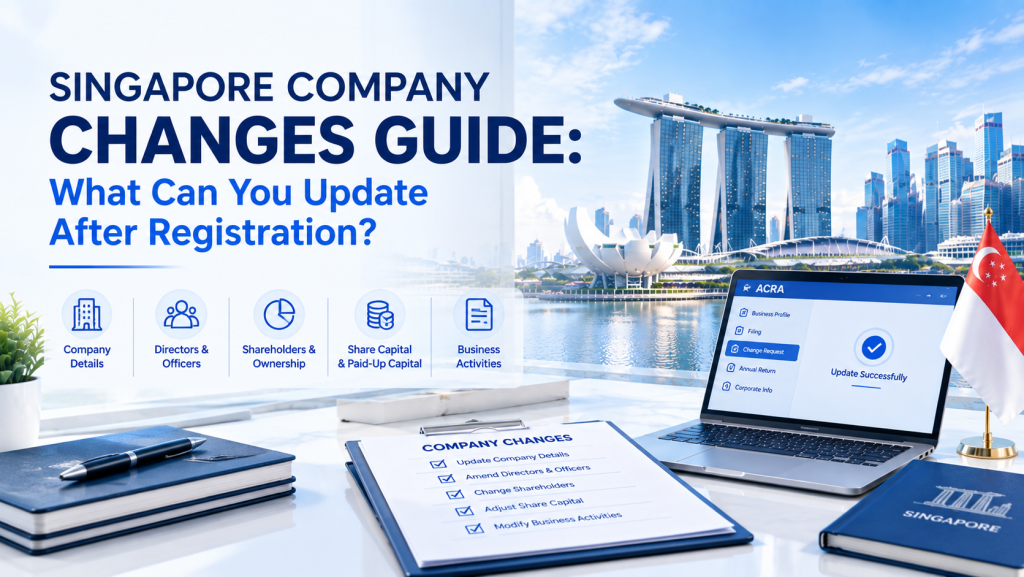
Singapore Company Changes allow businesses to update important corporate information after incorporation. A company may need to change its name, registered address, financial year end, business activities, directors, shareholders, share ownership, or paid-up capital as its business develops.
For international entrepreneurs, knowing which information can change and which authority to notify is essential for maintaining a compliant Singapore company. Depending on the type of update, the company may need to file with the Accounting and Corporate Regulatory Authority (ACRA), notify the Inland Revenue Authority of Singapore (IRAS), or complete additional procedures such as stamp duty requirements.
In 2026, many corporate updates can be handled online through Bizfile or my Tax Portal. However, each type of update has its own requirements and deadlines.
What Singapore Company Changes Can You Make?
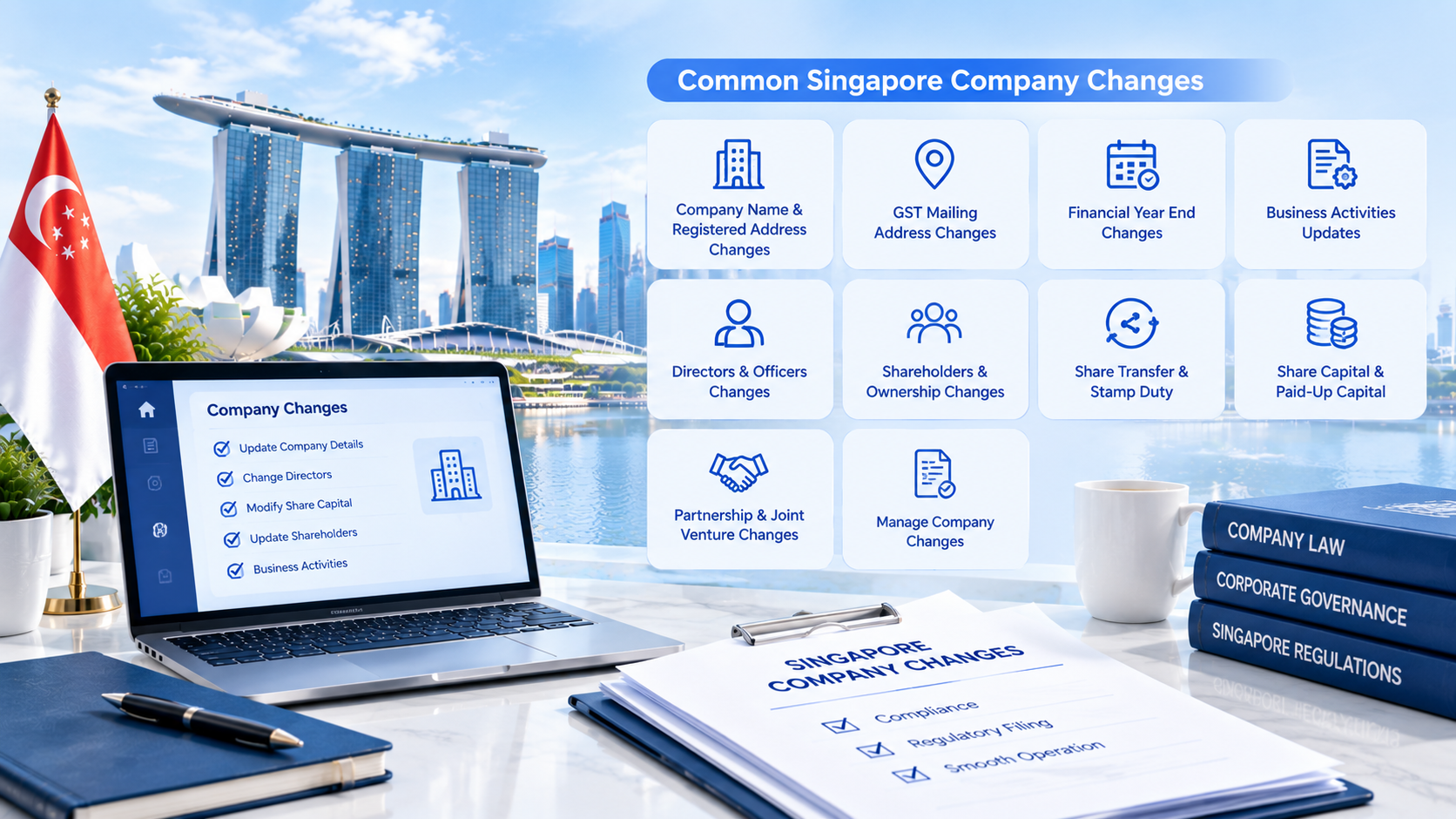
After incorporation, a Singapore company can make various changes to its corporate information and ownership structure. Common updates include:
- Company name and registered address
- Financial year end
- Business activities
- Directors and company officers
- Shareholders and share ownership
- Share capital
- Partnership or joint venture details
- GST mailing address
Not every change follows the same procedure. Therefore, business owners should first identify the type of update and then check whether ACRA, IRAS, or another authority needs to be involved.
Company Name and Registered Address Changes
A company can change its registered name or registered office address after incorporation. The company should update these details with ACRA through Bizfile.
When a company changes its name or registered office address, it generally does not need to notify IRAS separately. IRAS can update its records based on information submitted to ACRA. If the company needs to update tax correspondence details for a specific reason, it can contact IRAS through myTax Mail.
For international business owners, keeping the registered address accurate is especially important because government agencies and other parties may use it for official correspondence.

GST Mailing Address Changes
A GST-registered business can use a separate mailing address for GST-related correspondence. An authorised person can update this information through myTax Portal by selecting the relevant contact details update service.
However, businesses cannot use a P.O. Box or a foreign address as their GST mailing address. This address is different from the company's registered office address, so businesses should make sure they update the correct record.
Financial Year End Changes for Singapore Companies
A company may decide to change its financial year end (FYE) because of changes in its accounting arrangements, business operations, or group structure.
Companies should update their FYE through Bizfile. ACRA allows companies to change their current or immediate previous FYE in certain circumstances. However, specific conditions apply. For example, a company generally cannot change its FYE if it has already missed the deadline for its AGM, annual return, or financial statements.
Some changes require ACRA's approval. This can apply when the new financial year would exceed 18 months or when a company wants to change its FYE again within five years after a previous change.
Informing IRAS About Financial Year End Changes
Changing the FYE can also affect tax administration. Companies should therefore keep their ACRA information accurate because IRAS uses FYE information for matters such as Estimated Chargeable Income (ECI) filing notifications and corporate income tax administration.
GST-registered businesses should also check whether the change affects their GST accounting arrangements. A change in FYE does not automatically change the GST accounting period. Businesses that want to change their GST accounting period need to submit a separate request to IRAS.
Updating Business Activities After Incorporation
A company's business activities may change as it enters new markets or adjusts its commercial strategy. For example, an international business may expand from consulting into technology services, e-commerce, trading, or other activities.
When the company's principal business activity changes, the business should update its corporate information where required. At the same time, it should check whether the new activity requires a licence or approval.
Updating company information does not automatically give a business permission to conduct a regulated activity. Businesses should therefore review the relevant licensing requirements before starting a new line of business.
Changes to Directors and Company Officers
Changes to directors, company secretaries, and other company officers are also common after incorporation. A company may appoint a new director, remove an existing director, or update other officer information as its management structure changes.
ACRA requires companies to update relevant information about company officers, shareholders, and shares through Bizfile. In general, companies must file these changes within 14 days. Keeping this information current matters for international businesses because banks, investors, commercial partners, and other parties may review ACRA records during their due diligence.
Singapore Company Changes: Shareholders and Ownership
Singapore Company Changes can also involve shareholders and share ownership. Shareholders may transfer their shares for several business reasons, including investment exits, employee share arrangements, fundraising, or changes in the ownership structure.
Common situations include:
- A minority shareholder wants to sell part or all of their investment.
- An employee leaves the company and transfers shares received through an employee share plan.
- A founder sells shares to raise funds or reduce their ownership interest.
- Existing shareholders transfer shares as part of a broader ownership change.
A share transfer involves more than changing a shareholder's name in the company records. The company should review its constitution, obtain the required approvals, prepare the relevant documents, and complete the necessary tax and filing procedures.
Share Transfer Process for Singapore Company Changes
A typical share transfer may involve several steps:
- Review the company's constitution to identify any restrictions on share transfers.
- Prepare the transfer documents, including the relevant instrument of transfer and corporate approvals.
- Obtain the required signatures from the relevant parties.
- Complete stamp duty requirements where applicable.
- Update the company's shareholder and share information with ACRA.
ACRA requires companies to use its Update shares information eService to report share transfers. The company should generally update the relevant information within 14 days. Because a share transfer can involve legal and tax considerations, businesses should seek professional advice when the transaction has a complicated ownership structure.
Share Transfer and Stamp Duty Requirements
Stamp duty is another important consideration when a company transfers shares. For a typical share transfer, the stamp duty rate is 0.2% of the purchase price or the value of the shares transferred, whichever is higher, subject to the applicable rules. For private companies, IRAS may determine the value of transferred shares using the company's net asset value or other applicable valuation methods, depending on the circumstances.
The buyer or transferee generally pays the stamp duty unless the agreement or applicable rules provide otherwise. Where stamp duty applies, the business should complete stamping before lodging the share transfer with ACRA. IRAS provides digital services for share transfer stamping and payment.
Changes to Share Capital and Paid-Up Capital
Companies may also change their share capital as their business develops. For example, a company may issue new shares to investors, increase its paid-up capital, or update the paid-up amount when shareholders complete payment for partially paid shares.
ACRA requires companies to keep their share and shareholder information accurate. When a shareholder fully pays for partially paid shares, for example, the company should update the relevant information and paid-up share capital through Bizfile.
Since changes in share capital can affect ownership percentages and corporate records, companies should complete the relevant approvals and filings carefully.
Partnership and Joint Venture Changes
Some corporate and GST-related changes also apply to partnerships and joint ventures. These businesses may need to notify IRAS when their partners or joint venture members change.
Changes to Partner Details
When the partners of a partnership change, the business may need to update IRAS with the relevant information and supporting documents. For GST-related matters, IRAS provides specific procedures for reporting changes to partnership details. Businesses should submit the required information within the applicable deadline after the change.
Changes to Joint Venture Members
A change in joint venture members may also require notification to IRAS. Depending on the circumstances, the business may need to submit a business details change notification together with supporting documents. These procedures mainly apply to businesses operating through partnerships or joint ventures rather than standard private limited companies.
How to Manage Singapore Company Changes
Managing Singapore Company Changes correctly requires businesses to identify the right authority and filing procedure for each update.
A practical process is to:
- Identify exactly what information has changed.
- Check whether ACRA, IRAS, or both need notification.
- Review the company's constitution and internal approval requirements.
- Prepare the required supporting documents.
- Submit the relevant update through Bizfile or myTax Portal.
- Complete stamp duty requirements for applicable share transfers.
- Keep copies of the updated corporate records.
For international entrepreneurs, handling several changes at the same time can become time-consuming. IngStart provides online company registration and compliance services for overseas business owners, including corporate information management, annual compliance, tax-related services, and other ongoing business support. This can help international entrepreneurs manage their Singapore company requirements more efficiently.
What International Business Owners Should Know About Company Changes
For non-Singapore residents, updating company information can involve more than editing an online record. Some changes require corporate approvals, supporting documents, tax notifications, or additional regulatory checks. For example, changing a registered address is relatively straightforward. In contrast, transferring shares may require a review of the constitution, transfer documents, stamp duty, and ACRA filings.
Similarly, changing the financial year end can affect corporate filing schedules and tax administration. As a result, business owners should consider the wider compliance impact before making major changes.
Final Thoughts on Singapore Company Changes
Singapore Company Changes cover a broad range of updates, from basic company information to important ownership and structural changes. These include the company name, registered address, financial year end, business activities, directors, shareholders, shares, and share capital.
In 2026, companies can handle many key updates through ACRA's Bizfile system, while certain tax-related matters require action through IRAS and myTax Portal. Share transfers also require careful attention to stamp duty and ACRA filing requirements.
For international business owners, the best approach is to identify the exact change, check the applicable deadline, prepare the required documents, and notify the correct authority. With proper planning, Singapore Company Changes can be completed smoothly while keeping the company's information accurate and compliant.
Article Recommendations
- Singapore Company Tax Guide 2026: Rates, Rules & Compliance Requirements
- Singapore Company Annual Filing Guide 2026: Requirements, Documents & Compliance Tips
- Singapore Company Registration Guide 2026: Requirements, Process & Tips for Global Entrepreneurs
If you still have questions, please contact our team on WhatsApp at +1 213 751 2111. We'll help you find the right solution for your business and keep your company compliant as it grows.