
For international entrepreneurs, choosing the right US company type is one of the first decisions to make when starting a business in the United States. Different structures offer different levels of liability protection, tax treatment, management flexibility, and funding options. Therefore, understanding the main US company types can help you choose a structure that better fits your business goals in 2026.
5 Common US Company Types
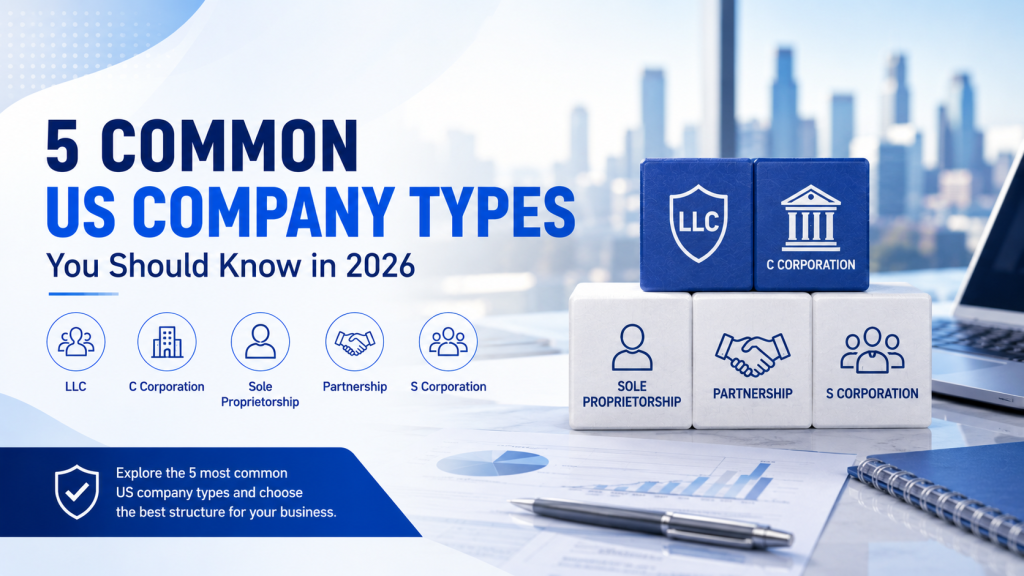
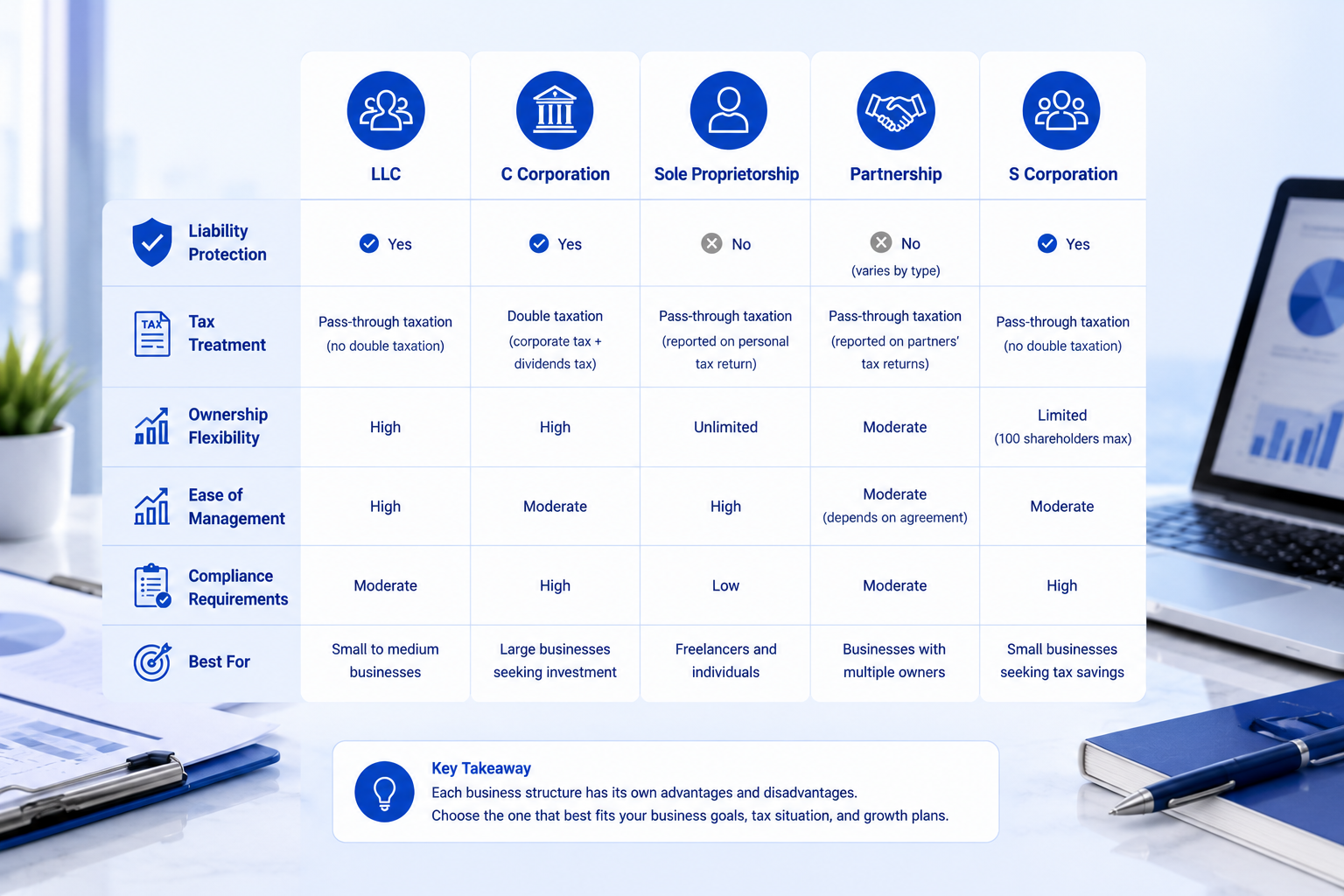
The five common US company types covered in this guide are Limited Liability Company (LLC), C Corporation, Sole Proprietorship, Partnership, and S Corporation. Each structure has its own advantages and limitations, so the best choice depends on your ownership, business activities, tax situation, and long-term plans.
LLC: A Flexible US Company Type
A Limited Liability Company (LLC) is one of the most popular business structures in the United States. It combines the liability protection of a corporation with a relatively flexible management and tax structure.
How an LLC Works
An LLC can have one or multiple members. These members may be individuals or, in many cases, other business entities. The owners generally receive limited liability protection, which helps separate their personal assets from the company's debts and obligations.
An LLC can also hire employees, sign contracts, lease property, and maintain its own business bank account. In addition, its members can establish management and ownership arrangements through an operating agreement.
For tax purposes, an LLC can receive different federal tax classifications depending on its structure and elections. This flexibility makes the LLC a practical choice for many small businesses and international entrepreneurs.

Advantages of an LLC
- Limited liability protection for members
- Flexible management structure
- Relatively simple administration
- Can have one or multiple owners
- Flexible federal tax classification
- Suitable for many small and growing businesses
Disadvantages of an LLC
LLC costs and tax requirements vary by state. For example, some states impose additional annual fees or franchise taxes on LLCs. Depending on how the business operates, owners may also face self-employment taxes or other tax obligations. In addition, certain regulated professions may need to use a professional entity instead of a standard LLC.
Who May Consider an LLC?
An LLC may be suitable for entrepreneurs who:
- Want liability protection
- Prefer a flexible business structure
- Plan to operate a small or medium-sized business
- Want different federal tax classification options
For international entrepreneurs, however, the tax treatment of an LLC can be more complicated than it first appears. Therefore, it is important to review both federal and state requirements before choosing this structure.
C Corporation: A US Company Type for Growth
A C Corporation is a separate legal entity from its shareholders. It can own assets, enter contracts, borrow money, and conduct business independently from its owners.
How a C Corporation Works
A C Corporation generally has shareholders, directors, and officers. Shareholders own the company through shares, while the board of directors oversees major corporate decisions.
One major advantage is that a C Corporation can issue different classes of stock and raise capital from investors. This makes the structure particularly common among businesses that plan to seek outside investment or grow significantly.
Advantages of a C Corporation
- Strong separation between the company and its owners
- Limited liability protection
- No general limit on the number of shareholders
- Easier access to certain forms of outside investment
- Can issue shares and different classes of stock
- Suitable for businesses planning significant growth
Disadvantages of a C Corporation
The main drawback is its potentially more complex tax and compliance structure. A C Corporation generally pays federal corporate income tax on its taxable income. When the company distributes after-tax profits as dividends, shareholders may also pay tax on those dividends, which can result in what is commonly called double taxation.
Corporations also generally involve more formal records, reporting, and administrative requirements than simpler business structures.
Who May Consider a C Corporation?
A C Corporation may be a better fit for businesses that:
- Do not have an SSN or ITIN but need a U.S. business structure
- Plan to raise capital from investors
- Want to retain profits for business expansion
- Expect to scale or potentially pursue an IPO in the future
Sole Proprietorship: A Simple US Company Type
A Sole Proprietorship is one of the simplest ways for an individual to conduct business in the United States. The business and its owner are generally not separate legal entities.
Advantages of a Sole Proprietorship
- Simple to establish
- Low administrative requirements
- The owner receives the business profits
- Easy to close or discontinue
Disadvantages of a Sole Proprietorship
The biggest disadvantage is the lack of a separate legal entity. Because the owner and business are generally treated as one, the owner can have unlimited personal liability for business debts and obligations. It can also be more difficult to raise outside investment or obtain certain types of business financing. In addition, business income may be subject to self-employment tax. For these reasons, a Sole Proprietorship may work for a small, low-risk business, but it may not provide enough protection for businesses with significant liabilities.
Partnership: A US Company Type for Multiple Owners
A Partnership allows two or more people to operate a business together. Partners typically contribute capital, skills, or other resources and share the business's profits and responsibilities.
Advantages of a Partnership
- Relatively easy to establish
- Lower initial costs than many corporate structures
- Multiple partners can contribute capital
- Flexible management arrangements
- Partnership taxation can generally avoid entity-level federal income tax
Disadvantages of a Partnership
Depending on the type of partnership, partners may have significant personal liability for business debts. Therefore, the specific partnership structure matters. Partnerships also require strong communication between owners. Disagreements can slow decision-making, affect daily operations, and make future business planning more difficult. In addition, raising additional capital may become challenging if the partners cannot agree on further investment.
S Corporation: A US Company Type With Pass-Through Taxation
An S Corporation is not a separate state-law entity type in the same way as an LLC or corporation. Instead, it is generally a federal tax election available to eligible corporations and certain LLCs.
Advantages of an S Corporation
An S Corporation generally uses pass-through taxation. Business income and losses can generally pass through to shareholders and be reported on their individual tax returns, which can help avoid corporate-level federal income tax.
Other potential advantages include:
- Limited liability protection
- Pass-through federal tax treatment
- Potential tax planning opportunities for eligible owner-employees
- A formal corporate structure
Disadvantages of an S Corporation
S Corporation status comes with important eligibility restrictions. Generally, an S Corporation cannot have more than 100 shareholders, and shareholders must meet specific eligibility requirements. For example, nonresident aliens generally cannot be S Corporation shareholders.
The company also needs to follow specific tax and corporate compliance rules. As a result, the structure may not work well for international entrepreneurs who want foreign investors or a more flexible ownership structure.
US Company Types: LLC vs. C Corporation
Among the different US company types, LLCs and C Corporations are two of the most commonly considered structures by international entrepreneurs.
| Comparison | LLC | C Corporation |
|---|---|---|
| Legal structure | Flexible business entity | Separate corporate entity |
| Ownership | Members | Shareholders |
| Stock | No traditional corporate stock | Can issue shares |
| Public listing | Cannot directly use the LLC structure for an IPO | Can potentially go public |
| Tax treatment | Flexible, depending on classification | Generally taxed at the corporate level |
| Management | Flexible | More formal structure |
| Investment | Suitable for many small businesses | Often preferred for venture investment |
| Growth potential | Flexible for many businesses | Strong option for high-growth companies |
An LLC generally offers more flexibility and simpler management, while a C Corporation can provide a more suitable structure for businesses seeking substantial outside investment and long-term expansion.
For example, if the goal is to retain profits inside the business and raise venture capital in the future, a C Corporation may be more appropriate. On the other hand, an LLC may be more attractive when flexible management and simpler administration are the main priorities.
How to Choose the Right US Company Type
There is no single best US company type for every entrepreneur. Before registering a company, consider several key factors. First, think about the level of liability protection you need. Next, consider how you want the business to be taxed and whether you plan to distribute or reinvest profits. You should also consider your ownership structure. If you plan to bring in international investors, for example, an S Corporation may not be suitable because of its shareholder eligibility restrictions. Finally, consider your long-term plans. A small online business may have very different needs from a technology startup that plans to raise venture capital.
For international entrepreneurs who are unsure which structure to choose, IngStart provides U.S. company registration and related compliance services. Its online platform can help overseas founders manage company formation and ongoing business requirements more conveniently, making the setup process easier to navigate.
Final Thoughts on US Company Types
Understanding the differences between the major US company types is an important part of starting a business in the United States. An LLC offers flexibility and liability protection, while a C Corporation may better suit businesses seeking investment and rapid growth. A Sole Proprietorship provides simplicity, a Partnership supports multiple owners, and an S Corporation can offer pass-through taxation for eligible businesses.
Before making a final decision, consider your ownership structure, business activities, tax requirements, funding plans, and long-term goals. Choosing the right structure at the beginning can make future U.S. business management and compliance much easier.
Article Recommendations
- US Company Registration Guide: LLC vs LTD, State Selection & Foreign Profit Tax
- US Tax Forms Guide: Complete List of Common IRS Tax Forms
- SSN EIN ITIN Difference: Do You Need an SSN, EIN, or ITIN?
If you still have questions, please contact our team on WhatsApp at +1 213 751 2111. We'll help you find the right solution for your business and keep your company compliant as it grows.