
C-Corp Holding LLC: How to Legally Reduce US Company Taxes
What Is a C-Corp Holding LLC?
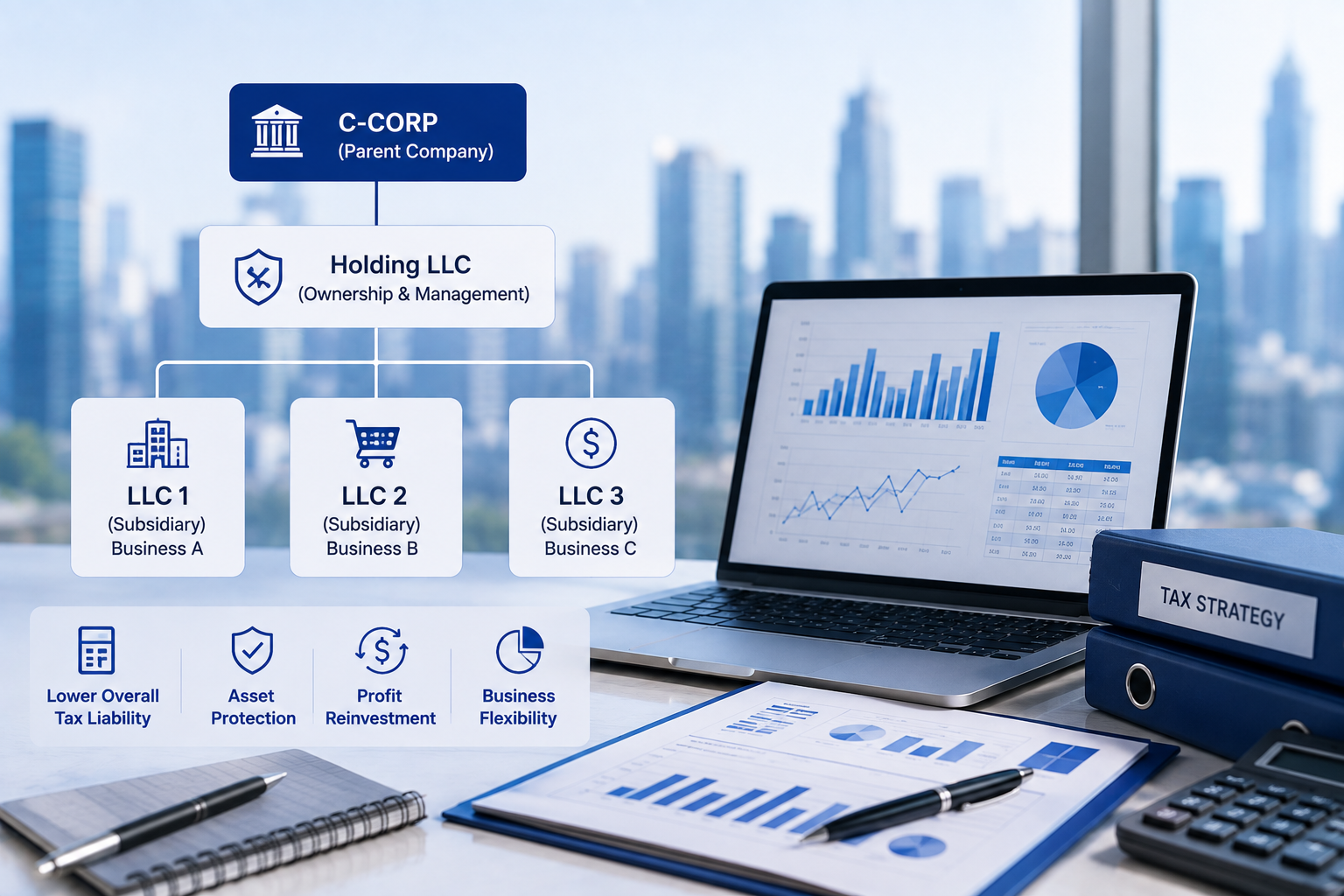
A C-Corp Holding LLC structure combines a US C corporation with one or more LLCs. In this arrangement, the C corporation may hold an ownership interest in an LLC, while the LLC handles specific business activities. Businesses may consider this structure to separate ownership, operations, and different business lines. It can also provide more flexibility when a company plans to reinvest profits, expand operations, or manage several business activities.
However, a C-Corp Holding LLC does not automatically reduce taxes. The actual tax result depends on the company's income, expenses, ownership, business activities, and tax elections. For international entrepreneurs, it is therefore important to understand both the potential benefits and the compliance responsibilities before choosing this structure.
How a C-Corp Holding LLC Structure Works
In a typical C-Corp Holding LLC arrangement, the C corporation serves as the parent or holding company, while the LLC operates a specific business or project.
For example, a business may use the following structure:
- C-Corp: Parent or holding company
- LLC: Operating company
- Business activities: Managed through the LLC
- Ownership: The C-Corp may own the LLC, depending on the structure
This approach can help separate different business activities. At the same time, each entity should maintain its own records, accounts, contracts, and required tax filings.
Different Roles Within a C-Corp Holding LLC
The C corporation and LLC can serve different purposes. The C corporation may focus on ownership, investment, intellectual property, or broader business management. Meanwhile, the LLC may handle daily operations, customer contracts, sales, or specific projects. Therefore, entrepreneurs should clearly define the role of each entity before establishing the structure.
US Company Tax Treatment: C-Corp vs. LLC
Understanding the tax treatment of both entities is essential when considering a C-Corp Holding LLC.
How C-Corp Taxation Works
A C corporation generally pays federal corporate income tax on its taxable income. The current federal corporate income tax rate is 21%. If the corporation distributes after-tax profits to shareholders as dividends, the shareholders may also pay tax on those dividends. This creates what is commonly known as double taxation.
However, a C corporation can generally deduct qualifying business expenses before calculating taxable income. Therefore, businesses that plan to retain and reinvest profits may find the C corporation structure useful in certain circumstances.
How LLC Taxation Works
An LLC does not have one fixed federal tax treatment. For federal tax purposes, a single-member LLC generally receives disregarded-entity treatment unless it elects another classification. A multi-member LLC generally receives partnership treatment unless it elects corporate taxation. The IRS guidance on LLC tax classification explains how an LLC's federal tax classification depends on its ownership and tax election.
As a result, an LLC's profits may pass through to its owners rather than creating a separate corporate income tax at the entity level. The actual tax treatment depends on the LLC's classification, ownership, and tax elections.
How Can a C-Corp Holding LLC Help With Tax Planning?
A C-Corp Holding LLC can support tax planning when a business has a genuine reason to separate ownership, operations, and profit management.
However, businesses should not create multiple entities simply to avoid taxes. Instead, the structure should reflect real business activities and financial plans.
Reinvesting Business Profits
A C corporation may retain profits inside the company instead of distributing them immediately to shareholders. For businesses that need to reinvest earnings into employees, technology, marketing, inventory, or expansion, retaining profits can provide additional flexibility. Nevertheless, the company still needs to calculate and pay applicable corporate taxes.
Separating Different Business Activities
An LLC can operate a specific business line while the C corporation manages broader ownership or investment interests. For example, one entity may handle daily business operations while another manages ownership or investment activities. This separation can make it easier to track the income and expenses of different activities. However, each entity should operate as a genuine separate business.
Managing Legitimate Business Expenses
Companies can generally deduct legitimate and properly documented business expenses under applicable tax rules. A well-organized C-Corp Holding LLC structure can make it easier to identify which entity incurred each expense. However, businesses should not create artificial expenses simply to reduce taxable income. Proper bookkeeping and supporting documentation remain important.

Which Businesses May Benefit From a C-Corp Holding LLC?
Not every business needs a C-Corp Holding LLC. For a small company with simple operations, a single LLC may provide a more practical solution. A holding structure may become more relevant when a business has multiple activities or long-term growth plans.
Businesses Planning Long-Term Growth
Companies that plan to expand, raise investment, or operate several business lines may consider a C-Corp Holding LLC. The structure can provide a framework for separating different activities while keeping ownership centralized.
Businesses With Multiple Projects
Entrepreneurs who operate several projects may use separate LLCs to manage individual activities. For example, one LLC could operate an e-commerce business while another handles a separate consulting or technology project. This arrangement can make it easier to track the financial performance of each business.
Businesses Planning to Reinvest Profits
Companies that expect to retain significant profits for future expansion may also consider a C corporation.
However, founders should compare the potential benefits with corporate taxation, shareholder taxation, and additional compliance costs before choosing this structure.
Legal and Compliance Considerations for a C-Corp Holding LLC
Although a C-Corp Holding LLC can provide flexibility, it also creates additional administrative responsibilities. Each entity should maintain its own legal and financial identity.
Keep Separate Accounts and Records
The C corporation and LLC should maintain separate bank accounts and accounting records. Companies should also document transactions between related entities clearly. In addition, mixing personal and business funds can create unnecessary legal and tax problems.
Maintain Required State Filings
Each company must meet the filing requirements of the state where it operates or registers. Depending on the structure, these requirements may include annual reports, franchise taxes, registered agent services, and other state-level obligations. Therefore, entrepreneurs should review the requirements for every state connected to their business activities.
Meet Federal Tax Requirements
The C corporation and LLC may have different federal tax filing obligations. For example, a C corporation generally files Form 1120. An LLC may have different filing requirements depending on its tax classification and ownership.
International owners may also face additional reporting requirements. As a result, professional tax advice can help determine which forms apply to a particular structure. For international entrepreneurs who need help with US company formation, EIN applications, registered agent services, or ongoing compliance, Ingstart provides support for these business needs. This can help founders manage the formation process more efficiently while preparing for their ongoing responsibilities.
Avoid Using a C-Corp Holding LLC Only for Tax Avoidance
A company should have a genuine business reason for establishing multiple entities. Tax planning can be part of the decision, but the structure should also reflect real ownership, operations, contracts, assets, or investment activities. Creating entities without a legitimate business purpose may increase compliance costs without providing meaningful benefits.
Is a C-Corp Holding LLC Right for Your Business?
There is no single structure that works for every company.
Before establishing a C-Corp Holding LLC, consider:
- Your business activities
- Expected revenue and profit
- Your ownership structure
- The number of business lines you operate
- Whether you plan to reinvest profits
- Your investment plans
- Your US and non-US tax obligations
- State filing and maintenance costs
For a small online business with straightforward operations, one LLC may be enough. In contrast, a growing company with multiple activities, investment plans, or long-term expansion goals may have stronger reasons to consider a C-Corp and LLC combination.
Final Thoughts on C-Corp Holding LLC
A C-Corp Holding LLC can provide a flexible framework for businesses that need to separate ownership, operations, and different business activities. It may also support certain tax-planning strategies, particularly when a company plans to retain and reinvest profits.
However, this structure does not guarantee lower taxes. Businesses must consider federal and state taxes, shareholder taxation, filing requirements, administrative costs, and the tax rules that apply to the owner's home country. Therefore, the best approach is to design the structure around the company's actual business needs first and then evaluate its potential tax benefits. Proper entity management, accurate records, and ongoing compliance are essential for maintaining a C-Corp Holding LLC structure over the long term.
Article Recommendations
- US Tax Refund 2026 Guide: Federal and State Refund Times & Tracking
- US Tax Forms Guide: Complete List of Common IRS Tax Forms
- Can You Set Up a US Foundation? Types, Registration Process & Compliance Guide
If you still have questions, please contact our team on WhatsApp at +1 213 751 2111. We'll help you find the right solution for your business and keep your company compliant as it grows.