
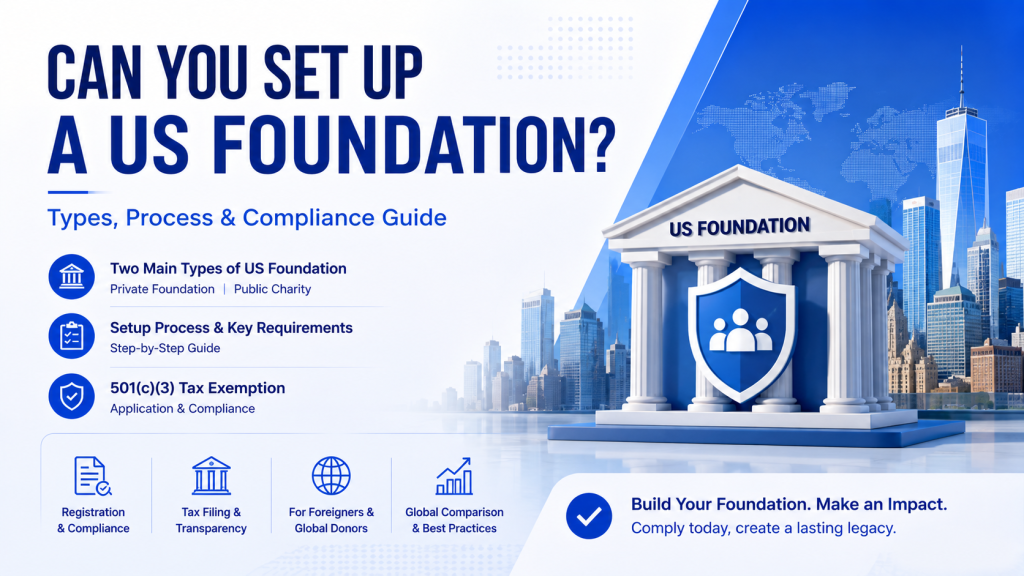
Can You Set Up a US Foundation? Types, Process & Compliance Guide
A US Foundation can be established for charitable, educational, family, or other qualifying purposes. However, a foundation is not simply a company with a different name. In practice, founders usually establish a nonprofit corporation, trust, or similar legal structure and then apply for federal tax-exempt status when eligible.
For international founders, the process can involve both state and federal requirements. Therefore, it is important to understand the foundation structure, registration process, tax rules, and ongoing compliance before getting started.
Can You Set Up a US Foundation?
Yes. US law allows organizations to operate for charitable and other qualifying purposes. However, simply registering an organization does not automatically make it tax-exempt.
A US Foundation that wants federal tax-exempt status under Section 501(c)(3) must meet specific organizational and operational requirements. Its purposes and activities must generally fall within the qualifying purposes defined by the Internal Revenue Code. In addition, the organization's assets must remain dedicated to its exempt purposes. This means that the founders cannot simply use foundation assets for personal benefit. Therefore, before setting up a US Foundation, you should first determine the purpose, structure, funding source, and expected activities.
Two Main Types of US Foundation
For federal tax purposes, 501(c)(3) organizations are generally classified as either private foundations or public charities. The main difference is how they receive support and how they operate.
Private Foundation
A private foundation usually receives most of its funding from a limited number of donors, such as an individual, family, or company. It may then use the funds to make charitable grants or support its own charitable programs. Private foundations have additional tax and operating rules. For example, they generally need to file Form 990-PF every year and follow rules covering areas such as self-dealing, charitable distributions, investments, and certain business interests. This structure can be suitable when the founder or family wants to maintain greater control over charitable funds.
Public Charity
A public charity generally receives broader support from the public, government sources, or other qualifying organizations. Schools, hospitals, churches, and certain publicly supported organizations can fall into this category.
Public charities must meet applicable public support or other classification requirements. As a result, this structure can be more suitable for organizations that plan to raise funds from a broad group of donors.
Basic Requirements and Setup Process for a US Foundation
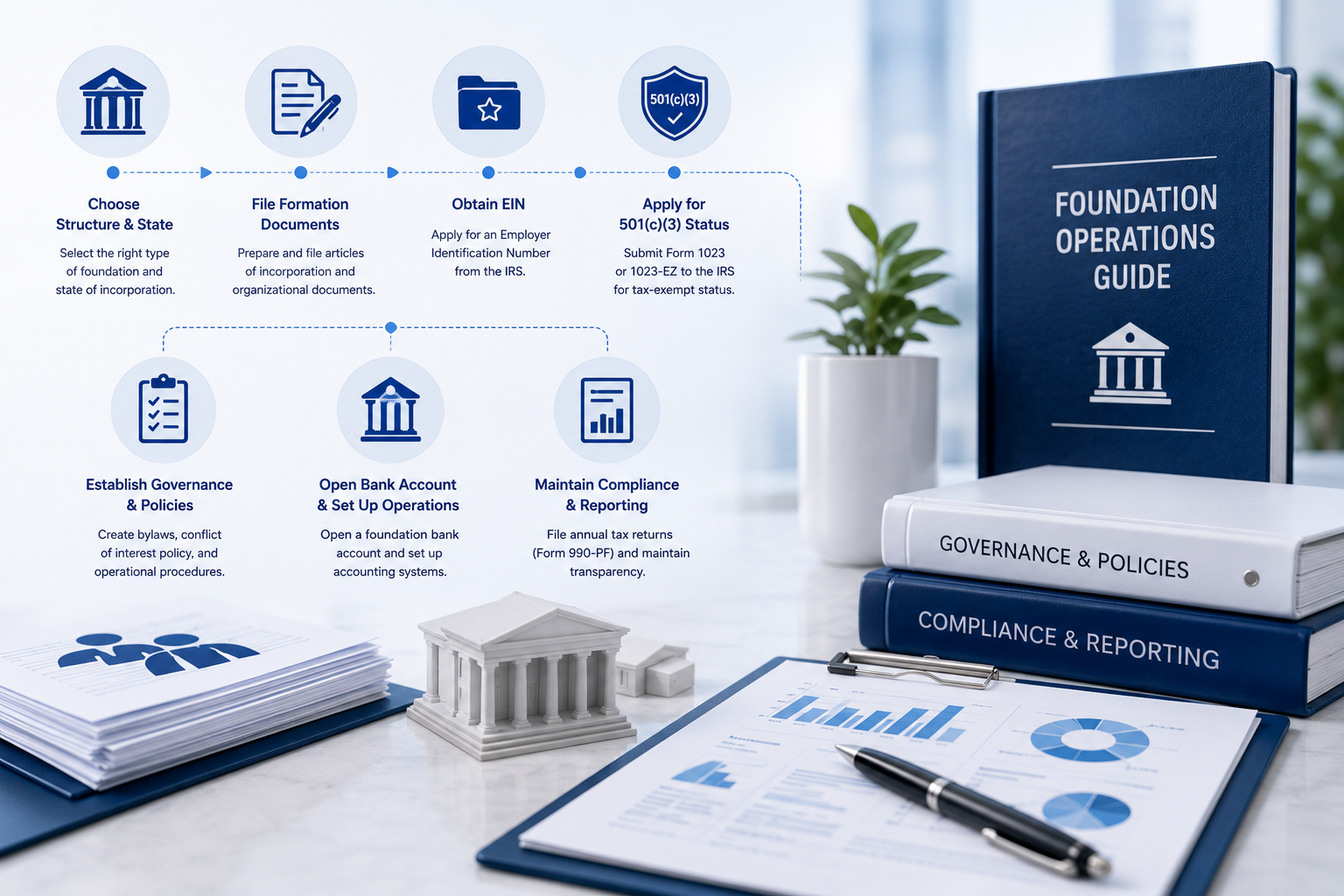
The exact process depends on the structure and state where the organization is established. However, a typical setup may include the following steps:
- Define the charitable purpose: Clearly determine what the foundation will support.
- Choose the legal structure: Common options include a nonprofit corporation or charitable trust.
- Select the state: State rules can affect formation, governance, reporting, and charitable solicitation.
- Prepare formation documents: The documents should clearly describe the organization's qualifying purposes.
- Appoint directors or trustees: The organization should establish appropriate governance arrangements.
- Register the organization: Submit the required formation documents to the relevant state authority.
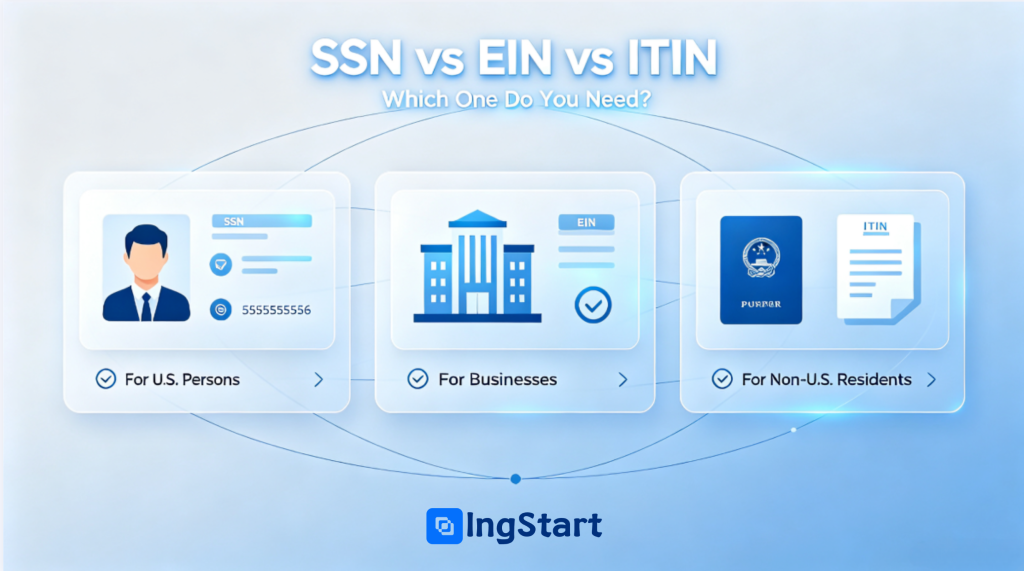
- Apply for an EIN: An Employer Identification Number may be needed for tax and banking purposes.
- Apply for federal tax exemption: If eligible, submit the appropriate application to the IRS.
- Complete state registrations: Depending on activities, additional state registrations or tax exemptions may apply.
For 501(c)(3) status, the IRS requires qualifying organizations to submit an application for recognition of exemption, generally using Form 1023 or Form 1023-EZ when eligible.
For international founders, the process may involve several documents and compliance steps. Ingstart provides company formation and compliance support for international clients, helping founders coordinate US entity setup and related compliance requirements. This can be useful when the founder needs to manage several steps without being physically present in the United States.

Where Does a US Foundation Need to Register?
Setting up a US Foundation may involve both state and federal authorities.
At the state level, the organization normally needs to establish its legal entity through the relevant state authority, such as the Secretary of State or another designated agency. Depending on its activities, it may also need to register for charitable solicitation or apply for state tax exemptions.
At the federal level, the IRS handles federal tax-exempt status. However, state registration and federal tax exemption are separate matters. Receiving 501(c)(3) recognition does not automatically complete every state-level requirement.
Therefore, founders should check the requirements in every state where the organization operates, holds assets, or solicits donations.
How Does a US Foundation Get 501(c)(3) Tax Exemption?
501(c)(3) status can provide important tax benefits, but an organization must meet the relevant requirements first.
Generally, the organization must be organized and operated exclusively for qualifying exempt purposes. It also cannot use its earnings for the private benefit of shareholders or individuals. In addition, political campaign activity is prohibited, while lobbying activities are subject to restrictions.
The application process generally includes:
- Prepare the organization's formation and governing documents.
- Confirm that its purposes meet 501(c)(3) requirements.
- Obtain an EIN when required.
- Prepare Form 1023 or Form 1023-EZ if eligible.
- Submit the application and required user fee.
- Respond to any additional questions from the IRS.
- Keep the IRS determination letter and supporting records.
The IRS states that Form 1023 or Form 1023-EZ is used to apply for recognition of 501(c)(3) exemption, subject to applicable eligibility rules.
Common Uses of a US Foundation
A US Foundation can serve different charitable and long-term planning purposes. Common examples include:
- Charitable donations: Supporting nonprofit programs or specific charitable projects.
- Family philanthropy: Creating a structured way for a family to manage charitable giving.
- Education support: Funding scholarships, educational programs, or related activities.
- Community projects: Supporting local or international charitable initiatives.
- Research and public benefit: Funding qualifying research or public-interest programs.
- Long-term charitable planning: Building a structured organization for ongoing charitable activities.
However, the foundation must use its funds and activities for qualifying purposes. It should not be treated as a personal asset-holding structure.
Tax Filing and Transparency Requirements
Obtaining 501(c)(3) status does not mean that the organization has no ongoing compliance obligations. Depending on its classification and activities, a US Foundation may need to file annual information returns with the IRS and maintain financial and organizational records. Private foundations generally file Form 990-PF each year.
Public charities may have different filing requirements. They may also need to provide information about public support and other financial matters. In addition, certain IRS filings and exemption applications are subject to public disclosure. Therefore, foundations should maintain accurate records and keep their governance and financial information organized.
State-level requirements may also apply. For example, a foundation that solicits donations in multiple states may need to review charitable registration requirements in those states.
Can Foreigners Set Up a US Foundation?
Yes, foreign individuals can potentially establish a US charitable organization. However, being a foreign founder does not remove the need to meet US legal, tax, and reporting requirements. For international founders, the key issues usually include the organization's purpose, legal structure, governance, funding sources, state registration, IRS requirements, and ongoing reporting.
In addition, cross-border donations and transactions can create further tax and reporting considerations. Therefore, foreign founders should review the structure carefully before transferring funds or beginning charitable activities. Most importantly, the foundation should have a genuine charitable purpose and operate consistently with that purpose.
US Foundation vs Foundations in Other Countries
A US Foundation can be compared with charitable structures in jurisdictions such as the Cayman Islands or Singapore. However, the legal systems and tax rules are different. In the United States, a foundation seeking federal tax-exempt treatment commonly works within the 501(c)(3) framework. The organization must meet specific federal requirements while also following applicable state rules.
By comparison, other jurisdictions may use different legal forms, tax systems, registration authorities, and reporting requirements. Therefore, international founders should not choose a jurisdiction based only on tax rates. Instead, they should consider the organization's purpose, donor base, location of activities, funding sources, reporting obligations, and long-term plans.
Recommendations and Compliance Considerations
A US Foundation can be a useful structure for genuine charitable activities. However, it should not be established simply as a way to reduce taxes or hold personal assets.
Before setting up a foundation, consider the following points:
- Clearly define the charitable purpose.
- Choose an appropriate legal structure.
- Understand both state and federal requirements.
- Keep foundation funds separate from personal funds.
- Maintain complete financial and governance records.
- File required tax and information returns on time.
- Follow the rules that apply to private foundations or public charities.
- Review cross-border donations and transactions carefully.
- Avoid activities that could create private benefit or violate tax-exempt rules.
In particular, foundation classification matters because private foundations and public charities can be subject to different tax and operational rules.
Conclusion: Setting Up a US Foundation Properly
A US Foundation can be established for charitable, educational, family, and other qualifying purposes. However, forming the organization is only the first step. Founders must also consider state registration, IRS requirements, 501(c)(3) status, tax filings, transparency, and ongoing compliance.
For international founders, the process can be more complex because cross-border funding and activities may create additional requirements. Therefore, it is important to choose the right structure from the beginning and maintain proper compliance throughout the foundation's operation. A well-planned US Foundation can provide a structured way to support charitable goals. At the same time, it should always operate for a genuine qualifying purpose rather than serve as a personal tax or asset-holding tool.
Article Recommendations
- US Tax Refund 2026 Guide: Federal and State Refund Times & Tracking
- US Tax Forms Guide: Complete List of Common IRS Tax Forms
- What Is an ITIN Number? A Complete Guide for Non-US Residents
If you still have questions, please contact our team on WhatsApp at +1 213 751 2111. We'll help you find the right solution for your business and keep your company compliant as it grows.