
For businesses planning international trade, choosing the right company location can make a major difference. Hong Kong vs Singapore is a common comparison because both locations offer strong financial systems, international connectivity, and business-friendly environments.
Both Hong Kong and Singapore can serve as regional bases for trading companies, e-commerce businesses, professional services, and other international operations. However, their tax systems, market connections, banking environments, and compliance requirements are different.
This guide compares the main advantages of Hong Kong vs Singapore for international trade and explains what international entrepreneurs should consider before choosing between them.
Hong Kong vs Singapore: Hong Kong Company Advantages
A Hong Kong company can provide several advantages for businesses involved in cross-border trade and regional operations.
Tax and Compliance
Hong Kong uses a territorial source principle for profits tax. In general, Hong Kong taxes profits that arise in or are derived from Hong Kong, while profits sourced outside Hong Kong may fall outside the scope of Hong Kong Profits Tax. However, businesses must determine the source of their profits based on the actual facts and applicable rules. An overseas business should not assume that simply registering a company in Hong Kong makes all foreign profits tax-free.
For corporations, Hong Kong's two-tiered profits tax rates apply 8.25% to the first HK$2 million of assessable profits and 16.5% to the portion above HK$2 million, subject to the relevant eligibility rules.
Therefore, the Hong Kong tax system can be attractive to international businesses, but companies should still review their actual business activities, management arrangements, and source of profits.
International Trade and Payments
Hong Kong has a long-established international trading and financial environment. Businesses can use Hong Kong companies to manage cross-border transactions, work with overseas suppliers and customers, and access international banking services.
For trading businesses, this structure can simplify the management of international payments compared with operating through a market where cross-border business procedures may be more restrictive.
However, company registration does not automatically give a business permission to trade every type of product. Certain goods may require specific licences or permits, so businesses should check the applicable requirements before starting trade activities.

Hong Kong Company for Regional Business
A Hong Kong company can also support businesses that want to manage operations across Asia and other international markets.
For example, a business may use a Hong Kong company to handle international contracts, supplier relationships, customer payments, or regional investment activities. The exact structure depends on where the business operates and where its customers and suppliers are located.
As a result, Hong Kong vs Singapore is not simply a question of which location has a lower tax rate. The company's actual business model and transaction flows also matter.
Hong Kong vs Singapore: Singapore Company Advantages
Singapore is another major business and trading hub in Asia. It combines a developed financial system with strong international connections and access to the wider Southeast Asian market.
Strong Business Environment
Singapore has a well-developed legal and regulatory framework, strong infrastructure, and a mature financial sector. These factors make it suitable for companies that want to build a long-term regional operation.
In addition, Singapore places strong emphasis on corporate governance and compliance. Although this can create more administrative requirements, it can also provide businesses with a clear framework for managing their operations.
Singapore Corporate Tax
Singapore's standard Corporate Income Tax rate is 17% of chargeable income for both local and foreign companies.
At the same time, qualifying companies may benefit from tax exemption schemes. For example, qualifying new start-up companies can receive partial exemptions on certain amounts of normal chargeable income during their first three consecutive Years of Assessment.
Singapore also provides other tax reliefs and incentives depending on the company's activities and circumstances. Therefore, international businesses should consider their actual tax position rather than comparing headline tax rates alone.
Flexible International Operations
A Singapore company can conduct both local and international business activities, subject to the relevant laws and regulatory requirements.
This can give international businesses flexibility when serving customers in different markets. Singapore's location also makes it convenient for companies that want to develop business relationships across Southeast Asia and the wider Asia-Pacific region.
For this reason, Hong Kong vs Singapore can depend heavily on the company's target markets. Businesses focused on Southeast Asia may place greater value on Singapore's regional position, while companies with stronger connections to Hong Kong and Greater China may consider Hong Kong more closely.
International Trade and Regional Access
Singapore is one of Asia's major trading and logistics hubs. Its port, airport, financial services, and extensive international connections support businesses involved in global trade.
Singapore also provides access to the broader ASEAN market. Therefore, companies that plan to expand into Southeast Asia may use Singapore as a regional base.
At the same time, Singapore requires companies to follow corporate registration and compliance rules. For example, a Singapore company generally needs at least one ordinarily resident director and must maintain the required corporate information and filings.
Double Taxation Agreements
Singapore has signed Avoidance of Double Taxation Agreements, limited DTAs, and Exchange of Information arrangements with around 100 jurisdictions. These agreements can help determine how certain cross-border income is taxed and may reduce double taxation when the applicable conditions are satisfied.
This can be particularly relevant for companies that receive income from multiple countries. However, treaty benefits depend on the specific agreement, income type, tax residency, and other requirements.
Hong Kong vs Singapore: Which Is Better for International Trade?
When comparing Hong Kong vs Singapore, international businesses should look beyond the basic tax rate.
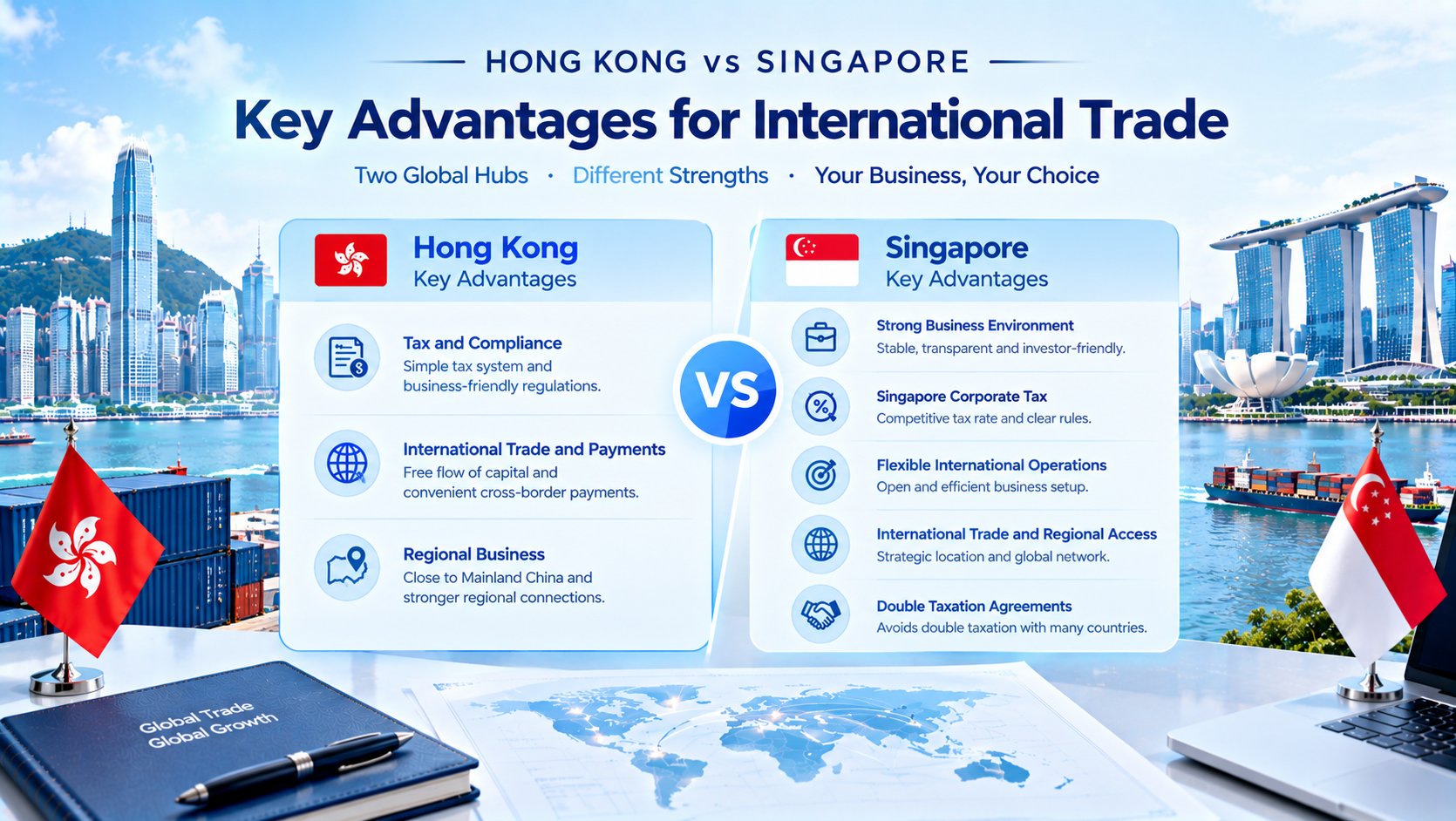
Hong Kong may suit businesses that want to operate in an international financial and trading centre with strong connections to Asian markets. Its territorial source principle can also be relevant when determining the Hong Kong tax treatment of business profits.
Singapore, on the other hand, can be attractive for businesses that want a regional base for Southeast Asia. Its established corporate system, international agreements, logistics infrastructure, and financial services can support companies with broader Asia-Pacific operations.
The right choice therefore depends on factors such as:
- Target markets and customers
- Location of suppliers and business partners
- Nature of the trading activities
- Expected payment flows
- Corporate tax position
- Banking requirements
- Local compliance obligations
- Plans for regional expansion
For international entrepreneurs who need help with company formation and ongoing administration, IngStart provides Hong Kong and Singapore company registration services, together with banking assistance, tax-related services, and corporate compliance support. This can help businesses compare their setup options before establishing a regional company.
Hong Kong vs Singapore: Key Differences
The main differences can be summarized as follows:
| Factor | Hong Kong | Singapore |
|---|---|---|
| Corporate tax | Two-tiered profits tax rates of 8.25% and 16.5% for qualifying corporations | Standard corporate income tax rate of 17% |
| Tax approach | Territorial source principle | Corporate income tax based on Singapore tax rules |
| Trade position | Strong international trading and financial centre | Major Asian trading and logistics hub |
| Regional focus | Strong links with Hong Kong and Asian markets | Strong access to Southeast Asia and ASEAN |
| International tax agreements | Broad international tax network | Around 100 DTAs and EOI arrangements |
| Banking | Developed international banking system | Developed banking and financial system |
| Compliance | Ongoing corporate and tax compliance required | Ongoing corporate, tax, and regulatory compliance required |
The table provides a general comparison only. A company's actual tax and compliance position depends on its activities, ownership, management, transactions, and tax residency.
Conclusion
Hong Kong vs Singapore is an important comparison for international businesses planning cross-border trade in Asia. Both locations offer strong financial infrastructure, international connectivity, and established business environments.
Hong Kong may be suitable for businesses that value its international trading environment, financial services, and territorial source principle. Singapore may be suitable for companies that want to build a regional base in Southeast Asia and benefit from its developed business infrastructure and extensive network of tax agreements.
Ultimately, businesses should choose based on their actual markets, trading activities, tax position, banking needs, and long-term expansion plans rather than relying on a single tax rate or business advantage.
Article Recommendations
- Hong Kong Company Registration Guide 2026: Steps and Requirements for Global Entrepreneurs
- Singapore Company Registration Guide 2026: Requirements, Process & Tips for Global Entrepreneurs
- Brand Overseas Expansion Complete Guide: How Can Enterprises Build a Sustainable Overseas Growth System?
If you still have questions, please contact our team on WhatsApp at +1 213 751 2111. We'll help you find the right solution for your business and keep your company compliant as it grows.