
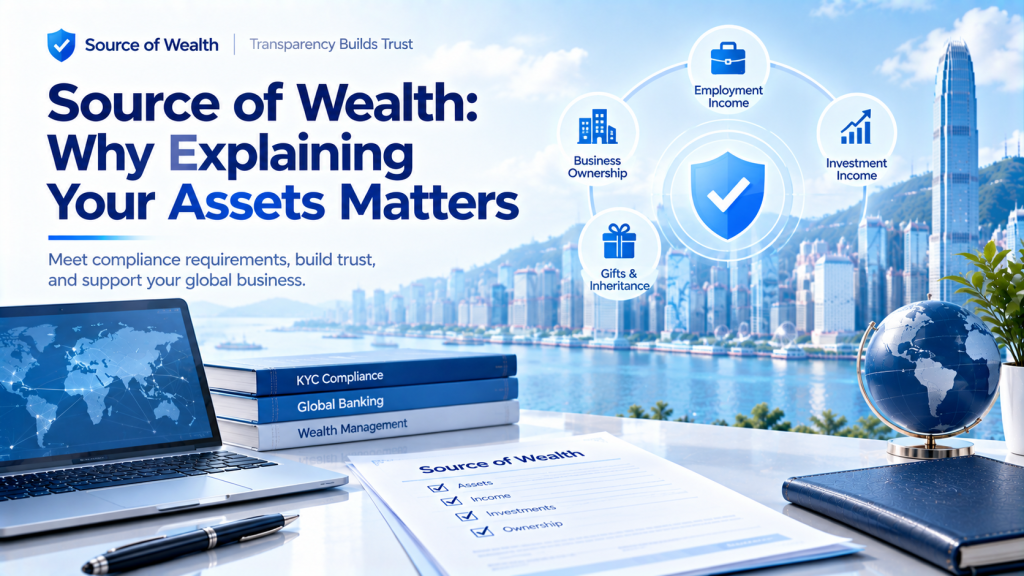
Source of Wealth: The Starting Point for Offshore Business
When you enter the international financial system, Source of Wealth is one of the first things banks and financial institutions may want to understand. Whether you are opening a personal account, setting up a brokerage account, incorporating an overseas company, or using private banking and wealth structures, institutions may ask where your wealth came from.
For individuals and businesses operating across borders, this question can appear at different stages. You may need to explain your wealth when opening a personal account, receiving business payments, applying for private banking, or setting up structures such as trusts and foundations.
Many people think Source of Wealth is simply a box on a KYC form. They may write “business income,” “investment income,” or “family wealth” and consider the matter finished. However, in practice, Source of Wealth is much broader. Financial institutions may want to understand how the wealth was created, whether the explanation is reasonable, and whether supporting documents can verify the story.
In other words, the question is not only how much money you have, but how you can explain where it came from.

Why Source of Wealth Matters in KYC
When you enter a regulated financial system, banks and other financial institutions normally need to understand the origin of a customer's wealth and funds. For example, saying that you have USD 5 million is very different from being able to clearly explain how that USD 5 million was accumulated.
You may be asked for documents such as:
- Passport or other identification
- Employment or business information
- Bank statements
- Tax records
- Financial statements
- Investment records
- Sale and purchase agreements
- Dividend records
- Gift or inheritance documents
This does not necessarily mean that the institution is targeting clients from a particular country or region. Similar KYC and AML requirements can apply to customers from Europe, Asia, the Middle East, Africa, North America, and other regions.
The reason is straightforward. Banks and regulated financial institutions need to manage money laundering, terrorist financing, sanctions, fraud, and other financial crime risks. Therefore, asking about Source of Wealth is part of the wider compliance process.
As a result, instead of asking why a bank needs so many documents, it is often more useful to prepare a clear and consistent explanation of how your wealth was created.
Source of Wealth: How Your Wealth Was Created Matters
Why can two people with similar assets have completely different account-opening experiences? One person may provide a clear employment history, tax records, investment statements, and bank records. Another person may have the same amount of wealth but cannot explain how the money accumulated over the years.
The difference is often not the amount of money. It is the Source of Wealth story and the evidence supporting it. From a practical KYC perspective, wealth commonly comes from several broad categories. Other sources, such as pensions, real estate, or government benefits, may also be relevant depending on the individual's circumstances.
1. Employment Income: Simple but Limited
Employment income is usually one of the easier sources of wealth to document. A long-term employee may have an employment contract, salary records, bank statements, and tax documents. Together, these documents can show a relatively clear connection between income and accumulated assets.
However, employment income also has a natural limitation. If someone reports a very large asset base but their documented salary does not reasonably support that level of wealth, the institution may ask additional questions. Therefore, salary alone may not explain a person's entire Source of Wealth when their assets have grown through other channels.
2. Business Ownership: A Common Source of Wealth
Business income and company ownership are another major source of wealth for international clients. In this situation, financial institutions usually want to understand the underlying business rather than simply the number of companies a person owns.
They may look at:
- What the company actually does
- How the company generates revenue
- Whether the business has real operations
- Financial statements and tax records
- Dividends or other distributions
- The relationship between the company and the individual
A well-documented business can provide a clear explanation of Source of Wealth. However, a complicated corporate structure without financial records may create more questions instead of fewer. This is why having several offshore companies does not automatically make a wealth profile easier to explain.
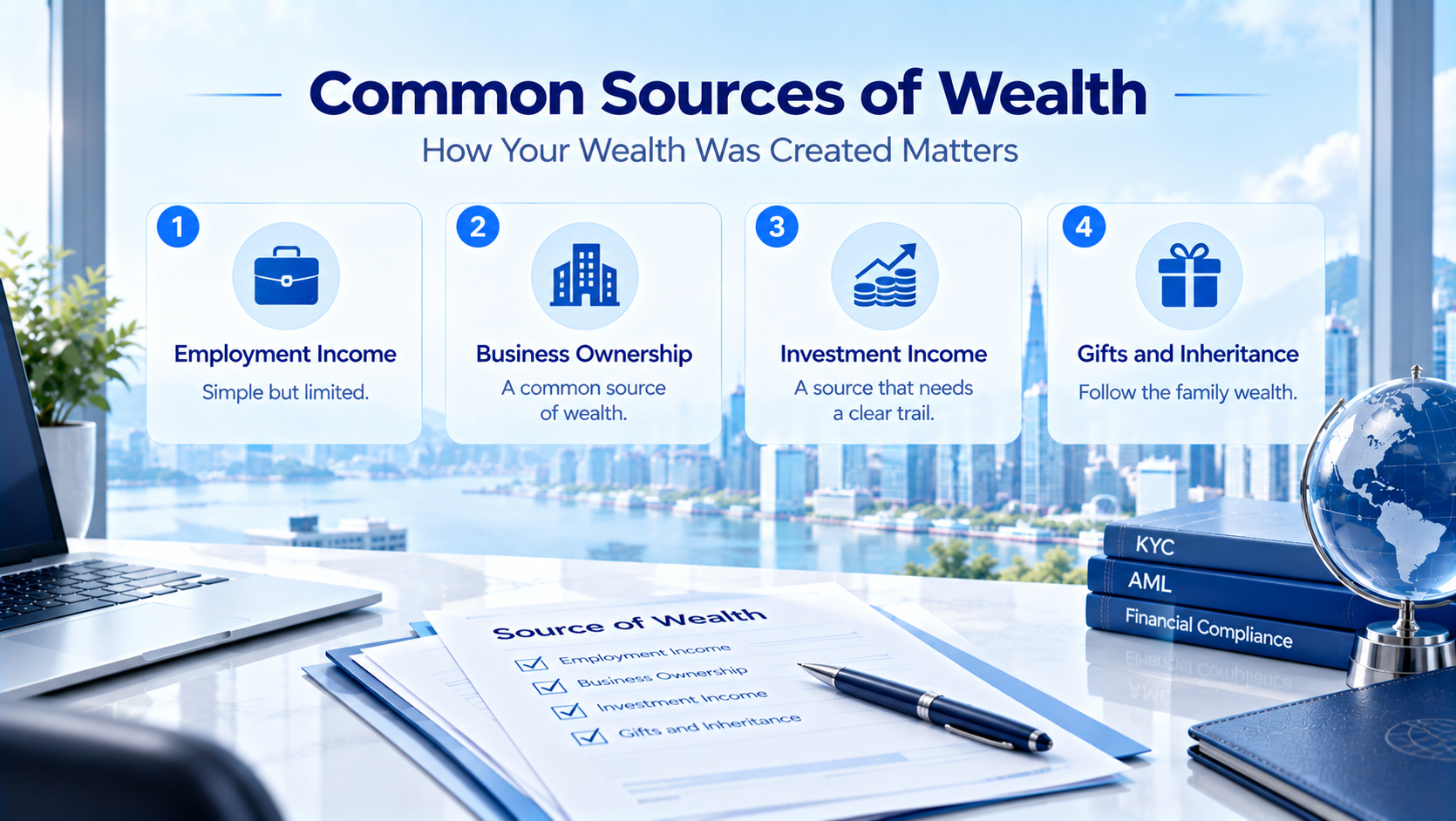
3. Investment Income: A Source That Needs a Clear Trail
Investment income can look simple on paper. Someone may simply say, “I made this money from investments.” However, that explanation may not be enough for a KYC review. The institution may need to understand the full investment path, including:
Initial capital → Investment account → Investment activity → Sale or withdrawal → Final proceeds
Supporting documents should ideally connect these stages. For example, investment statements, transaction records, bank statements, and tax documents can help demonstrate where the original capital came from and how the investment proceeds were generated.
Therefore, when investment income forms a major part of your Source of Wealth, keeping historical records can become very important.
4. Gifts and Inheritance: Follow the Family Wealth
Gifts and inheritance may sound straightforward. However, they can sometimes require more explanation than expected.
If your wealth comes from a gift, the institution may want to understand who provided the gift, where the donor's wealth came from, why the transfer was made, and whether the transaction can be supported by appropriate documents.
The same applies to inheritance. Depending on the circumstances, relevant documents may include:
- Estate or probate documents
- Inheritance agreements
- Gift agreements
- Bank transfer records
- Tax documents
- Evidence of the donor's or deceased person's wealth
In practice, explaining your own Source of Wealth may therefore require explaining part of another person's financial history as well.
Complex Wealth Can Make Source of Wealth Harder to Explain
Having more wealth does not automatically make a KYC review more difficult. However, wealth accumulated through complicated structures or over a long period can be harder to document. One common example is digital assets and cryptocurrency.
Early crypto investors may have used different exchanges, wallets, OTC transactions, and payment channels over many years. Some platforms may have closed, while old accounts, email addresses, or phone numbers may no longer be accessible. As a result, reconstructing an investment history from many years ago can become difficult.
A similar issue can appear with:
- Multiple investment accounts
- Long-term property investments
- Stock and options trading
- Private company investments
- Multiple offshore entities
- Cross-border transfers
- Old bank accounts
The problem is often not that the wealth is unusual. Instead, the problem is that the Source of Wealth evidence has gaps.
For example, a person may have a company that owns another company, which owns another investment vehicle. The structure may be legally valid, but if nobody can clearly explain which entity generated the profits and how those profits eventually reached the individual, the KYC review may take longer.
Source of Wealth vs. Source of Funds
The two concepts are related, but they are not the same. Source of Wealth generally explains how a person's overall wealth was accumulated over time. It looks at the broader financial history behind the person's assets.
Source of Funds, on the other hand, focuses on where the specific money being used in a particular transaction or account came from.
For example, imagine an entrepreneur has accumulated USD 5 million through years of business operations and investments. The USD 5 million may represent the person's broader Source of Wealth. However, if USD 500,000 is being transferred into a new bank account, the institution may also ask where that specific USD 500,000 came from.
A simple way to understand the difference is:
| Term | Main Question |
|---|---|
| Source of Wealth | How did you build your overall wealth? |
| Source of Funds | Where did the specific funds for this transaction come from? |
Therefore, the information provided for SOW and SOF should not simply be copied into both sections.
How to Prepare Your Source of Wealth Information
For international entrepreneurs and investors, preparing a clear Source of Wealth record in advance can make future KYC reviews easier. A practical approach is to keep documents that show the complete financial story, such as employment records, company financial statements, tax documents, investment statements, property transaction documents, gift or inheritance records, and relevant bank statements.
More importantly, the documents should tell a consistent story. If your wealth comes from several sources, do not force everything into one explanation. Instead, separate the major sources and show how each contributed to your current assets.
For example:
- Employment income created the initial capital.
- Business profits increased the asset base.
- Investment income generated additional returns.
- A property sale created a significant one-time gain.
This approach can make the overall Source of Wealth easier for a financial institution to understand and verify.
For international entrepreneurs who are also managing overseas company registration, banking, tax, and compliance matters, IngStart provides business setup and ongoing support for international companies. Keeping company, banking, and tax records organized can also help when financial institutions later request supporting information.
Conclusion
Source of Wealth is much more than a field on a KYC application. It is the financial story behind your assets. Whether your wealth comes from employment, business ownership, investments, gifts, or inheritance, financial institutions may want to understand how the wealth was created and whether the explanation can be supported by reliable documents.
At the same time, complex structures do not necessarily create a problem. The key issue is whether the ownership structure, money flows, and supporting evidence can be clearly explained.
Therefore, international entrepreneurs and investors should keep important financial records over time instead of waiting until a bank or financial institution asks for them. A clear Source of Wealth history can make future account opening, investment activity, and other financial reviews much easier.
Article Recommendations
- W-8 Form Guide for Foreign Taxpayers: A Complete Guide for Foreign Individuals and Businesses
- Paytend License Revoked: What Happened and What It Means
- Cliproxy: Creating an efficient and secure IP proxy solution for cross-border business
If you still have questions, please contact our team on WhatsApp at +1 213 751 2111. We'll help you find the right solution for your business and keep your company compliant as it grows.