
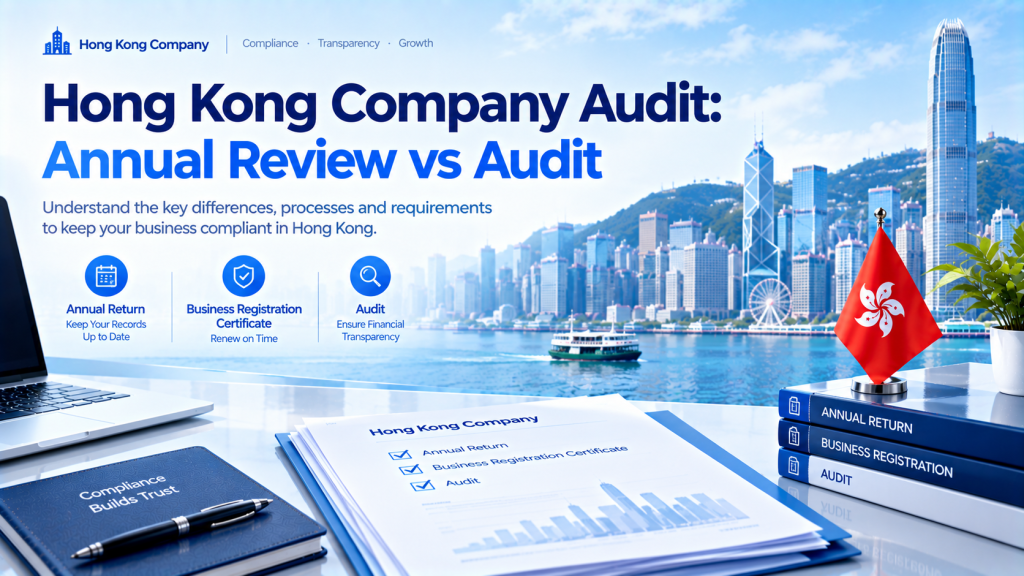
For international business owners, Hong Kong Company Audit and the annual return are two different parts of company compliance. However, many business owners confuse these terms because both form part of a company's ongoing annual obligations.
In simple terms, an annual return updates a company's corporate information with the Hong Kong Companies Registry. An audit, on the other hand, involves an independent review of the company's financial statements by a certified public accountant. The two processes have different purposes, documents, and deadlines.
Therefore, understanding the difference between a Hong Kong annual return and a Hong Kong Company Audit can help overseas business owners manage their companies more efficiently.
Hong Kong Company Annual Return
A Hong Kong company generally needs to submit an annual return to the Companies Registry after incorporation. For a local private company, the annual return generally falls due within 42 days after the anniversary of incorporation. The first annual return normally follows the same deadline after the company's first anniversary.
The annual return mainly confirms and updates the company's corporate information. It does not serve as a financial audit.

Hong Kong Company Annual Return Process
The annual return process generally includes:
- Prepare the annual return: A private company normally uses Form NAR1 to provide the required corporate information.
- Review company details: The company should check its registered office, directors, company secretary, shareholders, and share capital.
- Submit the annual return: The company delivers the return to the Companies Registry within the statutory deadline.
- Pay the annual registration fee: The company pays the applicable fee together with the filing.
For a private company, the standard annual registration fee is currently HK$105 when the company delivers the annual return within 42 days after the return date. Late delivery results in substantially higher registration fees.
Business Registration Certificate Renewal
Business registration creates another obligation that international company owners should distinguish from the annual return. A Hong Kong company generally needs to maintain a valid Business Registration Certificate. The Inland Revenue Department issues a renewal demand note before the renewal period begins. Once the company pays the required fee and levy, the demand note serves as the renewed certificate.
Therefore, company owners should not treat the Companies Registry annual return and Business Registration Certificate renewal as the same procedure. The annual return updates company information with the Companies Registry, while business registration covers the company's registration under the Business Registration Ordinance.
Hong Kong Company Audit Process
A Hong Kong Company Audit focuses on the company's financial statements rather than its basic corporate information.
For companies carrying on business in Hong Kong, audited financial statements generally support profits tax filing, subject to applicable exceptions such as certain dormant companies. When the relevant requirements apply, the Inland Revenue Department generally requires corporations to submit audited financial statements together with their profits tax returns.
The audit process commonly includes the following steps:
- Organize accounting records: The company collects invoices, bank statements, receipts, contracts, and other financial records.
- Prepare the accounts: Accountants use the financial records to prepare the company's financial statements.
- Review the financial statements: The auditor examines the financial information and supporting evidence.
- Complete the audit: The auditor performs the necessary audit procedures and considers whether the company needs any adjustments.
- Issue the auditor's report: After completing the audit, the auditor issues a report that forms part of the company's financial reporting and tax compliance documents.
As a result, a Hong Kong Company Audit mainly examines the reliability of financial statements, while an annual return mainly keeps corporate records up to date.
Hong Kong Company Audit vs Annual Return
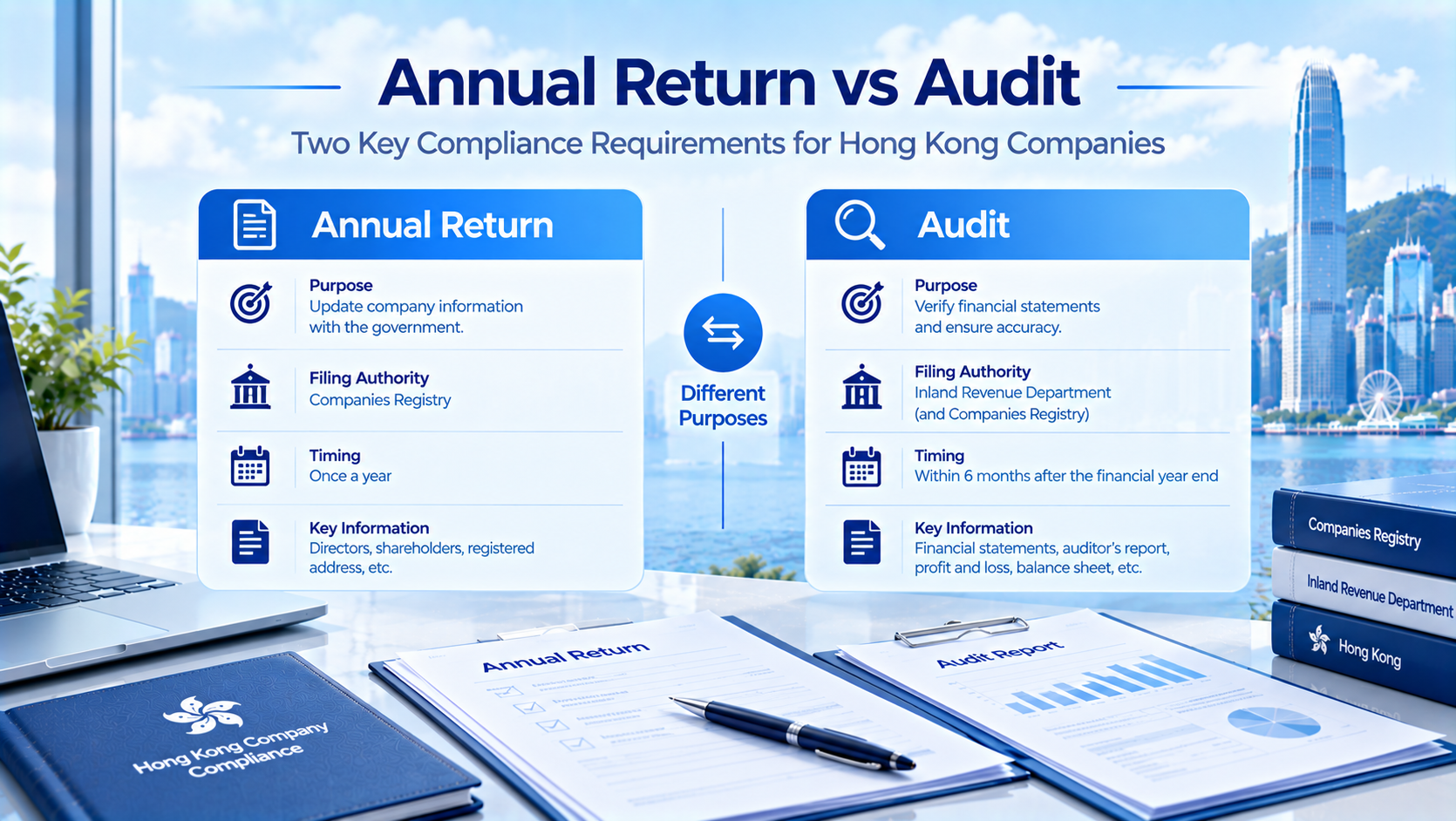
The easiest way to understand the difference is to compare their purpose, filing authority, timing, and content.
1. Different Purposes
Annual return: Its main purpose is to update the Companies Registry on the company's current corporate information.
Audit: Its purpose is to provide an independent examination of the company's financial statements and support financial and tax reporting.
In other words, the annual return focuses on company information, while a Hong Kong Company Audit focuses on financial information.
2. Different Filing Authorities
The company submits its annual return to the Hong Kong Companies Registry. When required, the company also provides audited financial statements to the Inland Revenue Department together with the relevant profits tax return. Therefore, these two processes involve different government functions and require separate compliance planning.
3. Different Timing
For a local private company, the annual return generally falls due within 42 days after the anniversary of incorporation. An audit does not follow a rule that requires completion on the company's incorporation anniversary. Instead, its timing connects to the company's financial reporting and profits tax filing requirements. Therefore, international owners should not assume that the annual return deadline and the Hong Kong Company Audit deadline are the same.
4. Different Information
An annual return mainly contains corporate information, such as:
- Company name and registered details
- Directors
- Company secretary
- Shareholders
- Share capital
- Other information required by the Companies Registry
By comparison, an audit involves financial information and supporting records, such as:
- Accounting records
- Bank statements
- Sales and purchase records
- Expenses
- Assets and liabilities
- Financial statements
- Supporting documents
This difference explains why the two processes require different preparation.
What Happens If the Annual Return Is Late?
Late annual returns can lead to additional costs and legal consequences.
For a local private company, the annual registration fee increases according to how long the annual return remains overdue:
| Filing time | Annual registration fee |
|---|---|
| Within 42 days after the return date | HK$105 |
| More than 42 days but within 3 months | HK$870 |
| More than 3 months but within 6 months | HK$1,740 |
| More than 6 months but within 9 months | HK$2,610 |
| More than 9 months | HK$3,480 |
These are the current fees listed by the Companies Registry.
More importantly, failure to deliver an annual return within the statutory period constitutes an offence. The company and responsible officers may face prosecution and default fines. The Companies Registry may also consider strike-off action in appropriate cases.
What Happens If a Company Does Not Complete Its Audit?
Audit-related problems differ because they connect closely with financial reporting and profits tax compliance.
If a company needs to submit audited financial statements with its profits tax return, missing the required accounting and audit work can delay or affect the company's tax filing process. The company may need to complete the outstanding work before it can properly handle the relevant tax filing.
However, it is not accurate to say that a late audit automatically causes the Hong Kong authorities to freeze all company assets. The actual consequences depend on the company's tax position, filing history, and actions taken by the relevant authorities.
For this reason, international business owners should address overdue tax and audit matters promptly rather than assume that every compliance issue has the same consequence.
Hong Kong Company Audit: How to Manage Both
Annual returns and audits remain separate tasks, but companies can manage them together through a clear compliance schedule.
A company can follow these basic steps:
- Track the annual return deadline.
- Keep corporate information up to date.
- Maintain accounting records throughout the year.
- Prepare financial statements before the relevant tax filing deadline.
- Arrange the required audit with a certified public accountant.
- Submit the annual return to the Companies Registry.
- Complete the relevant profits tax filing and provide audited financial statements when required.
- Keep copies of filing confirmations, financial statements, and audit reports.
For overseas entrepreneurs, managing these requirements remotely can be inconvenient. IngStart provides Hong Kong company registration and ongoing corporate services, including annual compliance, tax-related support, accounting and audit assistance, and business administration services. This can help international business owners manage different compliance tasks in one place.
Hong Kong Company Audit Checklist
Before completing the annual compliance cycle, international business owners can check:
- Annual return deadline
- Companies Registry filing
- Business Registration Certificate renewal
- Corporate information
- Accounting records
- Financial statements
- Audit arrangements
- Profits tax filing requirements
- Supporting documents and filing records
Keeping these items organized can reduce the risk of missing separate deadlines.
Conclusion
A Hong Kong Company Audit and a Hong Kong annual return serve different purposes.
The annual return mainly updates the Companies Registry on the company's corporate information. By contrast, the audit focuses on the company's financial statements and supports its financial and tax reporting requirements.
For a local private company, the annual return generally falls due within 42 days after the anniversary of incorporation. Meanwhile, the audit timing connects to the company's financial reporting and profits tax obligations rather than simply its incorporation anniversary.
Therefore, international business owners should treat the annual return, Business Registration Certificate renewal, audit, and profits tax filing as separate compliance tasks. With a clear schedule and well-maintained records, a Hong Kong company can manage these obligations more efficiently and reduce the risk of late filing problems.
Article Recommendations
- Hong Kong Business Registration Guide: How to Apply for a Business Registration Certificate
- Hong Kong Company Compliance: What Happens If You Do Not File or Deregister?
- Hong Kong Annual Filing 2026: Requirements, Documents & Complete Process Guide
If you still have questions, please contact our team on WhatsApp at +1 213 751 2111. We'll help you find the right solution for your business and keep your company compliant as it grows.