
Singapore is one of Asia's leading business hubs and attracts companies and entrepreneurs from around the world. Its strong infrastructure, skilled workforce, stable business environment, and access to regional markets make it an attractive place to start or expand a business.
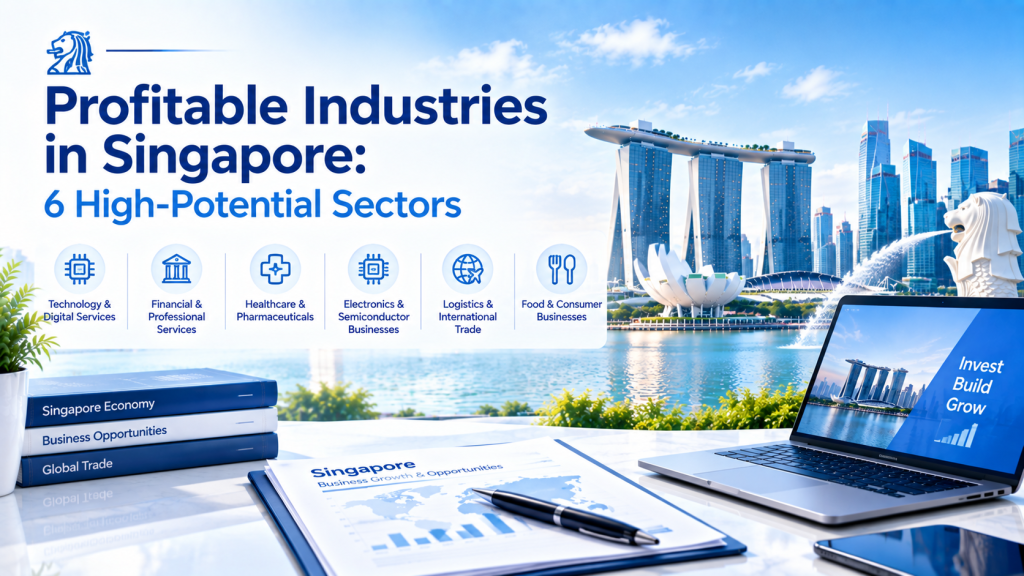
However, choosing a profitable business requires more than looking at high prices or product markups. Market demand, operating costs, regulations, competition, and long-term growth all matter. Therefore, when looking at the Profitable Industries in Singapore, it is better to focus on sectors with strong demand and clear growth opportunities. Based on Singapore's current economic structure and industry development, the following six sectors are worth considering.
1. Technology and Digital Services
Technology is one of the most promising areas in Singapore. The country has developed a strong digital ecosystem, supported by skilled talent, advanced infrastructure, and strong demand for technology solutions.
Businesses can explore areas such as:
- Software development
- Artificial intelligence
- Cybersecurity
- Cloud services
- Digital platforms
- IT consulting
- Business automation
Singapore's Economic Development Board identifies digital technology as one of the country's key growth industries. It also highlights the country's strong digital infrastructure and technology ecosystem. For entrepreneurs, technology businesses can also serve customers across Southeast Asia instead of relying only on the Singapore market.

2. Financial and Professional Services
Financial services remain an important part of Singapore's economy. The country is a major regional financial centre and supports banking, investment, insurance, wealth management, and other financial activities.
Professional services also have strong development potential. These include:
- Business consulting
- Accounting
- Legal services
- Marketing
- Engineering services
- Management consulting
- Risk and compliance services
Singapore's professional services sector contributed 5.6% of GDP in 2025, according to the Economic Development Board. The sector also employs more than 230,000 people across areas such as finance and accounting, consulting, legal, engineering, advertising, marketing, and design. For businesses that provide specialized knowledge rather than physical products, Singapore can therefore offer a strong regional base.
3. Healthcare and Pharmaceuticals
Healthcare is another important sector among the Profitable Industries in Singapore. Singapore has developed a strong healthcare and biomedical ecosystem. Its industry covers pharmaceuticals, biotechnology, medical technology, healthcare services, and related research.
The country also attracts international companies that use Singapore as a base for manufacturing, research, and regional operations. In 2025, biomedical manufacturers continued to expand capacity in Singapore to serve demand for high-value biopharmaceutical and medical technology products.
Potential business areas include:
- Medical technology
- Healthcare services
- Biotechnology
- Pharmaceutical products
- Health technology
- Medical equipment
- Healthcare consulting
However, entrepreneurs should note that healthcare and pharmaceutical activities can be highly regulated. Depending on the activity, additional licences, approvals, or professional qualifications may be required.
4. Electronics and Semiconductor Businesses
Electronics and semiconductors are also major industries in Singapore. The country has built a well-developed advanced manufacturing ecosystem that supports semiconductor production, precision engineering, electronics, and related technology businesses.
In 2025, semiconductor companies made significant investments in Singapore to meet demand for AI-related chips, servers, and related products. EDB reported that about S$12.1 billion of Singapore's S$14.2 billion in fixed asset investment commitments in 2025 came from manufacturing-related projects.
The semiconductor sector is also supported by growing demand for artificial intelligence, data centres, electric vehicles, and advanced electronics.
Potential opportunities include:
- Semiconductor manufacturing
- Electronics components
- Precision engineering
- Industrial automation
- Robotics
- Semiconductor equipment
- Electronics supply-chain services
This sector usually requires greater capital, technical expertise, and operational capabilities than a small retail business. However, its regional and global market potential can be significant.
5. Logistics and International Trade
Singapore's strategic location makes logistics and international trade another important business sector. The country connects major Asian markets and has developed strong port, airport, transport, and supply-chain infrastructure. This makes it suitable for businesses involved in regional distribution and cross-border trade.
Potential business models include:
- Freight forwarding
- Warehousing
- Supply-chain management
- E-commerce logistics
- Regional distribution
- Import and export
- Trade support services
Singapore's role as a regional business hub also creates demand for companies that help international businesses manage their Southeast Asian supply chains.
For entrepreneurs entering the market, however, logistics and trading businesses may require specific registrations, permits, or customs procedures depending on the goods and activities involved.
6. Food and Consumer Businesses
Food and consumer businesses remain important parts of Singapore's service economy. The food and beverage industry includes restaurants, cafes, catering businesses, food manufacturing, and other food-related services. Singapore also has a strong consumer market supported by both local residents and international visitors.
Singapore's Department of Statistics tracks the performance of the retail and food and beverage services industries through dedicated industry indices. This reflects the importance of these sectors within the country's service economy.
Entrepreneurs can consider areas such as:
- Restaurants and cafes
- Food delivery
- Catering
- Food manufacturing
- Specialty food products
- Consumer brands
- Beauty and personal care products
However, profitability varies significantly between businesses. High demand does not automatically mean high profit because rent, labour, ingredients, marketing, and licensing costs can also be substantial.
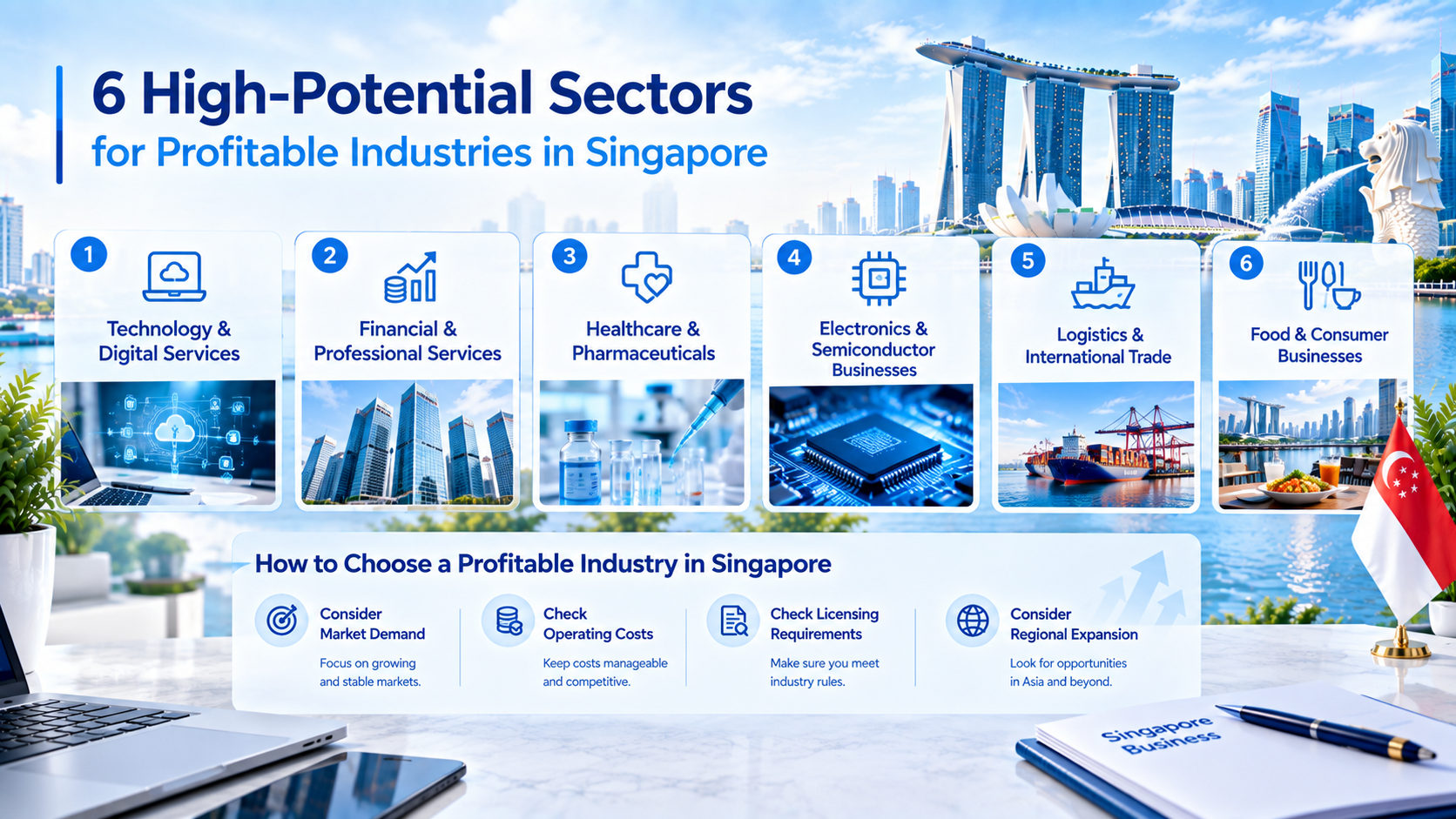
How to Choose a Profitable Industry in Singapore
Looking at the Profitable Industries in Singapore is only the first step. Before starting a business, entrepreneurs should evaluate the market more carefully.
Consider Market Demand
First, research whether customers actually need your product or service. A large market does not guarantee success. A smaller market with strong demand and less competition may provide better opportunities for a new business.
Check Operating Costs
Singapore is a highly developed business hub, but operating costs can also be relatively high. Rent, salaries, professional services, logistics, marketing, and other expenses should all be included when estimating potential profits.
Check Licensing Requirements
Some industries are regulated and require additional licences or approvals. Before registering a company, check whether your planned business activities require specific permits or professional qualifications.
Consider Regional Expansion
One major advantage of Singapore is its access to Southeast Asian markets. Instead of focusing only on local customers, businesses can use Singapore as a regional base and expand into markets such as Malaysia, Indonesia, Thailand, Vietnam, and other ASEAN economies.
Setting Up a Business in Singapore
After choosing an industry, entrepreneurs need to consider the company structure and registration requirements. The business should select suitable business activities and the appropriate SSIC codes when registering with ACRA. If the chosen activity is regulated, the company may also need to obtain additional licences before starting operations. Foreign entrepreneurs should also consider local residency requirements, registered office arrangements, company secretary requirements, taxation, and ongoing compliance.
For entrepreneurs who want support with the setup process, Ingstart provides Singapore company registration and related compliance services. This can help overseas business owners organize their company setup and compliance requirements more efficiently.
Conclusion
The Profitable Industries in Singapore are not limited to traditional retail businesses. Technology, financial and professional services, healthcare and pharmaceuticals, electronics and semiconductors, logistics, and consumer businesses all offer different opportunities.
Singapore's current economic strategy also places strong emphasis on technology, advanced manufacturing, professional services, healthcare, semiconductors, logistics, and other high-value sectors. EDB's recent investment data shows continued activity in manufacturing, headquarters, professional services, and research and development.
However, no industry can guarantee high profits. Entrepreneurs should consider market demand, competition, operating costs, regulations, and their own expertise before making a decision. For international entrepreneurs, choosing the right industry and setting up the company correctly can provide a stronger foundation for entering Singapore and expanding into the wider Asian market.
Article Recommendations
- Singapore Company Registration Types Guide for Foreign Entrepreneurs
- Singapore Company Registration Guide 2026: Requirements, Process & Tips for Global Entrepreneurs
- Singapore Company Tax Guide 2026: Rates, Rules & Compliance Requirements
If you still have questions, please contact our team on WhatsApp at +1 213 751 2111. We'll help you find the right solution for your business and keep your company compliant as it grows.