
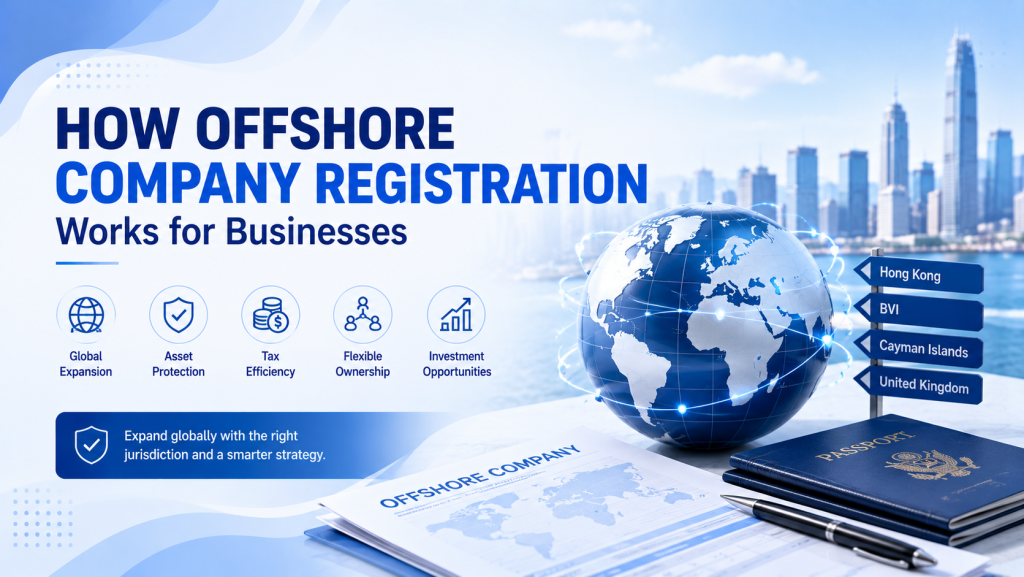
For international entrepreneurs, offshore company registration can provide a practical structure for cross-border business, international investment, global trade, and overseas expansion. Popular jurisdictions include Hong Kong, the British Virgin Islands (BVI), the Cayman Islands, Singapore, and the United Kingdom. However, each jurisdiction has different incorporation rules, tax systems, reporting requirements, and compliance obligations.
Therefore, choosing an offshore jurisdiction should not depend only on registration costs or tax rates. Instead, you should consider your business model, target markets, banking needs, ownership structure, and long-term plans. This guide explains the main points you should understand before starting offshore company registration.
Offshore Company Registration Process
Although the exact procedure varies by jurisdiction, the general offshore company registration process usually follows several basic steps.
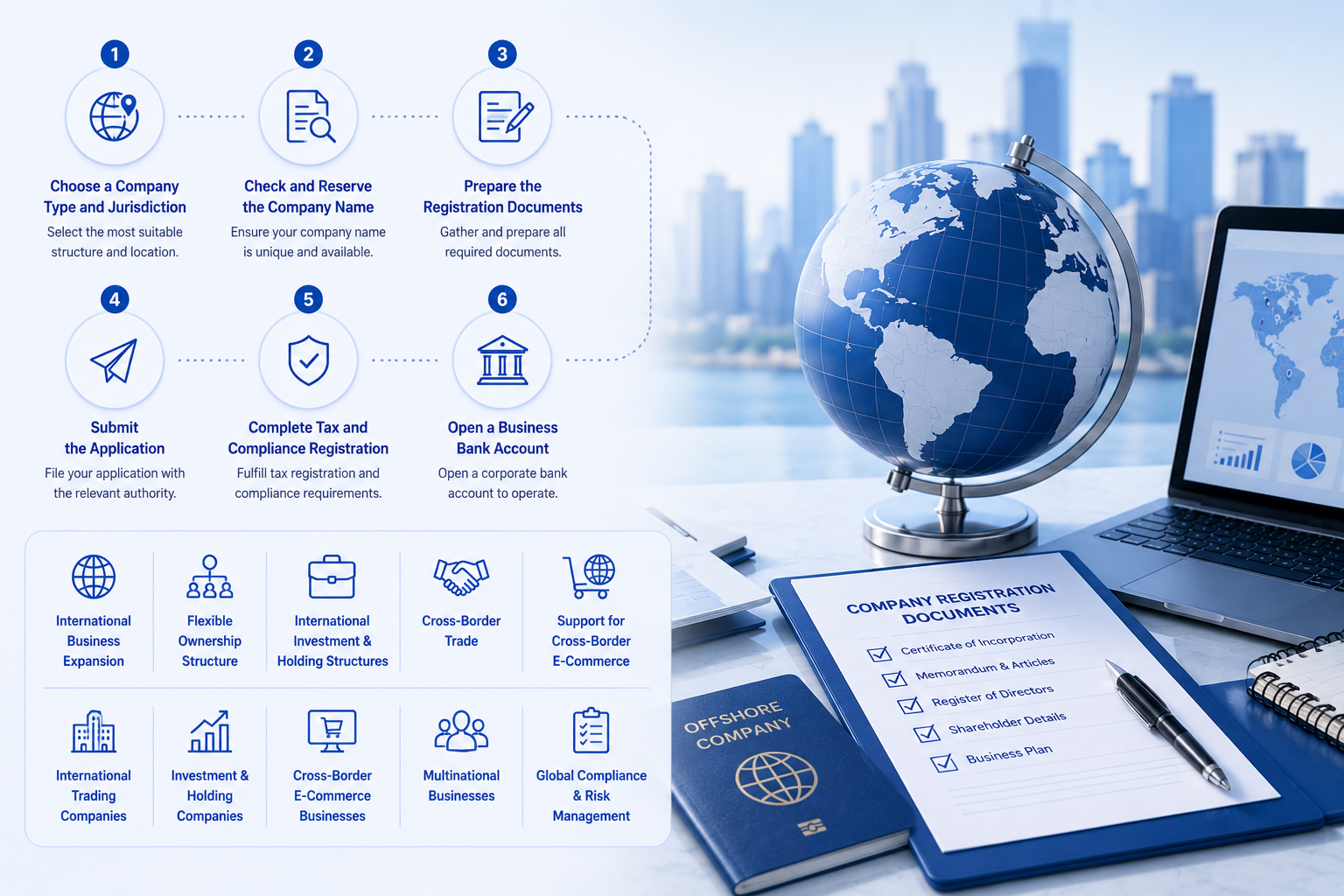
1. Choose a Company Type and Jurisdiction
First, determine what type of company you need and where you want to incorporate it. Different jurisdictions suit different business purposes.
For example, Hong Kong may work well for international trading and Asia-focused businesses. BVI and the Cayman Islands are commonly associated with holding structures and international investment. Meanwhile, the UK can be suitable for businesses that want a company structure connected to a major international market. Therefore, you should compare the jurisdiction's company law, taxation, banking environment, reporting rules, and ongoing costs before making a decision.
2. Check and Reserve the Company Name
Next, choose a suitable company name and check its availability with the relevant authority. The name must normally comply with local naming rules. In addition, some jurisdictions restrict specific words or expressions that could suggest banking, insurance, government, or other regulated activities. A name check before filing can help reduce the risk of delays or rejection.
3. Prepare the Registration Documents
After selecting the jurisdiction and company name, prepare the required documents.
Depending on the jurisdiction and company structure, these documents may include:
- Passport or identity documents of directors and shareholders
- Proof of residential address
- Proposed company name
- Registered office information
- Articles of association
- Shareholding information
- Business activity information
- Beneficial ownership information
For international applicants, additional due diligence documents may also be required.
4. Submit the Application
Once the documents are ready, the incorporation application can be submitted to the relevant company registry, usually directly or through an authorized corporate service provider. After approval, the company receives incorporation documents confirming its legal existence. The exact documents vary between jurisdictions.
5. Complete Tax and Compliance Registration
Company registration does not mean that all compliance obligations have been completed. Depending on the business and jurisdiction, you may need to arrange tax registration, obtain a tax identification number, maintain accounting records, submit annual returns, or meet beneficial ownership requirements.
For example, Hong Kong requires companies to meet ongoing filing obligations. A Hong Kong private company generally needs to submit an annual return within 42 days after the anniversary of its incorporation.
6. Open a Business Bank Account
Finally, you can prepare the company documents and supporting materials required for business banking. Banks normally review the company's business model, ownership structure, expected transaction activity, source of funds, and customer or supplier information. As a result, company registration alone does not guarantee that a bank will approve an account.

Benefits of Offshore Company Registration
For suitable businesses, offshore company registration can provide several practical advantages. However, the benefits depend heavily on the chosen jurisdiction and the company's actual business activities.
International Business Expansion
An offshore company can provide a legal structure for conducting business across multiple markets. For example, an international trading company may use an overseas entity to manage contracts, suppliers, customers, and cross-border payments. As a result, the company can create a clearer structure for international operations.
Flexible Ownership Structure
Many international jurisdictions allow foreign individuals and companies to become shareholders or directors. This flexibility can be useful for entrepreneurs who do not live in the jurisdiction where they establish their company. However, local requirements may still apply, so applicants should check the ownership and management rules before incorporation.
International Investment and Holding Structures
Some offshore jurisdictions are commonly used for holding companies and international investment structures. In particular, BVI and Cayman Islands companies may appear in international investment or corporate holding structures. Nevertheless, the suitability of such structures depends on the transaction, investors, tax residence, and applicable laws.
Cross-Border Trade
International trading companies may also consider offshore company registration when they operate across several markets. A properly structured overseas company can make it easier to manage international contracts and payments. However, an offshore company does not automatically eliminate customs duties, taxes, or other trade obligations. Therefore, businesses should never treat offshore registration as a way to avoid legal or tax responsibilities.
Support for Cross-Border E-Commerce
For e-commerce businesses, an overseas company can sometimes support international payment collection, supplier relationships, marketplace operations, and overseas expansion. However, the company still needs to comply with the laws of the countries where it sells products or provides services.
Popular Jurisdictions for Offshore Company Registration
Different jurisdictions offer different advantages. Therefore, there is no single “best” location for every international entrepreneur.
Hong Kong
Hong Kong is a popular choice for businesses involved in international trade and Asia-Pacific operations. Its location, financial infrastructure, and international business environment make it attractive to companies that work with customers and suppliers across Asia and other markets.
Hong Kong also follows a territorial source principle for profits tax. Generally, profits arising in or derived from Hong Kong from a trade, profession, or business may be subject to profits tax, while foreign-sourced profits may receive different treatment depending on the applicable rules and circumstances.
Therefore, companies should assess the actual source of their profits instead of assuming that a Hong Kong company automatically has no tax obligations. Hong Kong companies must also maintain ongoing corporate compliance. For example, local private companies generally submit an annual return within 42 days after their incorporation anniversary.
British Virgin Islands
The British Virgin Islands, commonly known as BVI, is another well-known jurisdiction for international corporate structures. BVI companies are often considered for holding companies, investment structures, joint ventures, and cross-border transactions. However, businesses still need to meet applicable accounting, beneficial ownership, and regulatory requirements. Therefore, BVI should be evaluated based on the entire corporate structure rather than simply its incorporation cost.
Cayman Islands
The Cayman Islands is widely recognized as an international financial center and is commonly used for investment funds, holding structures, and international transactions. Its corporate framework can be attractive to international investors. Nevertheless, companies should consider the purpose of the structure, investor requirements, reporting obligations, and tax rules in the countries where the owners and businesses operate.
United Kingdom
The UK can also be considered by international entrepreneurs who want to establish a company in a major global market. Compared with traditional offshore jurisdictions, the UK provides a more mainstream corporate environment. It may therefore be suitable for businesses that want a recognizable company structure while operating internationally. However, UK companies have ongoing reporting and tax obligations, so entrepreneurs should consider compliance costs before choosing this option.
Who Should Consider Offshore Company Registration?
Offshore company registration may be suitable for several types of international businesses.
International Trading Companies
Companies that regularly purchase products from one country and sell them in another may consider an overseas structure to support their international operations.
Investment and Holding Companies
Investors and business groups may establish holding companies to organize investments, subsidiaries, or joint ventures. However, the structure should match the applicable tax and corporate laws in every relevant jurisdiction.
Cross-Border E-Commerce Businesses
E-commerce companies that sell products or services internationally may consider an overseas company as part of their global business structure. In addition, the company may need suitable payment and banking solutions to support international transactions.
Multinational Businesses
Businesses operating in several countries may use overseas entities to organize different parts of their international operations. As the structure becomes more complex, professional tax and legal advice becomes increasingly important.
Key Considerations Before Offshore Company Registration
Although offshore company registration can offer structural flexibility, entrepreneurs should consider several important issues before incorporating.
Tax Compliance
An offshore company does not automatically make its income tax-free. Your tax obligations may depend on where the company operates, where management takes place, where income is generated, and where the shareholders or beneficial owners are tax residents. Therefore, you should review both the company's local tax obligations and the tax rules that apply to the owners.
Annual Compliance
Most jurisdictions require companies to maintain certain corporate records and complete periodic filings. For example, Hong Kong companies have annual return obligations, and late filing can result in substantially higher registration fees. As a result, businesses should keep track of incorporation dates, filing deadlines, government fees, accounting records, and other compliance requirements.
Banking
Opening a bank account can be more difficult than incorporating a company. Banks may ask for information about the company's business model, expected transactions, customers, suppliers, source of funds, and ownership structure. Therefore, preparing a clear business profile and supporting documents can improve the account-opening process.
Substance and Business Activities
Some international tax rules focus on economic substance, management, and actual business activities. Therefore, companies should not choose a jurisdiction simply because it has a low or favorable tax environment. Instead, the company structure should reflect its genuine business purpose and actual operations.
Professional Service Provider
For international entrepreneurs, handling every incorporation and compliance procedure alone can be difficult. A professional service provider can help with company formation, document preparation, annual compliance, tax-related coordination, and other administrative tasks.
For example, IngStart provides an online platform for international company registration and ongoing corporate services. Entrepreneurs can use its services to manage company formation, banking support, annual compliance, tax-related services, and company records through a more centralized process.
How to Choose the Right Offshore Jurisdiction
There is no universal answer when choosing a jurisdiction for offshore company registration. Instead, compare the following factors:
| Factor | What to Consider |
|---|---|
| Business purpose | Trading, investment, holding, e-commerce, or other activities |
| Location | Main customers, suppliers, and markets |
| Tax | Corporate tax and international tax implications |
| Banking | Availability of suitable business banking options |
| Compliance | Annual returns, accounting, and reporting requirements |
| Ownership | Rules for foreign shareholders and directors |
| Cost | Incorporation and annual maintenance expenses |
| Reputation | International recognition and banking acceptance |
| Long-term plans | Expansion, investment, financing, or restructuring |
By comparing these factors together, you can avoid choosing a jurisdiction based only on its registration fee or tax rate.
Offshore Company Registration: Final Thoughts
Offshore company registration can be useful for international trade, cross-border e-commerce, investment, holding structures, and global expansion. However, the right jurisdiction depends on your business model and long-term goals.
Hong Kong, BVI, the Cayman Islands, and the UK each have different corporate and compliance environments. Therefore, entrepreneurs should compare taxation, banking, reporting, ownership, and ongoing costs before making a decision.
Most importantly, an offshore company should serve a genuine business purpose and remain compliant with the laws of the jurisdictions involved. With the right structure and ongoing management, offshore company registration can become a practical part of an international business strategy.
Article Recommendations
- US Company Maintenance Costs: What Business Owners Need to Know
- C-Corp Holding LLC: How to Legally Reduce US Business Taxes in 2026
- US Company Registration: 10 Common Questions Answered
If you still have questions, please contact our team on WhatsApp at +1 213 751 2111. We'll help you find the right solution for your business and keep your company compliant as it grows.