
What Is Hong Kong Company Holding?
Hong Kong Company Holding is a structure in which a Hong Kong company invests in and holds shares in a company established in mainland China. International businesses may use this structure to manage investments, support cross-border operations, and prepare for future expansion.
For mainland Chinese businesses, a Hong Kong holding company may also provide a route to international investment and capital markets. However, the benefits depend on the company's business activities, ownership structure, and applicable laws. Setting up a Hong Kong company does not automatically provide tax advantages or remove mainland China's investment and foreign exchange requirements.
How Does Hong Kong Company Holding Work?
A Hong Kong company can invest in a mainland Chinese company as a foreign investor, subject to the applicable foreign investment rules. The mainland company may then be classified as a foreign-invested enterprise, depending on its ownership and structure.

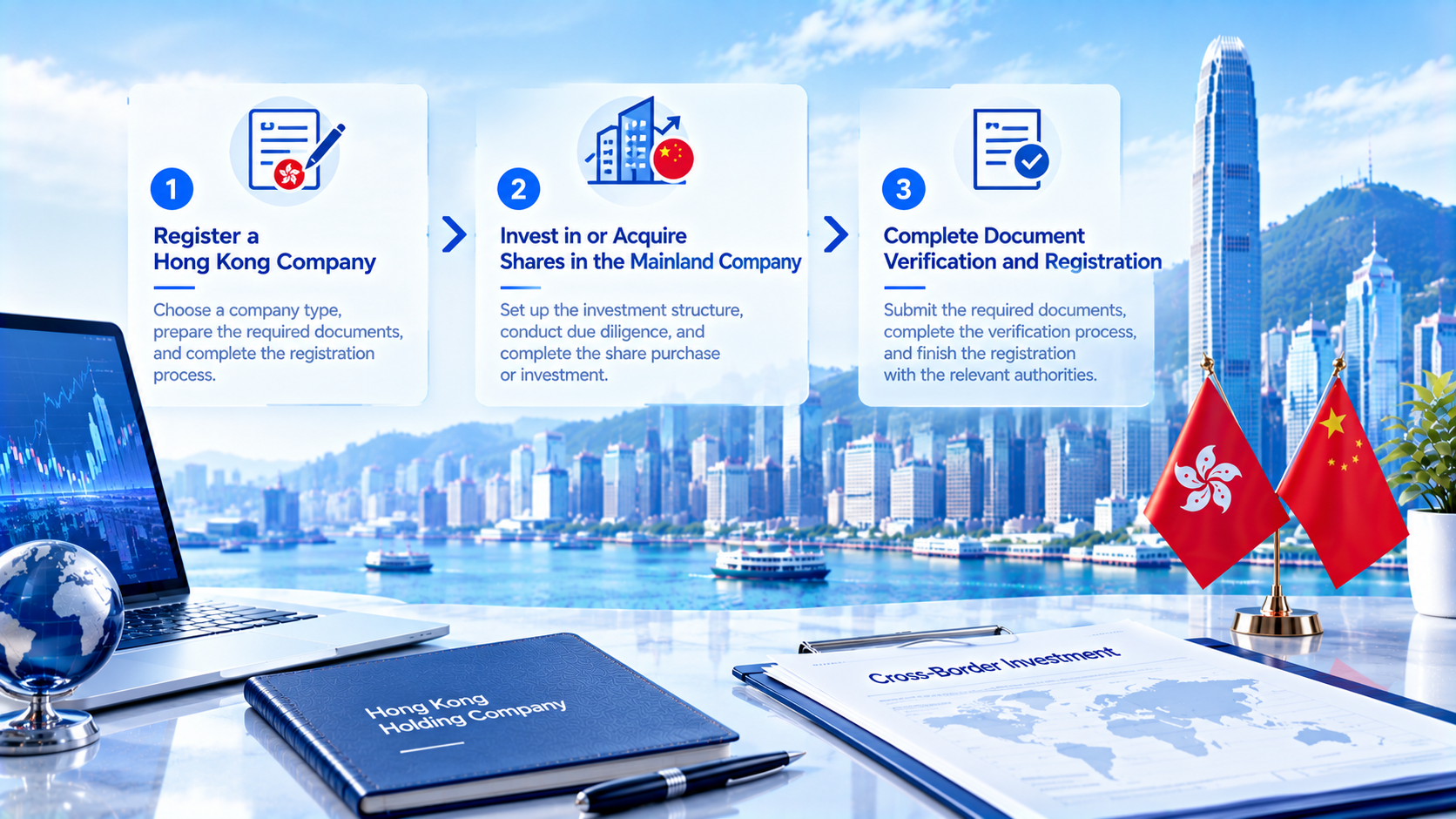
The process generally involves these steps:
1. Register a Hong Kong Company
First, establish a Hong Kong company that will act as the holding company. Prepare its incorporation documents and ownership information for the proposed investment in mainland China.
The Hong Kong company may need to provide certified or notarized documents, depending on the requirements of the relevant mainland registration authority and the specific transaction.
2. Invest in or Acquire Shares in the Mainland Company
Next, the Hong Kong company can invest in a new mainland business or acquire shares in an existing company. The parties must follow the relevant company registration, foreign investment, and other regulatory procedures.
For an existing mainland company, the transaction may require shareholder approvals, amendments to company records, registration updates, and supporting documents. The exact requirements depend on the type of transaction and the company's industry.
Importantly, there is no general rule that a Hong Kong company can hold no more than 49% of every mainland Chinese company. Foreign ownership limits depend on the industry and the applicable negative lists or other restrictions.
3. Complete Document Verification and Registration
The Hong Kong company may need to prepare incorporation records, proof of authority, shareholder information, and other supporting documents. Depending on the procedure, documents may need notarization, certification, or other verification before mainland authorities accept them.
The investor must also comply with applicable foreign investment reporting, registration, and foreign exchange requirements. Because the process can involve several authorities and document checks, professional assistance may help reduce avoidable delays.
What Are the Benefits of Hong Kong Company Holding?
A Hong Kong holding company can offer several potential advantages for businesses operating across mainland China and international markets. However, each benefit depends on the company's actual circumstances.
1. Access to Foreign Investment Structures
Using a Hong Kong company to invest in a mainland business can create a foreign-invested ownership structure. This may be useful for companies seeking overseas investment, international partners, or a clearer structure for cross-border operations.
However, foreign-invested status does not automatically qualify a company for special tax treatment or government incentives. Businesses must meet the requirements of each relevant policy.
2. Tax Planning Opportunities
Hong Kong has a territorial profits tax system and a two-tiered profits tax rate regime. For corporations, the standard rate is 16.5%, while the first HK$2 million of qualifying assessable profits may be taxed at 8.25%, subject to the applicable conditions.
A Hong Kong holding structure may also be relevant when planning cross-border dividends or other payments. Under mainland China's domestic rules, dividends paid to a foreign corporate shareholder may generally be subject to withholding tax. A reduced rate may be available under an applicable tax treaty or arrangement if the relevant conditions are met.
For example, the mainland China–Hong Kong tax arrangement may provide a reduced withholding tax rate on qualifying dividends. However, the outcome depends on factors such as beneficial ownership, tax residency, shareholding, and anti-abuse rules. Therefore, businesses should obtain tax advice before relying on a specific rate.
3. Greater Cross-Border Capital Flexibility
Hong Kong is an international financial center with a freely convertible currency and no general foreign exchange controls of the kind applied in mainland China. This can make it convenient for companies managing international investments and payments.
Nevertheless, investing funds into mainland China or transferring money out of the mainland remains subject to the applicable capital contribution, banking, tax, and foreign exchange procedures. A Hong Kong company does not remove these requirements.
4. A Flexible Structure for International Expansion
A Hong Kong holding company can serve as an intermediate entity between mainland operations and overseas investors or subsidiaries. Depending on the business plan, it may help organize ownership, manage investments, and prepare for fundraising or international expansion.
Some businesses also consider Hong Kong as part of a longer-term capital markets strategy. However, incorporating a Hong Kong company does not guarantee eligibility for a Hong Kong stock market listing. Listing applicants must satisfy the relevant exchange rules and regulatory requirements.
5. Clearer Separation of Ownership and Operations
A holding company can separate ownership of a mainland business from its day-to-day operations. This may help a group organize investments, bring in new shareholders, or manage several subsidiaries under one structure.
However, a holding company does not automatically conceal its beneficial owners. Hong Kong companies must comply with applicable company record and significant controllers requirements, while mainland companies also have relevant disclosure and registration obligations.
6. Lower Physical Office Costs for the Holding Company
A Hong Kong holding company may not need a large operating office if its role is limited to holding shares and managing investments. This can help reduce certain office and staffing costs.
However, a Hong Kong company must still maintain a registered office in Hong Kong, appoint a company secretary, and meet applicable annual filing and tax obligations. A registered address or corporate service provider does not replace any genuine operational substance required by law or for tax purposes.
How IngStart Can Help
For international entrepreneurs, setting up a Hong Kong holding company involves more than incorporation. The investor may also need to prepare corporate documents, understand mainland investment procedures, and manage ongoing compliance in multiple jurisdictions.
IngStart provides company registration and ongoing compliance services for international businesses. Its services can help entrepreneurs organize corporate documents and manage recurring administrative tasks when establishing and maintaining overseas company structures.
Before proceeding, businesses should confirm the relevant foreign investment restrictions, tax treatment, and document requirements for their specific transaction.
Conclusion
Hong Kong Company Holding can help businesses organize cross-border investments, access international financial services, and build a structure for future expansion. It may also create tax planning opportunities when the company meets the relevant domestic and treaty requirements.
However, the structure does not automatically provide tax exemptions, unrestricted capital transfers, or anonymity for shareholders. Foreign ownership restrictions, tax rules, document verification, and ongoing compliance must all be considered.
By reviewing the business purpose and legal requirements before investing, companies can decide whether a Hong Kong holding company is suitable for their mainland China operations and long-term international plans.
Article Recommendations
- Hong Kong Company Registration: Do Individuals Need ODI Filing?
- Hong Kong Business Registration Guide: How to Apply for a Business Registration Certificate
- Hong Kong Trademark Registration Guide: Process, Documents, and Validity
If you still have questions, please contact our team on WhatsApp at +1 213 751 2111. We'll help you find the right solution for your business and keep your company compliant as it grows.