

US Investment Tax for Foreigners: Income, Withholding, and ECI
The United States offers foreign investors access to stocks, real estate, intellectual property, partnerships, and one of the world’s largest consumer markets. However, earning income from US investments can also create federal tax and reporting obligations.
The rules for US investment tax for foreigners depend on the investor’s tax residency, the type of income received, where the income comes from, and whether it is connected with a US trade or business.
For US federal tax purposes, a foreign individual is generally classified as either a resident alien or a nonresident alien. Resident aliens are generally taxed in a similar way to US citizens and must report worldwide income. Nonresident aliens are usually taxed only on certain US-source income and income connected with a US business.
Most taxable income earned by a nonresident alien falls into one of two categories:
- Fixed, Determinable, Annual, or Periodical income, known as FDAP income
- Effectively Connected Income, known as ECI
Understanding the difference between these categories is essential before investing, operating a company, or purchasing property in the United States.
FDAP Income vs. Effectively Connected Income
FDAP income generally includes passive US-source income such as dividends, interest, rents, and royalties.
When FDAP income is not connected with a US trade or business, it is generally taxed at a flat rate of 30% on the gross amount. A US tax treaty may reduce or eliminate this tax for qualifying residents of certain countries.
Because the tax is imposed on gross income, investors generally cannot deduct expenses related to non-ECI FDAP income.
Effectively Connected Income is treated differently. ECI is income connected with conducting a trade or business in the United States. It is generally taxed on net income after allowable business expenses and deductions.
Nonresident alien individuals typically report ECI on Form 1040-NR and pay tax at the applicable graduated federal income tax rates.
Tax on US Stock Income for Foreign Investors
Foreign investors commonly earn two types of income from US stocks:
- Dividends
- Capital gains from selling shares
The two types of income are taxed differently.
US Stock Dividends
Dividends paid by US corporations to nonresident aliens are generally treated as US-source FDAP income.
The standard federal withholding rate is 30% of the gross dividend. However, an applicable income tax treaty may reduce the rate, often to 15%, 10%, or another treaty-specific percentage.
To claim treaty benefits, the foreign investor usually provides Form W-8BEN to the broker or withholding agent. This form confirms the investor’s foreign status and country of tax residence.
The treaty rate depends on:
- The investor’s country of residence
- Whether a US tax treaty is available
- Whether the investor qualifies as the beneficial owner
- The specific dividend provisions in the treaty
Foreign investors should submit a valid Form W-8BEN before receiving dividends. Without proper documentation, the broker may apply the full 30% withholding rate.

Capital Gains From Selling US Stocks
Capital gains from selling ordinary shares in US companies are generally not subject to US federal income tax for a nonresident alien.
However, exceptions may apply when:
- The gain is effectively connected with a US trade or business
- The investor is physically present in the United States for 183 days or more during the tax year
- The shares represent an interest in a US real property holding corporation
- Special partnership or real estate rules apply
An investor’s home country may still tax the gain even when no US federal tax is due.
Does Using a US Broker Create a US Business?
Buying and selling stocks or securities for your own account through a US broker generally does not mean that you are conducting a trade or business in the United States.
This trading safe harbor allows many foreign investors to use US brokerage accounts without having their investment income automatically classified as ECI.
The rule may not apply to securities dealers or investors whose activities form part of a broader US business.
Interest Earned From US Bank Accounts
Certain interest paid to a nonresident alien by a US bank, savings institution, or similar financial institution is generally exempt from US federal income tax, provided that the interest is not effectively connected with a US trade or business.
This exemption commonly applies to interest earned from:
- Savings accounts
- Checking accounts
- Certificates of deposit
- Certain bank deposit accounts
Qualifying portfolio interest from certain bonds and debt instruments may also be exempt from US tax.
However, not every payment called “interest” qualifies for an exemption. Interest from private loans, related-party financing, business debt, or nonqualifying securities may be taxable.
The foreign investor should provide Form W-8BEN to the bank or financial institution to document foreign status.

Royalties From US Intellectual Property
A foreign individual or company may earn royalties by allowing intellectual property to be used in the United States.
This can include income from:
- Copyrights
- Software
- Music
- Books and articles
- Patents
- Trademarks
- Films and videos
- Industrial processes
- Technical knowledge
The source of royalty income generally depends on where the intellectual property is used.
For example, when a foreign copyright owner licenses content for use in the United States, the resulting payment is normally treated as US-source royalty income.
US-source royalties paid to a nonresident alien are generally classified as FDAP income and subject to 30% withholding on the gross payment. A tax treaty may reduce or eliminate the withholding rate.
Some tax treaties apply different rates to copyright, patent, film, or industrial royalties. The recipient normally claims the treaty rate by giving Form W-8BEN to the payer.
Royalty income may instead be treated as ECI when the foreign owner actively operates a licensing, publishing, technology, or intellectual property business in the United States.
Tax on US Rental Property Income
Foreign owners of US real estate may be taxed on rental income in one of two ways.
Gross Rental Income Treatment
Under the default rule, passive rental income that is not connected with a US trade or business is generally treated as FDAP income.
It may be subject to a 30% tax on gross rental payments unless a treaty provides a lower rate.
Under this method, the owner generally cannot deduct expenses such as:
- Mortgage interest
- Property taxes
- Repairs
- Insurance
- Property management fees
- Maintenance
- Depreciation
This can be expensive because tax is imposed on the rent collected rather than the actual profit.
Electing to Treat Rental Income as ECI
A nonresident alien may generally elect to treat qualifying US real estate income as Effectively Connected Income.
With this election, the owner may deduct allowable expenses and pay tax on net rental income rather than gross rent.
Potential deductions include:
- Mortgage interest
- Property taxes
- Insurance
- Repairs and maintenance
- Management fees
- Professional fees
- Depreciation
The net income is generally reported on Form 1040-NR and taxed at graduated federal income tax rates.
Whether the election is beneficial depends on the property’s income, expenses, financing, and depreciation.
Selling US Real Estate
A gain or loss from selling a US real property interest is generally treated as effectively connected with a US trade or business.
The sale may also be subject to the Foreign Investment in Real Property Tax Act, commonly called FIRPTA.
Under FIRPTA, the buyer may be required to withhold part of the amount paid to the foreign seller. The withholding is generally a tax prepayment rather than the seller’s final tax liability.
The foreign seller usually files a US tax return to calculate the actual gain, claim allowable deductions, and receive credit for the tax withheld.
Selling or Transferring a US Partnership Interest
Foreign investors may hold interests in US partnerships, investment funds, real estate partnerships, or multimember LLCs taxed as partnerships.
Selling, exchanging, or otherwise disposing of a partnership interest may create US tax obligations.
Part of the gain may be treated as ECI when the partnership conducts a trade or business in the United States. Broadly, the rule looks at how much effectively connected gain the foreign partner would have received if the partnership had sold its assets.
The buyer may also be required to withhold 10% of the amount realized under Section 1446(f), unless an exception applies.
The amount realized can include:
- Cash paid to the seller
- The value of other property transferred
- Certain partnership liabilities allocated to the seller
The foreign seller may need to file a US tax return to calculate the actual taxable gain and claim credit for the withholding.
What Is Effectively Connected Income?
Effectively Connected Income refers to income connected with a foreign person’s conduct of a trade or business in the United States.
Whether a foreign investor is conducting a US trade or business depends on the facts. Relevant factors may include:
- Where services are performed
- Whether business activities are regular and continuous
- Whether the person maintains a US office
- Whether employees or dependent agents work in the United States
- Whether the person owns an interest in a partnership conducting a US business
- Whether the income is directly related to US business activities
The following income categories are commonly treated as ECI.
1. Taxable Scholarships for F, J, M, or Q Visa Holders
Foreign students, teachers, trainees, and researchers temporarily present in the United States under F, J, M, or Q visas may be treated as engaged in a US trade or business for certain federal tax purposes.
The taxable portion of a US-source scholarship, fellowship, or research grant may therefore be treated as ECI.
Not every scholarship payment is taxable. Amounts used for qualifying tuition, required fees, books, and equipment may be excluded when applicable requirements are met.
2. Income From a Partnership Conducting a US Business
A foreign person who is a partner in a partnership conducting a US trade or business is generally treated as conducting that business as well.
The foreign partner’s share of partnership ECI is subject to US tax even when the partnership does not distribute the related cash.
The partnership may also be required to withhold tax on ECI allocated to foreign partners.
This rule can create a cash-flow issue because the foreign partner may owe tax on allocated profit before receiving a distribution.
3. Income From Personal Services Performed in the United States
Compensation for services physically performed in the United States is generally treated as ECI.
Examples may include:
- Consulting
- Freelance work
- Professional services
- Speaking engagements
- Training services
- Technical work
- Employment income
The place where the services are performed is usually more important than where the customer is located or where payment is received.
A tax treaty may provide an exemption in limited circumstances, particularly when the individual is present in the United States only temporarily.
4. Income From a Business Operated in the United States
Income earned from owning and operating a US business is generally ECI.
This may include revenue from:
- Selling products
- Providing services
- Operating an online business
- Importing goods into the United States for sale
- Maintaining inventory in the United States
- Running a store, office, or warehouse
- Employing staff or dependent agents in the United States
For example, a foreign entrepreneur who imports products and sells them to US customers through a business operated in the United States may earn ECI.
Simply registering a US LLC does not automatically mean that all income is ECI. The actual activities of the company and owner must be considered.
5. Gains From Selling US Real Property
Gains and losses from selling or exchanging US real property interests are generally treated as ECI.
This rule can apply to:
- Residential property
- Commercial buildings
- Land
- Certain shares in US real property holding companies
- Certain partnership interests connected with US property
The foreign seller may have filing and FIRPTA withholding obligations even when the property was held only as an investment.
6. Rental Income Treated as ECI by Election
A nonresident alien can generally elect to treat qualifying US rental income as ECI.
This allows the owner to deduct eligible property expenses and pay tax on net rental profit.
The election can be valuable for properties with substantial mortgage interest, management costs, repairs, or depreciation. However, it also creates an ongoing US tax filing obligation.

How Is ECI Taxed?
Nonresident aliens generally pay federal income tax on ECI after deducting necessary and allowable expenses connected with the income.
Potential deductions may include:
- Business operating expenses
- Professional fees
- Property expenses
- Depreciation
- Interest
- Employee compensation
- Travel expenses that meet tax requirements
- Other ordinary and necessary costs
The resulting net income is generally taxed at the graduated rates that apply to US taxpayers.
A nonresident alien individual usually reports ECI on Form 1040-NR. Additional forms may be required for rental property, partnerships, business income, real estate sales, or treaty positions.
Treaty Protection and Permanent Establishment Rules
A US income tax treaty may limit the United States’ ability to tax certain business profits.
Under many treaties, the United States may tax a foreign resident’s business profits only when the person operates through a US permanent establishment.
A permanent establishment may include:
- A fixed office
- A branch
- A place of management
- A workshop
- A factory
- Certain activities performed by a dependent agent
Treaty protection depends on the specific treaty and the investor’s eligibility. Not every country has a tax treaty with the United States, and treaty benefits usually require proper documentation and disclosure.
Forms Commonly Used by Foreign Investors
Foreign investors may encounter several US tax forms:
Form W-8BEN
Used by foreign individuals to certify foreign status and claim tax treaty benefits.
Form 1042-S
Issued to report certain US-source payments made to foreign persons and the tax withheld.
Form 1040-NR
Used by nonresident alien individuals to report ECI and certain other taxable US income.
Form W-8ECI
Provided to a payer when income is effectively connected with a US trade or business and should not be subject to ordinary FDAP withholding.
Schedule E
May be used to report rental property or pass-through income together with Form 1040-NR.
Schedule K-1
Provided by partnerships to report a partner’s share of income, deductions, and credits.
Form 8288-A
Commonly associated with FIRPTA withholding when a foreign person sells US real property.
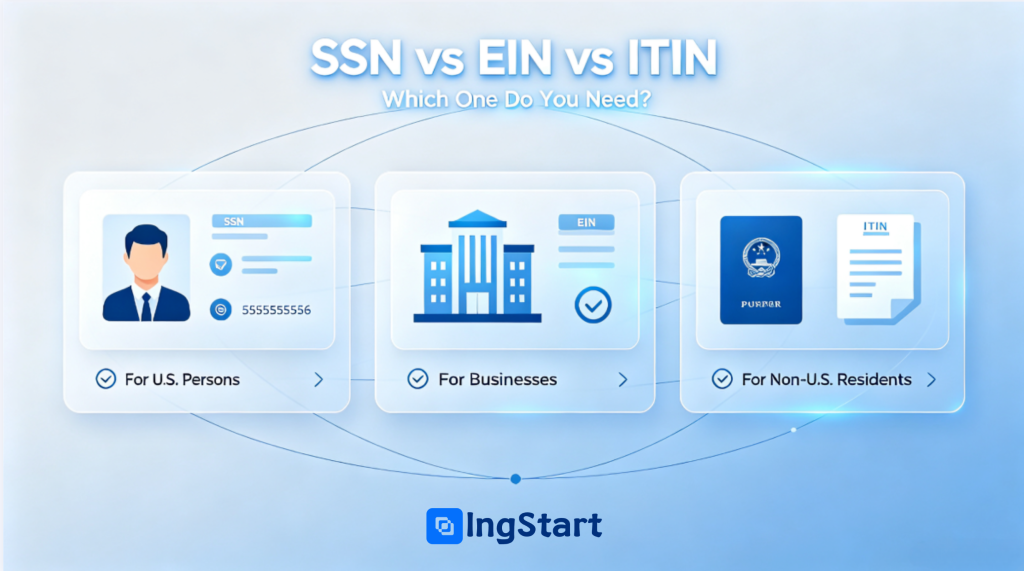
Does a Foreign Investor Need an ITIN?
A foreign investor may need an Individual Taxpayer Identification Number when required to file a US individual tax return but is not eligible for a Social Security Number.
An ITIN may be needed to:
- File Form 1040-NR
- Report rental income
- Report partnership income
- Report a US property sale
- Claim a tax refund
- Claim certain treaty benefits
- Meet another federal tax reporting requirement
An ITIN is not automatically required merely because a foreign person owns US stocks, opens a bank account, or forms a US LLC.
US Investment and Company Compliance With IngStart
Foreign investors often need to coordinate several separate matters, including company registration, EIN applications, tax identification, annual state filings, and federal reporting.
IngStart provides global company registration and compliance support for international entrepreneurs establishing companies in the United States and other major markets. Its services can help founders complete company formation, obtain an EIN, and understand the compliance steps that follow registration.
However, investment tax treatment depends on the individual investor’s residence, income type, business activities, and applicable treaties. Complex cases involving partnerships, real estate, ECI, or cross-border structures should be reviewed with a qualified US tax professional.
Final Thoughts
US investment tax for foreigners is not determined by a single withholding rate.
The correct treatment depends on:
- Whether the investor is a resident or nonresident alien
- Whether the income is US-source
- Whether it is FDAP income or ECI
- Whether a tax treaty applies
- Whether the investor is conducting a US trade or business
- Whether the investment involves real estate or a partnership
US dividends and royalties are commonly subject to withholding, while qualifying bank deposit interest and portfolio interest may be exempt. Ordinary stock gains are often not taxed for nonresident aliens, but real estate and partnership transactions are subject to special rules.
ECI is generally taxed on net income after allowable deductions, while non-ECI FDAP income is usually taxed on the gross amount.
Foreign investors should determine the tax treatment before receiving income or completing a transaction. Proper planning can help prevent excessive withholding, missed filing obligations, and unexpected US tax liabilities.
This article is for general informational purposes only and does not constitute tax, legal, investment, or financial advice. US tax rules and treaty provisions may change, and individual circumstances vary.