
Citi Bank Account for Non-U.S. Residents: Eligibility, Requirements & What to Expect
If you are looking to open a Citi Bank Account, Citibank may be one of the first banks you consider. Citi has a long history of serving international customers and operates across many countries. As a result, it can be an attractive option for people who need international banking services.
However, one question often comes up among international applicants: Can non-U.S. residents open a Citi Bank Account? The answer is yes, but eligibility depends on your circumstances. Your country of residence, account type, tax residency, documentation, and Citi's compliance requirements can all affect the application. Therefore, before applying, it is important to understand how the process works and what Citi may ask you to provide.
Does Citi Accept Non-U.S. Residents?
Yes, Citi serves international customers in many markets. However, the availability of a Citi Bank Account depends on the country, banking product, and Citi entity handling the application. For example, someone applying for an account with Citi in Singapore may face different requirements from someone applying for a U.S. checking or savings account. Each country has its own banking rules, identity verification procedures, and tax reporting requirements.
Therefore, there is no single application process that applies to every non-U.S. resident. Instead, Citi reviews applications according to local regulations and its internal compliance policies.
Who Is Most Likely to Qualify for a Citi Bank Account?
Although requirements vary between countries, applicants may have a stronger application when they can show a genuine connection to the country or banking market.
Common examples include:
- Living or working in the country
- Owning property locally
- Operating a registered business
- Studying abroad
- Maintaining an existing relationship with Citi
- Traveling regularly for business or investment purposes
Simply wanting access to U.S. banking services may not be enough. In addition, banks generally expect applicants to have a legitimate reason for opening an account. Therefore, explaining your intended account use clearly can help the bank understand your application.
Documents You'll Typically Need
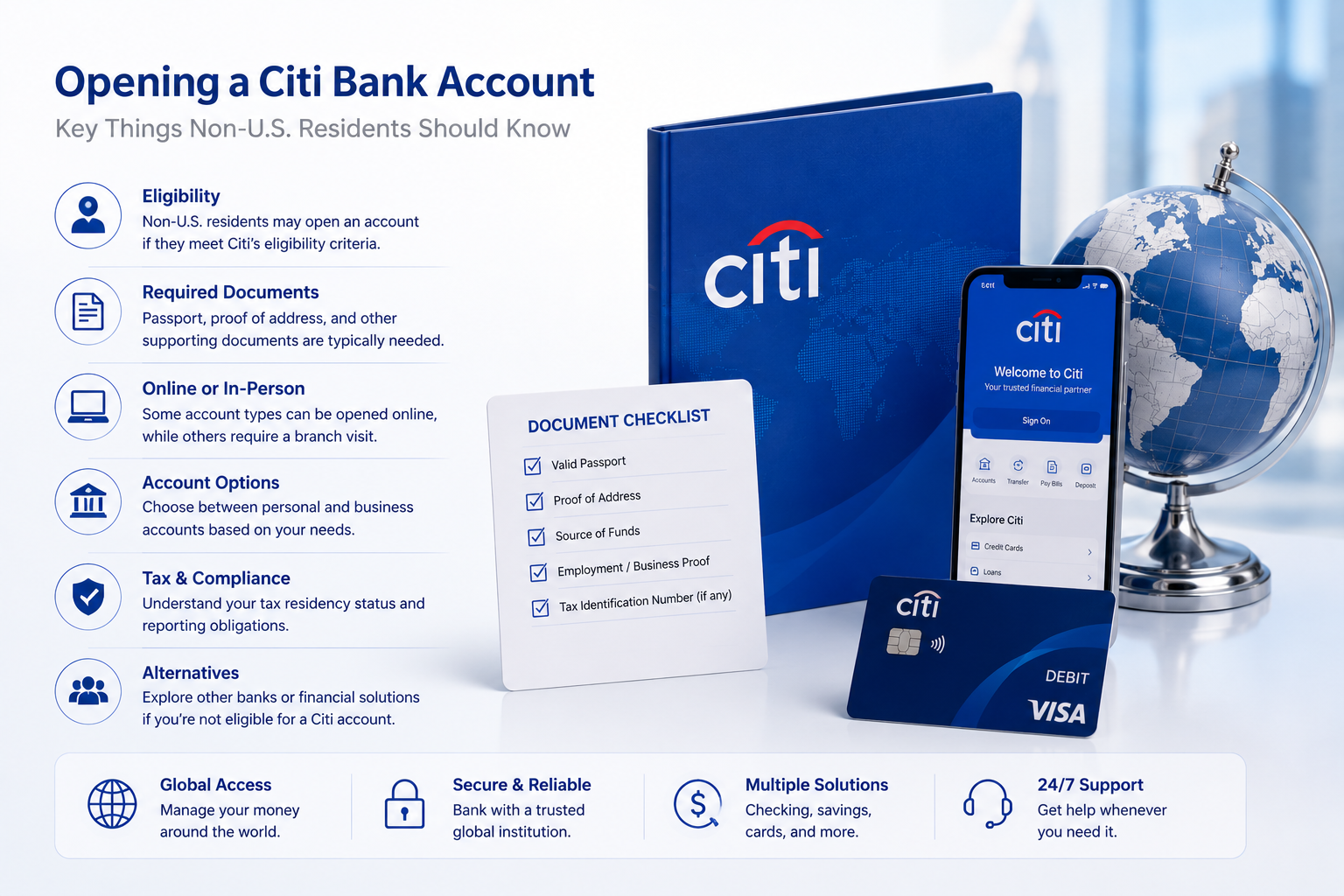
The documents required for a Citi Bank Account vary by location and account type. However, international applicants may commonly need some or all of the following:
- A valid passport or government-issued identification
- Proof of residential address
- Tax Identification Number (TIN), when applicable
- Documents showing the source of funds
- Visa or immigration documents, when relevant
- Additional financial information for certain account types
Some applicants may also need to complete identity verification through a video call or attend an appointment in person. For this reason, prepare your documents carefully before applying. Consistent and complete information can make the application process easier.
Can You Open a Citi Bank Account Online?
In some countries, yes. Citi offers digital onboarding for selected products and markets, allowing eligible customers to begin or complete the application online. You can check Citi's current account options and online application requirements on its official website Citi Bank Accounts and Online Application.
Furthermore, applicants who apply from outside their country of residence may face additional compliance checks. As a result, it is best to view online banking as an application option rather than a guarantee of remote account opening.
Why Are Some Citi Bank Account Applications Declined?
Having enough funds does not automatically guarantee approval. In many cases, compliance and identity verification play an important role in the bank's decision. Financial institutions must follow Know Your Customer (KYC) and Anti-Money Laundering (AML) requirements. These rules help banks prevent fraud, financial crime, and sanctions violations.
An application may be declined when:
- The applicant's identity cannot be fully verified.
- Residential information is incomplete or inconsistent.
- The applicant cannot show a clear banking purpose.
- Supporting documents do not meet local requirements.
- Internal compliance checks identify a higher level of risk.
However, a declined application does not necessarily mean that the applicant has done anything wrong. The decision may simply reflect the bank's compliance standards and risk management policies.
Understanding Tax Residency for a Citi Bank Account
Tax residency is another important part of the Citi Bank Account application process. In particular, applicants should understand that citizenship, residential status, and tax residency are different concepts. Citi may need to determine your tax residency to meet international reporting requirements, including the Foreign Account Tax Compliance Act (FATCA) and the Common Reporting Standard (CRS).
Depending on your circumstances, Citi may ask you to complete tax certification forms or provide information about your country of tax residence. Being a non-U.S. tax resident does not automatically prevent you from opening an account. However, it may affect the documents you need to provide and the reporting requirements connected with your account.
Should You Choose a Personal or Business Citi Bank Account?
Your intended use should determine whether you need a personal or business account. For everyday personal banking, a checking or savings account may be appropriate. On the other hand, entrepreneurs and business owners should consider a business account when the account will receive or send business funds.
Using a personal account for business revenue can create accounting problems. It may also conflict with the account's terms and conditions. Therefore, international entrepreneurs should keep personal and business finances separate whenever possible. A dedicated business account can make bookkeeping, tax reporting, and financial management easier.
Ingstart can provide support throughout the process. This can be especially useful for applicants who need to coordinate company registration with their banking and compliance needs. By handling these steps together, entrepreneurs can prepare their documents more efficiently and choose a banking solution that better matches their business structure.

What Are the Alternatives to a Citi Bank Account?
If you do not qualify for a Citi Bank Account, you may still have other international banking options.
Depending on your needs, you could consider:
- Banks with international customer programs
- Multi-currency banking services
- Offshore banking options available in your jurisdiction
- Digital financial institutions that support cross-border payments
- Local banks that provide U.S. dollar accounts
However, the best option depends on your purpose. For example, saving, investing, receiving international payments, and running a business may require different banking solutions.
Therefore, compare the account requirements and services before choosing an alternative.
Conclusion
Opening a Citi Bank Account as a non-U.S. resident is possible, but the process depends on several factors. Nationality is only one part of the assessment. Your country of residence, tax status, documents, intended account use, and compliance profile can also affect the result.
Before applying, review the requirements for the country and Citi entity you plan to use. Then, prepare your identification, address documents, tax information, and financial records in advance.
For international applicants, choosing the right account is not simply about finding the fastest application process. Instead, the goal is to find a banking relationship that fits your financial needs while meeting the relevant regulatory requirements.
Article Recommendations
- US Bank Accounts 2026: Remote Personal & Business Banking Guide
- US Tax Forms Guide: Complete List of Common IRS Tax Forms
- What Is an ITIN Number? A Complete Guide for Non-US Residents
If you still have questions, please contact our team on WhatsApp at +1 213 751 2111. We'll help you find the right solution for your business and keep your company compliant as it grows.