

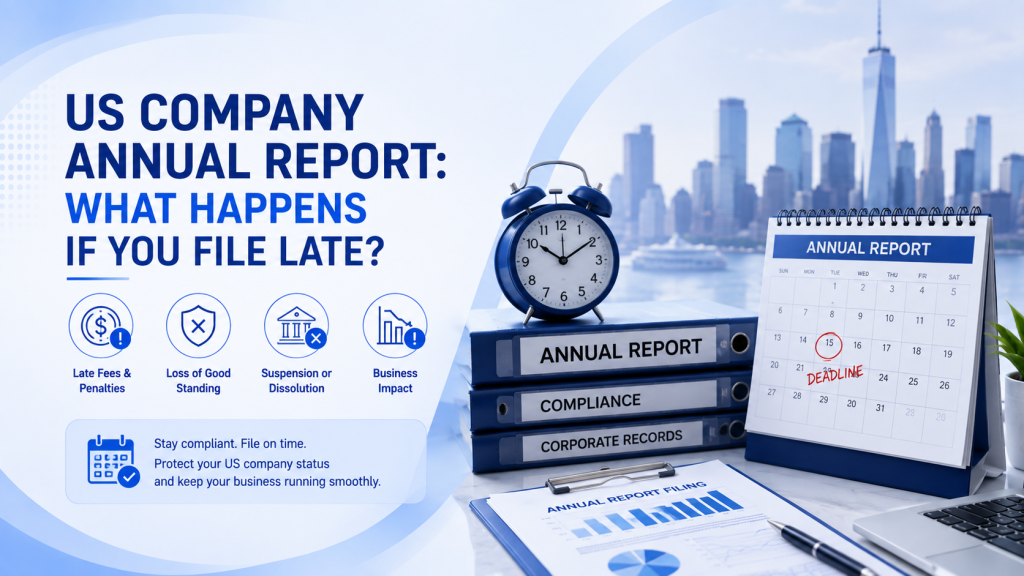
A US Company Annual Report is an important part of keeping a business compliant after formation. For non-U.S. business owners, it is easy to focus on company registration and overlook ongoing filing requirements. However, every state has its own rules, deadlines, and compliance procedures.
Missing a US Company Annual Report deadline can lead to late fees, penalties, loss of good standing, and, in serious cases, suspension or revocation of the company’s legal status. Therefore, understanding your filing obligations is essential if you operate a U.S. business in 2026.
What Happens When a US Company Annual Report Is Filed Late?
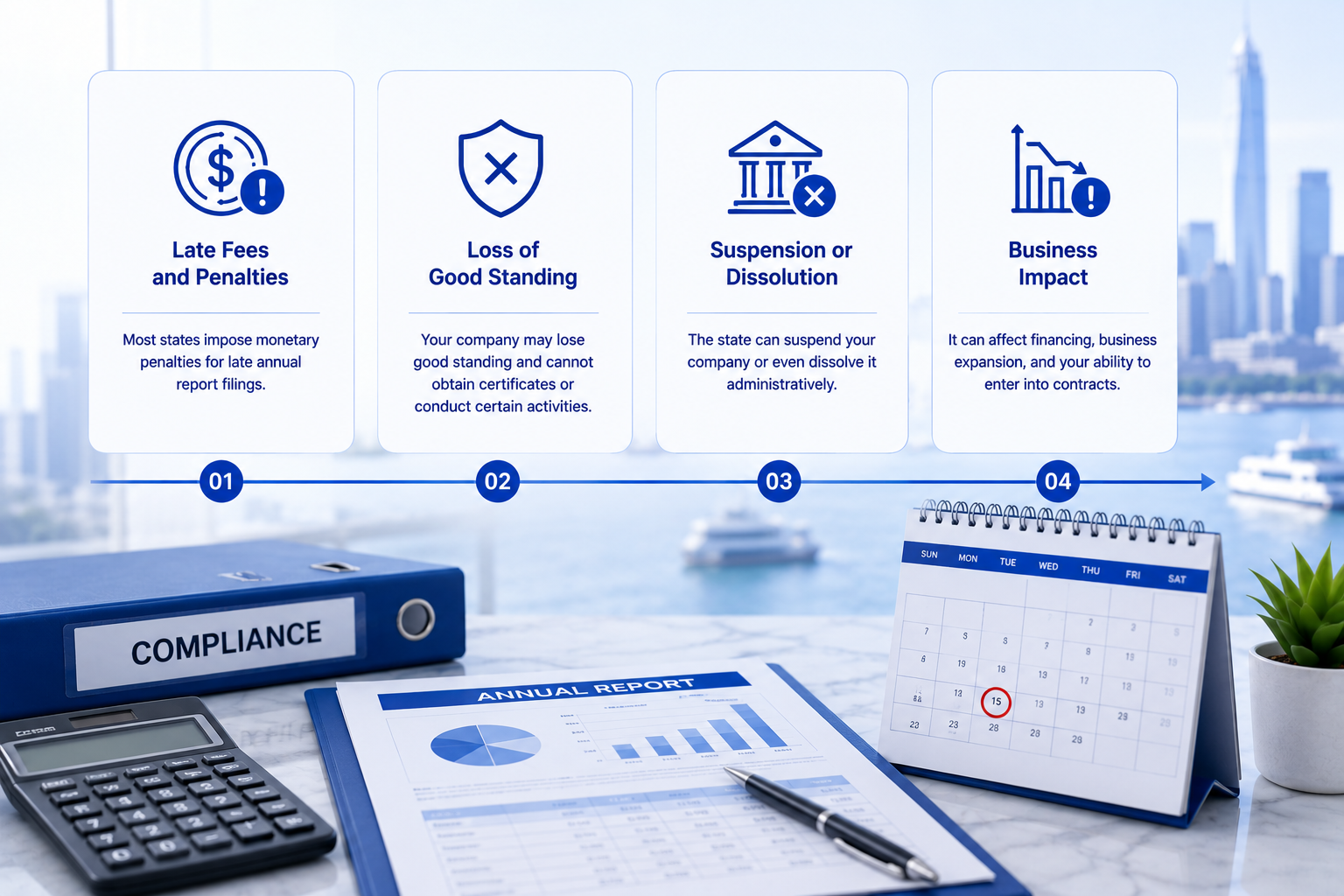
The consequences of filing a US Company Annual Report late depend on the state and the type of business entity. Nevertheless, several common problems may arise.
1. Government Penalties and Late Fees
The most direct consequence is a financial penalty. Some states charge a fixed late fee, while others add interest or penalties based on unpaid taxes. The longer a business remains non-compliant, the more expensive it may become to restore its status.
2. Loss of Good Standing
A late US Company Annual Report can cause a business to lose its good standing with the state. This may create problems when the company needs to:
- Open or maintain a business bank account
- Apply for financing
- Sign certain business contracts
- Register to operate in another state
- Obtain official certificates from the state
Therefore, even a small compliance issue can create wider operational problems.
3. Suspension or Administrative Dissolution
If a company ignores its filing obligations for too long, the state may suspend or revoke its authority to conduct business. In some cases, the state may administratively dissolve the company. Restoring a suspended or dissolved business often requires additional filings, penalties, and reinstatement fees.
4. Problems With Business Expansion
A company with overdue compliance filings may face difficulties when expanding its operations. For example, investors, banks, business partners, and government agencies may review the company's status before entering into important transactions. As a result, a missed US Company Annual Report deadline can affect future business opportunities.
Why Do Companies Miss Their US Company Annual Report Deadlines?
Late filings are often caused by simple compliance problems rather than intentional neglect.
For international business owners, the most common reasons include:
- Unfamiliarity with state filing requirements
- Confusion about different filing deadlines
- Failure to receive or notice reminder emails
- Changes in company management or ownership
- Incorrect registered agent or business address information
- Internal administrative delays
- Financial or operational difficulties
In addition, different states use different terms for similar compliance filings. Depending on the state, a business may need to file an Annual Report, Biennial Statement, Statement of Information, or franchise tax report.
This makes ongoing compliance more complicated for foreign entrepreneurs. For this reason, platforms such as IngStart can help international business owners manage company registration and follow-up compliance services through a more centralized online process.

US Company Annual Report Late Penalties by State
The following examples show how late filing rules differ between major U.S. business states in 2026.
New York US Company Annual Report Requirements
New York does not require standard business corporations and LLCs to file an annual report every year. Instead, they generally file a Biennial Statement every two years during the calendar month in which the company was originally formed or authorized.
The filing fee is $9. A business that misses the deadline can still file its overdue Biennial Statement, but companies should not assume that all compliance problems will disappear automatically. Other New York requirements, such as LLC publication rules or tax filings, may also affect a company's legal status. Therefore, New York businesses should track their Biennial Statement deadline carefully rather than treating the filing as a traditional annual requirement.
Texas US Company Annual Report Requirements
Texas businesses generally face an annual franchise tax reporting deadline of May 15. For the 2026 reporting year, the Texas Comptroller continues to require taxable entities to meet their filing obligations on time.
Late reports are subject to a $50 penalty. In addition, businesses that pay tax late may face a 5% penalty when payment is one to 30 days late and a 10% penalty when payment is more than 30 days late. Interest may also begin to accrue on unpaid tax balances. Continued non-compliance can lead to the loss of the company's right to transact business in Texas.
Florida US Company Annual Report Requirements
Florida requires many active business entities to file an Annual Report each year to maintain an active status with the state. The filing deadline is generally May 1. If an eligible business fails to file on time, Florida imposes a $400 late fee on profit corporations, LLCs, limited partnerships, and limited liability limited partnerships. Therefore, Florida companies should complete their US Company Annual Report filing before the deadline, even if there have been no changes to the company's information.
Delaware US Company Annual Report Requirements
There are different requirements depending on the business entity type in Delaware. Delaware corporations must generally file an Annual Report and pay franchise tax by March 1. A late corporate filing can result in a $200 penalty, plus 1.5% monthly interest on unpaid tax and penalties.
However, Delaware LLCs do not file a standard Annual Report. Instead, they generally pay an annual tax by June 1. Late payment can also result in a $200 penalty plus 1.5% monthly interest. Because Delaware rules differ between corporations and LLCs, international business owners should confirm their entity type before preparing their annual compliance documents.
California US Company Annual Report Requirements
California uses the term Statement of Information rather than a traditional Annual Report. The filing schedule depends on the type of entity. Generally, California stock corporations file annually, while LLCs file every two years. An initial Statement of Information is also required after formation or registration. Failure to file the required Statement of Information on time may result in a $250 penalty for most corporations and LLCs. Continued non-compliance may also lead to suspension or forfeiture of the business entity's rights. Therefore, California companies should pay close attention to their specific filing period rather than relying on a single annual deadline for all entity types.
Nevada US Company Annual Filing Requirements
Nevada requires many business entities to maintain their compliance through annual filings and state business license requirements. Missing these obligations can result in penalties and may place the company in default.
A late state business license renewal may result in an additional $100 penalty. Businesses that fail to meet applicable annual filing requirements may also face further enforcement actions, including default status or revocation of their authority to conduct business. Therefore, Nevada business owners should track both their entity filing requirements and their state business license obligations.
How to Avoid US Company Annual Report Penalties
The best way to avoid penalties is to manage compliance before a deadline becomes urgent.
First, keep your registered agent, business address, and contact information up to date. This helps ensure that important notices reach the right person.
Second, create a compliance calendar that includes annual reports, franchise taxes, biennial statements, and other state requirements. Each U.S. state follows different rules, so a single deadline cannot apply to every company.
Finally, international entrepreneurs can use professional compliance services to manage important filings. IngStart provides online company formation and compliance support for businesses operating across multiple jurisdictions. By combining company registration with ongoing compliance management, business owners can more easily track important deadlines after their U.S. company is formed.
Conclusion
A late US Company Annual Report can lead to more than a simple fine. Depending on the state, a business may face late penalties, interest charges, loss of good standing, suspension, or even administrative dissolution.
The rules also vary significantly between states. For example, Florida uses an annual filing deadline, New York generally requires a Biennial Statement, and Delaware applies different rules to corporations and LLCs.
For this reason, business owners should understand their company's specific state requirements and maintain a clear compliance schedule throughout 2026. Timely filings can help protect the company's legal status and support smoother banking, financing, and future business expansion.
Article Recommendations
- US Company Annual Report Filing Guide: Requirements, Deadlines & Compliance Tips (2026)
- US Tax Forms Guide: Complete List of Common IRS Tax Forms
- US Company Registration: 10 Common Questions Answered
If you still have questions, please contact our team on WhatsApp at +1 213 751 2111. We'll help you find the right solution for your business and keep your company compliant as it grows.