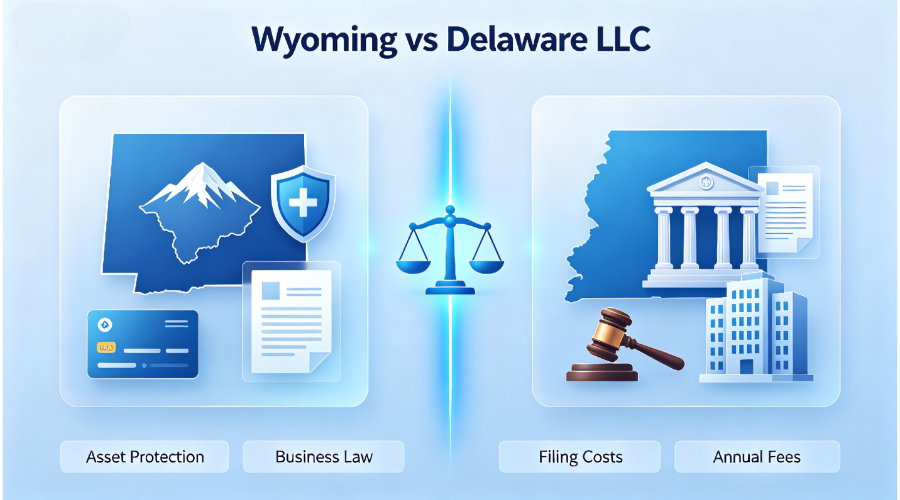

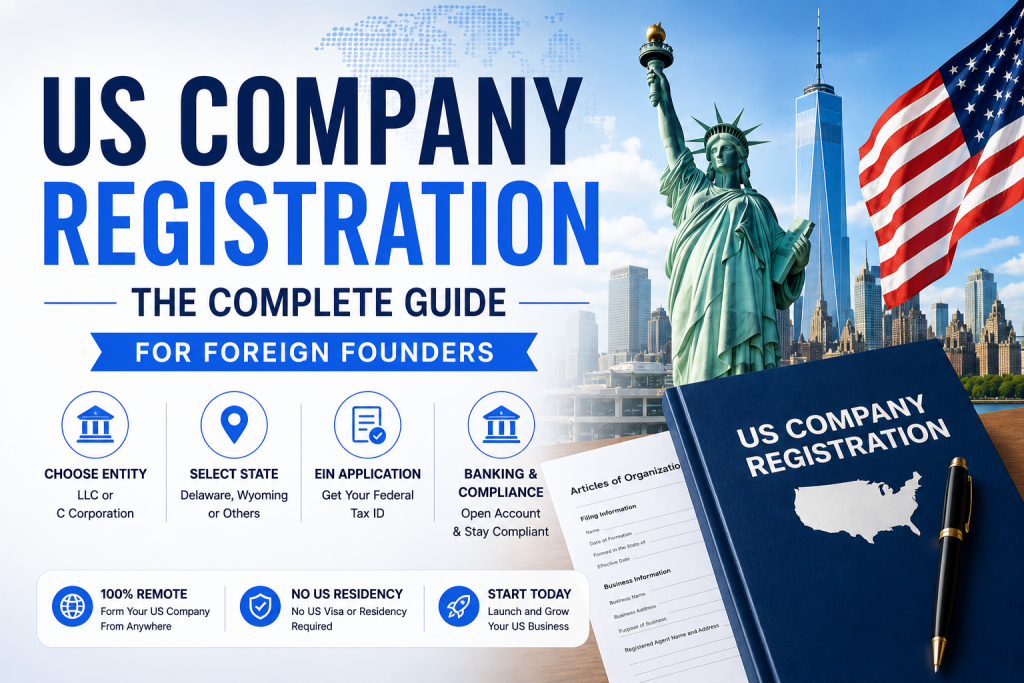
US Company Registration: The Complete Guide for Foreign Founders
Registering a company in the United States can be surprisingly accessible, even when you are not a US citizen, do not live in the United States, and do not have a Social Security Number.
However, forming the legal entity is only the beginning. A properly established US business may also need an Employer Identification Number, internal corporate documents, a business bank account, tax filings, state reports, licenses, accounting records, and ongoing compliance.
This guide explains the complete process of starting and maintaining a US company—from choosing the right entity and registration state to applying for an EIN, understanding taxes, and closing the company when it is no longer needed.
This guide provides general information and does not constitute legal or tax advice. Requirements vary by state, ownership structure, business activity, and the founder’s tax residency.
1. Who Should Register a US Company?
A US company can be useful for both American and international entrepreneurs. It is commonly used by founders who want to operate in the US market, work with international customers, build a global brand, raise capital, or access business infrastructure available to US entities.
Common applicants include:
- Cross-border e-commerce sellers
- SaaS and software founders
- Consultants and freelancers
- International trading companies
- App developers
- Content creators
- Digital marketing agencies
- Amazon, Shopify, and independent online sellers
- Startup founders seeking investment
- Businesses working with US clients
- Foreign companies expanding into the United States
Registering a US company may make it easier to sign contracts with American customers, separate business and personal finances, establish a formal ownership structure, and apply for certain banking or payment services.
That said, creating a US company does not guarantee access to Stripe, PayPal, Amazon, a US bank account, or any other third-party platform. Banks and payment providers conduct their own identity, business-model, sanctions, fraud, and risk reviews.
A US company may be appropriate when you have a clear commercial reason for establishing it. It may not be worthwhile when the company has no genuine business activity and is being created only to obtain a payment account.
2. What Are the Benefits of Registering a US Company?
The main advantage of forming a company is that it creates a separate legal and operational structure for conducting business.
Limited liability protection
An LLC or corporation generally separates the company’s liabilities from the owner’s personal assets. This protection is not absolute. Owners can still become personally liable when they personally guarantee debts, commit fraud, mix personal and company funds, or fail to treat the company as a separate entity.
Access to the US market
A US entity can contract with American suppliers, customers, platforms, and service providers. Some business partners prefer working with a domestic company because contracts, invoicing, tax documentation, and payments may be easier to manage.
Improved business credibility
A properly maintained company can appear more established than an individual operating without a formal entity. This may help when negotiating contracts, recruiting partners, or communicating with institutional customers.
Banking and payment opportunities
A US company may be eligible to apply for business bank accounts, merchant services, and payment platforms. Approval is never automatic. Providers may ask for ownership information, identification documents, proof of address, a company website, contracts, invoices, expected transaction activity, and the source of funds.
Flexible ownership
Depending on the entity, a US company can be owned by one person, multiple people, another company, or a combination of domestic and foreign owners.
Fundraising
US corporations, particularly Delaware C Corporations, are widely used by venture-backed startups. Their structure supports share issuance, preferred stock, boards of directors, employee equity plans, and multiple investment rounds.
Operational separation
Using a company bank account, bookkeeping system, and formal contracts makes it easier to separate personal spending from business activity.
The SBA emphasizes that an entity choice affects taxes, fundraising, paperwork, and personal liability, so the right structure should be selected based on the actual business rather than registration cost alone.
3. Can a Non-US Resident Register a US Company?
In general, a non-US citizen or non-US resident can own a US LLC or C Corporation. The founder usually does not need:
- US citizenship
- A green card
- A US visa
- A Social Security Number
- Permanent residence in the United States
The formation process can often be completed remotely.
However, three issues should not be confused:
- Owning a US company
- Working physically in the United States
- Obtaining US immigration status
Registering or owning a company does not automatically give the owner the right to live or work in the United States. Immigration and company formation are separate legal matters.
A foreign founder will generally need to provide identification and ownership information to banks, payment providers, accountants, registered agents, and other compliance service providers. A foreign owner may also have federal and state tax-reporting obligations even if the owner never enters the United States.
Do foreign founders need a US partner?
Normally, no. A foreign person can generally own 100% of an LLC or C Corporation, subject to industry-specific restrictions.
Some regulated sectors may impose additional ownership, citizenship, licensing, or approval requirements. Examples can include certain aviation, defense, broadcasting, banking, and regulated professional activities.
Do foreign founders need a US address?
A founder does not necessarily need to live at a US address, but the company will normally need a registered agent with a physical address in its state of formation.
The following addresses are different and should not be treated as interchangeable:
- Registered agent address
- Principal business address
- Mailing address
- Tax address
- Bank account address
- Virtual office address
A registered agent address is primarily used to receive official legal and state documents. It may not be accepted as the company’s operating or banking address.
4. Do You Need to Travel to the United States?
In most cases, you do not need to travel to the United States merely to form an LLC or corporation.
The core registration steps can usually be completed remotely:
- Selecting a company name
- Appointing a registered agent
- Filing formation documents
- Preparing an Operating Agreement or corporate bylaws
- Applying for an EIN
- Setting up bookkeeping and compliance systems
Travel may become relevant when opening certain traditional bank accounts, meeting investors, leasing physical premises, applying for local licenses, or carrying out operations that require in-person identity verification.
Some financial institutions offer remote applications, but each institution sets its own eligibility and verification rules. Even an online application may require substantial evidence that the company conducts a legitimate business.
A founder should never assume that “remote company registration” automatically means “remote bank account guaranteed.”
5. What Should You Consider Before Registering a US Company?
The biggest mistakes usually happen before the application is filed.
Before forming the company, answer the following questions.
What will the company actually do?
Define the business model clearly:
- What products or services will it sell?
- Who are its customers?
- In which countries will it operate?
- How will it receive payments?
- Will it have employees?
- Will it store inventory in the United States?
- Will it have an office, warehouse, or physical presence?
- Will it conduct regulated activities?
This information affects the state of registration, tax exposure, banking options, licenses, and entity choice.
Do you need an LLC or a corporation?
An LLC may be suitable for a small owner-operated business, while a corporation may be more appropriate for a startup planning to issue shares and raise institutional investment.
Where will the company be operated?
If the business will have employees, an office, inventory, or sustained activities in a particular state, that state may treat the company as doing business there.
Registering in Delaware or Wyoming does not necessarily eliminate the need to register in the actual operating state.
Who will own the business?
Decide:
- Number of owners
- Ownership percentages
- Voting rights
- Capital contributions
- Profit distribution
- Transfer restrictions
- Management authority
- Exit arrangements
Avoid informal promises between founders. Ownership terms should be documented from the beginning.
How will the company handle taxes and accounting?
Before registration, understand:
- Expected federal tax classification
- Possible state taxes
- Sales tax exposure
- Payroll obligations
- Foreign-owner information returns
- Bookkeeping requirements
- Filing deadlines
Does the business need a license?
Company formation does not authorize the company to operate in every industry. Federal, state, and local licenses may be required depending on the activity and location. The SBA notes that licensing requirements depend on the business activity and the agency that regulates it.
Can the owner pass banking and payment compliance checks?
The founder should be able to explain:
- The source of startup capital
- The source of revenue
- The target customer base
- Expected payment volumes
- Countries involved
- Suppliers and business partners
- Refund and chargeback risk
- Website ownership
- Product delivery process
A vague business description is one of the fastest ways to make a banking application look risky.
6. Choosing a US Company Type

The two structures most frequently considered by international founders are the LLC and the C Corporation.
LLC
An LLC is owned by one or more members.
It is popular because its management structure is flexible and its internal formalities are usually lighter than those of a corporation.
An LLC can be:
- A single-member LLC
- A multi-member LLC
- Member-managed
- Manager-managed
Advantages of an LLC
- Flexible management
- Flexible allocation of responsibilities
- Fewer traditional corporate formalities
- Suitable for many owner-operated businesses
- Can have one or multiple owners
- May choose certain federal tax classifications when eligible
Potential disadvantages
- Tax treatment can be complicated for foreign owners
- Some investors prefer corporations
- Foreign-owned LLCs can have significant information-reporting duties
- Ownership interests may be less standardized than corporate shares
- State treatment varies
A single-member LLC is generally disregarded for federal income-tax purposes by default unless it elects another classification. “Disregarded” does not mean ignored for all tax and reporting purposes.
A foreign-owned US disregarded entity may be treated as a reporting corporation for Form 5472 purposes. The IRS instructions identify a foreign-owned US disregarded entity as a reporting corporation and require reporting of qualifying transactions with related parties.
C Corporation
A C Corporation is a separate legal and tax-paying entity owned by shareholders.
Its governance normally includes:
- Shareholders
- A board of directors
- Officers
- Corporate bylaws
- Stock records
- Formal resolutions
Advantages of a C Corporation
- Familiar structure for investors
- Can issue different classes of stock
- Suitable for venture financing
- Easier to establish employee equity plans
- Clear division between shareholders, directors, and officers
- Corporate existence can continue despite changes in ownership
Potential disadvantages
- More formal governance
- Separate corporate income-tax filing
- Possible taxation at both corporate and shareholder levels when profits are distributed
- More extensive recordkeeping
- Higher legal and administrative costs in some cases
LLC vs. C Corporation
|
Factor |
LLC |
C Corporation |
|---|---|---|
|
Owners |
Members |
Shareholders |
|
Governance |
Flexible |
Board and officers |
|
Ownership evidence |
Membership interests |
Shares |
|
Investor familiarity |
Moderate |
High |
|
Venture-capital suitability |
Usually lower |
Usually higher |
|
Federal default tax treatment |
Depends on number of members |
Separate corporation |
|
Internal formalities |
Usually fewer |
Usually more |
|
Best suited to |
Owner-operated businesses |
Fundraising startups |
There is no universally superior option. The right entity depends on ownership, financing, taxation, expected profits, investor plans, and the countries in which the owners are tax residents.
7. Which State Should You Register the Company In?
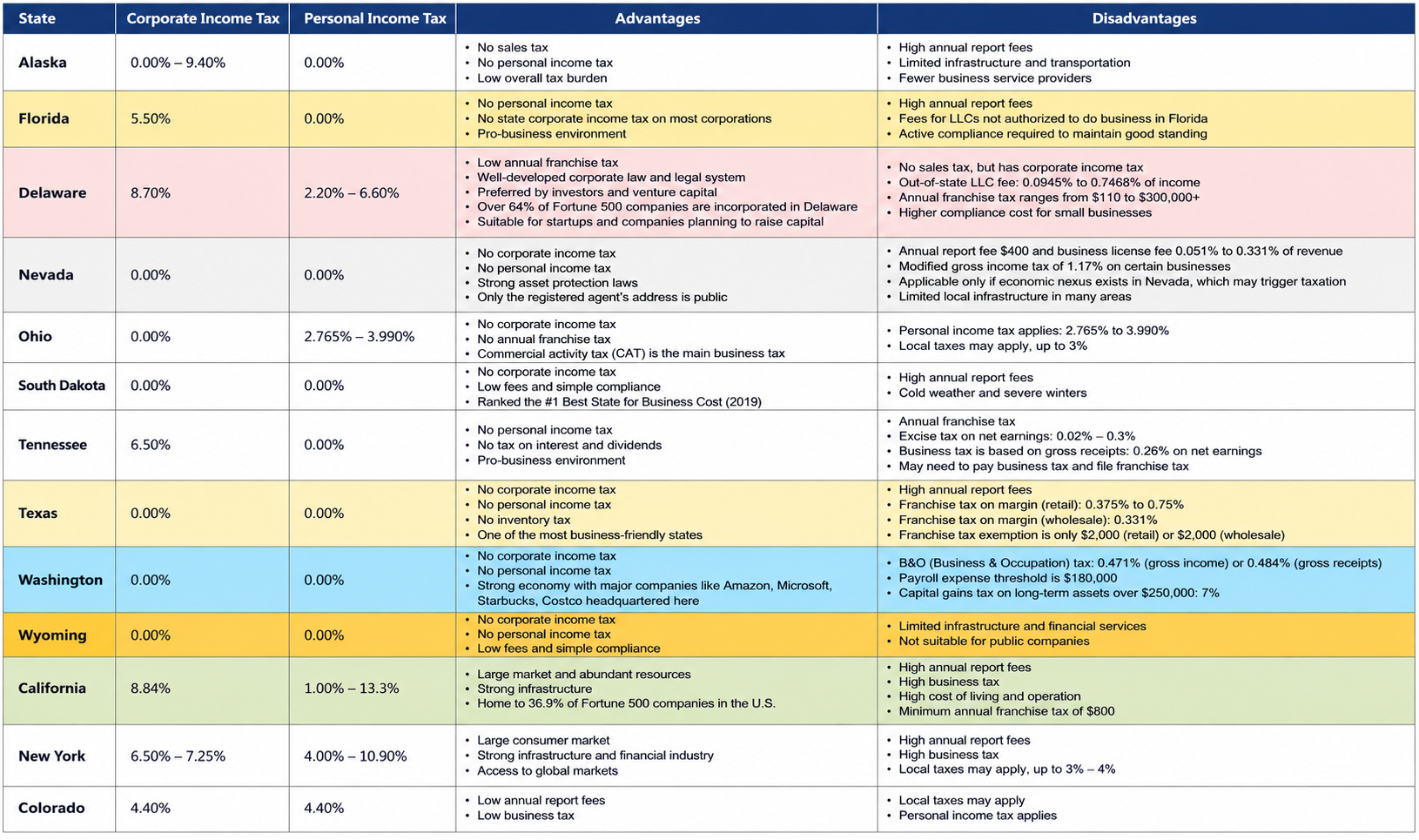
The United States has 50 states, and each state has its own company laws, filing fees, annual reports, taxes, and administrative requirements.
Many foreign founders immediately choose Delaware or Wyoming because those states are heavily promoted online. That may be appropriate, but it is not automatically the best choice.
Register in the operating state
When a business has meaningful activities in one state—such as an office, employees, inventory, a store, or ongoing local operations—it often makes sense to form the company there.
Otherwise, the company may need to:
- Remain registered in its formation state; and
- Register as a foreign entity in the operating state.
This can create two sets of fees, reports, registered-agent obligations, and compliance deadlines.
Here, “foreign entity” generally means an entity formed in another US state. It does not necessarily mean a non-US company.
Delaware
Delaware is frequently chosen by companies planning to raise venture capital.
It is known for:
- A developed body of corporate law
- A specialized Court of Chancery
- Familiarity among investors and corporate lawyers
- Flexible corporate governance
- Support for complex share structures
Delaware is not automatically the cheapest state. A company formed there may owe annual franchise taxes and registered-agent fees even when it operates elsewhere.
Wyoming
Wyoming is commonly considered by small online businesses because of its relatively simple administration and comparatively low maintenance costs.
It may be attractive for:
- Small owner-operated businesses
- Online service providers
- Businesses without a fixed operating state
- Founders prioritizing simpler state maintenance
However, claims of “complete anonymity” should be treated cautiously. Banks, tax authorities, registered agents, and compliance providers may still require the identity of the beneficial owners.
California
A company operating substantially in California may need to register and comply there even when it was formed elsewhere. California can have higher ongoing costs and more extensive state requirements than some other jurisdictions.
New York
New York can be suitable for businesses genuinely operating there, but LLC formation may involve publication-related requirements and additional costs depending on the circumstances.
Florida and Texas
Florida and Texas are frequently considered by companies with actual operations, employees, customers, or founders in those states. The correct choice depends on where the business is genuinely conducted, not merely on headline tax claims.
A practical state-selection framework
Choose a state by asking:
- Where will the founders work?
- Where will the employees work?
- Where is the office?
- Where is inventory stored?
- Where are services delivered?
- Does the company expect venture financing?
- What are the initial filing fees?
- What are the annual report and franchise-tax obligations?
- Is foreign qualification likely?
- What licenses are required?
The cheapest formation fee can be a trap. A slightly more expensive state may be cheaper overall when it is the company’s actual operating state.
The SBA notes that registration requirements depend on the business structure and location, and companies may need to register with state and local agencies.
8. How to Choose a US Company Registration Agent
The term “agent” can refer to two different services:
- A registered agent
- A company formation service provider
They are not necessarily the same.
Registered agent
A registered agent is appointed to receive:
- Service of process
- Lawsuit notices
- State correspondence
- Official compliance documents
The registered agent must generally maintain a physical address in the state of formation and be available during normal business hours.
What a registered agent usually does not do
A basic registered-agent package may not include:
- Tax returns
- Bookkeeping
- EIN applications
- Bank-account applications
- Mail forwarding
- Legal advice
- Annual reports
- License applications
- Corporate-document preparation
Check the service scope carefully.
How to evaluate a formation service provider
Consider the following:
Transparent pricing
The provider should explain:
- State filing fee
- Service fee
- Registered-agent fee
- Annual renewal
- EIN fee
- Mail-handling fee
- Annual report fee
- Tax filing fee
- Cancellation policy
Be cautious of extremely low introductory pricing followed by expensive automatic renewals.
Document quality
A complete formation package should provide more than a state certificate.
Depending on the entity, useful documents may include:
For an LLC:
- Articles or Certificate of Organization
- Operating Agreement
- Initial member resolution
- Membership ledger
- Ownership records
For a corporation:
- Certificate of Incorporation
- Bylaws
- Incorporator action
- Initial board consent
- Stock purchase documents
- Stock ledger
- Cap table
- Share certificates, where used
Compliance support
A good provider should clearly distinguish between:
- State formation
- EIN application
- Federal tax filing
- State tax filing
- Annual reports
- Franchise taxes
- Sales-tax registration
- Company changes
- Dissolution
Experience with foreign founders
International owners often face additional issues involving passports, foreign addresses, EIN applications without SSNs, tax treaties, Form 5472, and banking KYC.
A provider that only works with domestic founders may not understand these complications.
Data security
The provider may handle passports, addresses, tax numbers, company ownership records, and banking documents. Review how sensitive information is stored and accessed.
IngStart helps international founders coordinate company formation, EIN applications, corporate documents, annual filings, tax compliance, and ongoing maintenance through one centralized workflow. This can reduce the risk of using separate providers that each handle only one fragment of the company’s compliance responsibilities.

9. How Much Does It Cost to Maintain a US Company Each Year?
The annual cost of a US company is not limited to the registered-agent fee.
A company may incur:
- State formation fees
- Registered-agent renewal
- Annual or biennial report fees
- Franchise taxes
- Federal tax-return preparation
- State tax-return preparation
- Bookkeeping
- Sales-tax filings
- Payroll filings
- Business-license renewals
- Mail forwarding
- Virtual office services
- Legal or compliance support
- Foreign qualification costs
LLC annual expenses
A small LLC may pay for:
- Registered-agent service
- State annual report
- State franchise tax or annual fee
- Federal information returns
- State tax returns
- Bookkeeping
- Business licenses
Foreign-owned single-member LLCs can have filing costs even when they have little or no revenue because federal information returns may still be required.
Corporation annual expenses
A corporation may face:
- State franchise taxes
- Annual reports
- Corporate income-tax filings
- Payroll reporting
- Board and shareholder recordkeeping
- Cap-table administration
- Registered-agent costs
- Accounting and legal support
The real cost is compliance
A company that costs only a few hundred dollars to form can cost considerably more to maintain properly.
Founders should estimate the total three-year cost rather than looking only at the initial state filing fee.
A useful budget should include:
- Registration cost
- First-year tax preparation
- Annual registered agent
- State maintenance
- Bookkeeping
- Licenses
- Possible closure costs
10. What Taxes Does a US Company Need to Pay?
There is no single answer because tax obligations depend on:
- Entity type
- Federal tax classification
- State of formation
- States where the company operates
- Owners’ tax residency
- Source of income
- Employees
- Inventory
- Customers
- Related-party transactions
- Applicable tax treaties
A US company may encounter several tax categories.
Federal income tax
A C Corporation is generally treated as a separate taxpayer and files a corporate income-tax return.
An LLC’s federal treatment depends on its number of members and any tax elections it makes.
State income or franchise tax
A company may owe state-level taxes or annual franchise fees based on:
- Registration
- Business activity
- Income
- Capital
- Revenue
- Number of shares
- Other state-specific formulas
The state where the company was formed is not necessarily the only state that can impose obligations.
Sales tax
Sales tax is separate from income tax.
A company selling taxable goods or services may need to:
- Determine where it has sales-tax nexus
- Register for permits
- Collect tax
- File returns
- Remit the tax collected
Using a marketplace such as Amazon does not automatically eliminate all sales-tax responsibilities.
Payroll taxes
A company with employees may need to manage:
- Federal payroll withholding
- Social Security and Medicare taxes
- Federal unemployment tax
- State payroll taxes
- State unemployment insurance
- Local payroll obligations
Withholding tax
Payments to foreign owners, contractors, partners, or other recipients may be subject to US withholding and reporting rules.
Foreign-owner information reporting
Foreign ownership can create information-return obligations even when little or no income tax is payable.
The IRS states that Form 5472 is used by reporting corporations to disclose reportable transactions with foreign or domestic related parties.
A foreign-owned US disregarded entity may need to file Form 5472 together with a pro forma Form 1120 when it has reportable transactions. These transactions can include owner contributions, distributions, payments, and other dealings between the entity and related parties.
Zero revenue does not automatically mean zero filing
A company may still have filing obligations when:
- It had no revenue
- It made a loss
- It did not begin trading
- The owner funded company expenses
- It had transactions with its foreign owner
- It remained legally active during the year
This is one of the most important points for foreign founders. “No tax due” and “no return required” are not the same thing.
11. Is an EIN Required?
An Employer Identification Number is a nine-digit federal tax identification number issued by the IRS. It is used to identify businesses and other entities for tax administration.
Despite the word “Employer,” a company may need an EIN even when it has no employees.
An EIN is commonly needed for:
- Federal tax filings
- Business bank accounts
- Payroll
- Payment-provider applications
- State tax registration
- Business licenses
- Vendor forms
- Corporate administration
Can a foreign founder obtain an EIN without an SSN?
Yes, a foreign founder may be able to apply for an EIN even without an SSN or ITIN.
The IRS currently provides different application options depending on the applicant’s circumstances. International applicants may use Form SS-4 and apply through permitted channels such as mail, fax, or telephone under the applicable IRS rules.
Should the company be formed before applying?
Generally, the entity should be legally formed before the EIN application is submitted. The name on the EIN application should match the state formation records.
Who is the responsible party?
The EIN application identifies a responsible party—the individual who ultimately owns or controls the entity or exercises effective control over it.
Using a nominee or service provider as the responsible party can create problems unless permitted under the IRS rules.
Is the EIN application free?
The IRS does not charge a government fee to issue an EIN. Service providers may charge a professional fee for preparing and submitting the application.
Does an EIN expire?
An EIN generally remains associated with the entity. However, certain ownership or structural changes may require a new EIN. The IRS specifically notes that changes to an entity’s organization or ownership may sometimes require a new number.
12. What Are SSN, ITIN, and EIN?
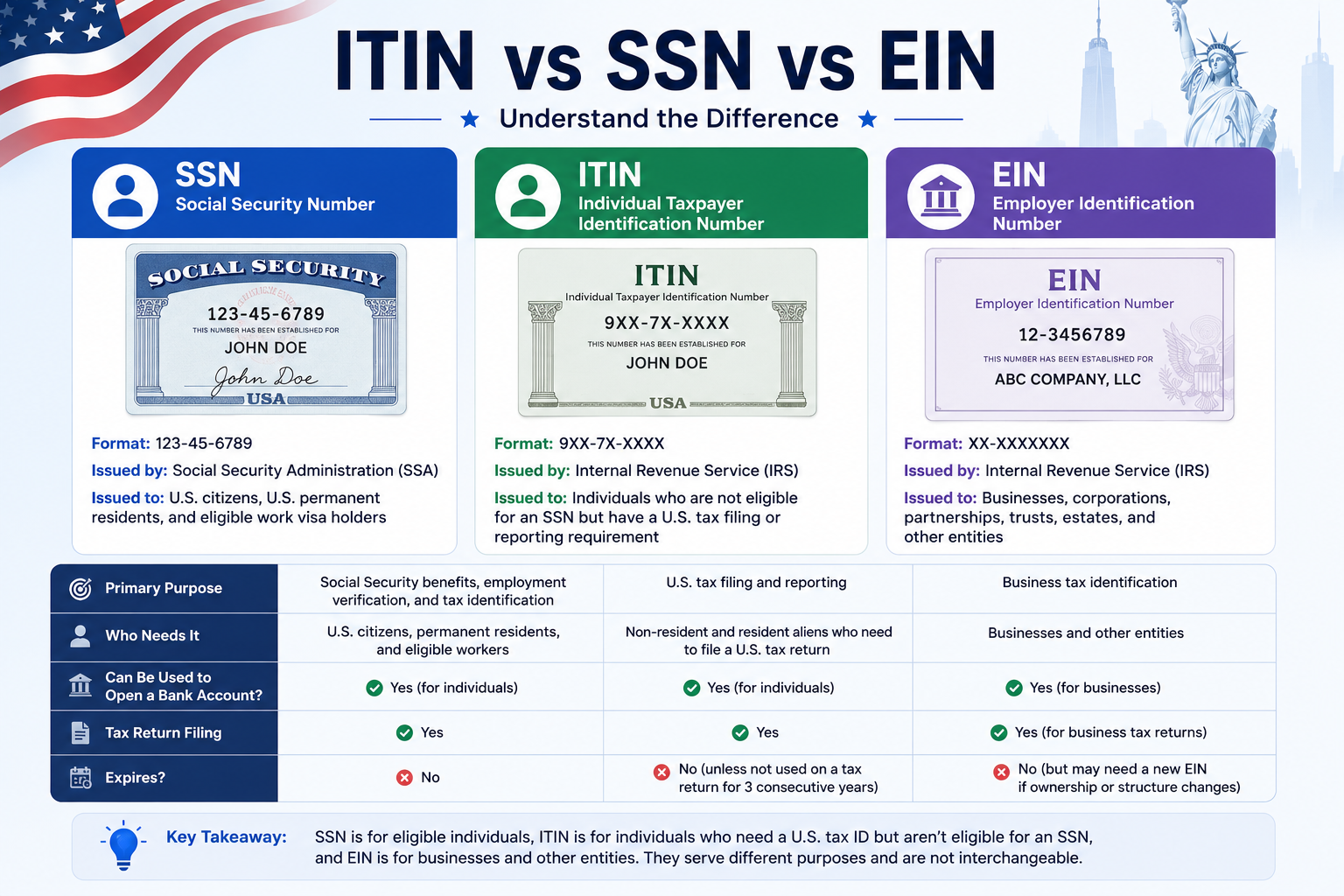
These three numbers are often confused.
SSN: Social Security Number
An SSN is issued to eligible individuals, primarily for Social Security and tax-administration purposes.
It is a personal number, not a company number.
A foreign founder is not automatically eligible for an SSN merely because they own a US company.
ITIN: Individual Taxpayer Identification Number
An ITIN is an individual tax-processing number issued by the IRS to certain people who need a US taxpayer identification number but are not eligible for an SSN.
An ITIN may be relevant when an individual has a US tax-return or reporting requirement.
An ITIN:
- Is issued to an individual
- Is not a work permit
- Does not provide immigration status
- Does not establish eligibility for Social Security benefits
- Does not replace a company’s EIN
EIN: Employer Identification Number
An EIN identifies a business or other entity.
It is generally used for:
- Business tax returns
- Bank accounts
- Payroll
- Licenses
- Vendor documentation
Quick comparison
|
Number |
Issued to |
Main purpose |
|---|---|---|
|
SSN |
Eligible individual |
Social Security and individual tax identification |
|
ITIN |
Individual not eligible for SSN |
Federal tax processing |
|
EIN |
Business or entity |
Business tax identification |
A founder may have an ITIN while the company has an EIN. They serve different purposes.
13. Can a US Company Be Dissolved When It Is No Longer Needed?
Yes. A US company can be closed, but simply stopping business activity does not automatically dissolve it.
If the company remains legally active, it may continue to accumulate:
- Annual report obligations
- Franchise taxes
- Registered-agent fees
- Tax-return requirements
- Penalties
- Interest
- License-renewal obligations
Typical LLC dissolution process
The steps may include:
- Approving the dissolution under the Operating Agreement
- Paying or arranging company debts
- Filing Articles or a Certificate of Dissolution
- Filing final federal and state tax returns
- Closing payroll and sales-tax accounts
- Cancelling licenses and permits
- Distributing remaining assets
- Closing the business bank account
- Retaining company records
Typical corporation dissolution process
A corporation may need:
- Board approval
- Shareholder approval
- A formal plan of dissolution
- Payment of creditors
- State dissolution filings
- Final tax returns
- Distribution of remaining assets
- Closure of licenses, payroll, and tax accounts
Administrative dissolution is not a clean exit
Some owners stop paying annual fees and wait for the state to administratively dissolve the company.
This approach can leave unresolved:
- Taxes
- Penalties
- Debts
- Legal claims
- Bank balances
- Contracts
- Ownership disputes
- Reinstatement costs
A voluntary and documented closure is generally safer.
Complete US Company Registration Process
The entire process can be summarized as follows.
Step 1: Define the business model
Clarify products, services, customers, countries, revenue sources, payment methods, and operational locations.
Step 2: Choose an LLC or C Corporation
Base the decision on ownership, taxation, governance, and financing—not on social-media trends.
Step 3: Select the state
Consider the operating state first. Then compare filing fees, annual maintenance, investor expectations, and foreign-qualification risks.
Step 4: Choose the company name
The name must normally be distinguishable from existing entities registered in the state and must include an appropriate entity designation.
The SBA recommends checking state registration records, trademarks, domain names, and any applicable DBA requirements when selecting a business name.
Step 5: Appoint a registered agent
Select an agent with a reliable physical address in the formation state and a clear process for forwarding official notices.
Step 6: File the formation document
An LLC commonly files Articles of Organization or a Certificate of Formation.
A corporation commonly files Articles of Incorporation or a Certificate of Incorporation.
The exact document name varies by state.
Step 7: Prepare internal documents
An LLC should normally have an Operating Agreement and ownership records.
A corporation should establish bylaws, directors, officers, share issuance, and a stock ledger.
Step 8: Apply for an EIN
Submit accurate information that matches the company’s state records and ownership structure.
Step 9: Open a business bank account
Prepare identification, company documents, an EIN confirmation, business evidence, address information, source-of-funds details, and expected transaction activity.
Step 10: Obtain licenses and tax registrations
Check federal, state, county, and city requirements.
Step 11: Establish accounting
Separate personal and business transactions from the first day.
Maintain:
- Bank statements
- Invoices
- Contracts
- Receipts
- Expense records
- Owner contributions
- Owner distributions
- Related-party transactions
Step 12: Build a compliance calendar
Track:
- Annual reports
- Franchise taxes
- Federal returns
- State returns
- Sales-tax returns
- Payroll filings
- Registered-agent renewal
- License renewals
The SBA’s business-launch framework similarly treats formation, tax identification, licenses, banking, and ongoing management as separate steps rather than a single registration action.
Important Update on US Beneficial Ownership Reporting
Beneficial ownership reporting rules have changed significantly.
Under FinCEN’s March 2025 interim final rule, entities created in the United States and their beneficial owners are exempt from federal BOI reporting under the Corporate Transparency Act. Certain foreign entities registered to do business in the United States may still be subject to reporting requirements.
This federal BOI exemption does not mean companies can operate anonymously.
Banks, payment providers, tax authorities, registered agents, and regulated service providers may still require:
- Beneficial-owner names
- Passport or identity documents
- Residential addresses
- Ownership percentages
- Control-person information
- Source-of-funds information
State-level disclosure and industry-specific requirements may also apply.
Because this area has changed repeatedly, founders should verify the current FinCEN rules at the time of formation rather than relying on older registration guides.
Common Mistakes When Registering a US Company
Choosing a state based only on the filing fee
Initial cost is only one part of the total expense.
Believing an LLC automatically means no tax
An LLC is a legal form, not a universal tax exemption.
Assuming no revenue means no tax return
Information returns and state reports may still be required.
Using the registered-agent address for everything
It may not be suitable as an operating, mailing, or bank address.
Applying for payment accounts with no business evidence
A certificate of formation alone rarely proves a complete operating business.
Mixing personal and company funds
This creates bookkeeping, tax, and legal problems.
Failing to document owner funding
Money transferred between the owner and company should be recorded properly as capital, loans, reimbursements, distributions, or another appropriate category.
Ignoring internal documents
An Operating Agreement, bylaws, resolutions, and ownership records are not decorative paperwork. They establish who owns and controls the business.
Forgetting annual deadlines
States do not always send reliable reminders. Missing a deadline can result in penalties or loss of good standing.
Abandoning the company instead of dissolving it
Inactive companies can continue generating costs and filing obligations.
Frequently Asked Questions
Can a foreigner own 100% of a US company?
In most ordinary industries, a foreign person can generally own 100% of an LLC or C Corporation. Regulated sectors may have special restrictions.
Do I need an SSN to form an LLC?
Generally, an SSN is not required merely to form an LLC at the state level.
Can I apply for an EIN without an SSN?
Foreign applicants may be able to apply through the IRS using Form SS-4 and the procedures available to international applicants.
Is Delaware always the best state?
No. Delaware is frequently suitable for venture-backed corporations, but a small business operating in another state may face unnecessary duplicate registration and maintenance costs.
Can I register in Wyoming while operating in California?
You may be able to form the entity in Wyoming, but the company may also need to register and comply in California if it is doing business there.
Does a US company need a business license?
It depends on the activity and location. Some businesses require federal approval, while others are regulated by state, county, or city authorities.
Can a US company conduct multiple business activities?
Generally, companies can conduct multiple lawful activities, but regulated services may require separate licenses or approvals.
Does forming a company guarantee a bank account?
No. Banks independently review the owners, business model, countries involved, addresses, source of funds, and expected activity.
Does forming a company guarantee access to Stripe or PayPal?
No. Payment platforms have independent eligibility and risk-management rules.
Does a foreign-owned LLC have to file Form 5472?
A foreign-owned US disregarded entity may have to file Form 5472 when it has reportable transactions with a related party. The precise obligation depends on the facts.
Can I close the company later?
Yes, but the company should be formally dissolved and its final tax and administrative obligations completed.
Final Thoughts
Registering a US company is not difficult in itself. The difficult part is selecting the correct structure and maintaining it properly after formation.
A successful setup requires more than filing a certificate with a state. Founders should consider:
- Entity selection
- Registration state
- Ownership documentation
- EIN application
- Banking
- Licenses
- Federal and state taxes
- Annual reports
- Bookkeeping
- Company closure
For international founders, the best approach is to design the company around the actual business model from the beginning. A cheap or fast registration can become expensive when the state, entity type, ownership records, or tax classification was chosen incorrectly.
IngStart provides international founders with a centralized way to manage US company formation, EIN applications, corporate documentation, annual compliance, tax filings, and ongoing company maintenance. Instead of treating formation as a one-time purchase, founders can track the complete life cycle of the company—from registration to annual maintenance and eventual dissolution.
Article Recommendations
- US Business Tax Compliance Guide: Required Tax Filings & Compliance After Company Formation (2026)
- How to Register a New York Stock Corporation
- US Investment Tax for Foreigners: Income, Withholding, and ECI
- Non-US Investment Tax for Foreign Investors