
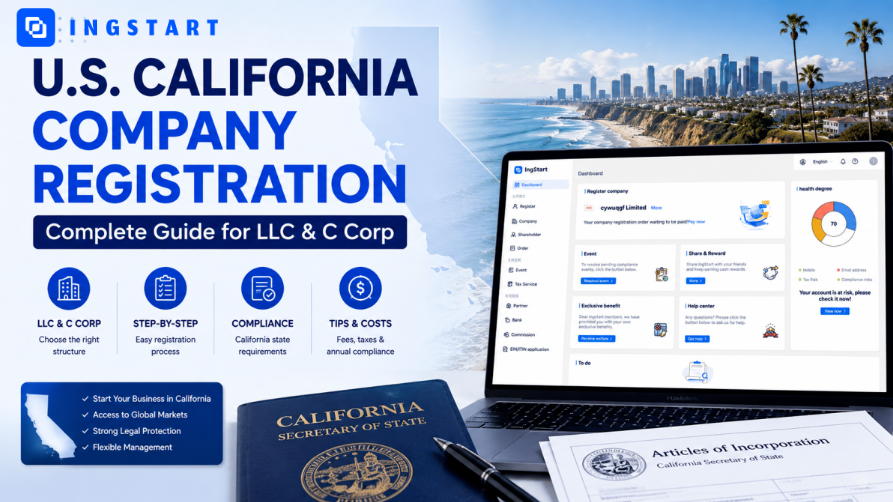
U.S. California Company Registration: Complete Guide for LLC & C Corp
California company registration is the first and most basic step to run a legal business in California. First of all, many new business owners pick this state because it has rich market resources and friendly business rules. Also, whether you are a local business owner or an overseas starter, California company registration can help you build a formal and trustworthy business brand. In addition, this simple guide will show you all key details of California company registration. It covers business benefits, company types, registration steps, costs and daily business rules for beginners.
Why Choose California Company Registration
If you plan to do California company registration, you may wonder why California is great for new businesses. To start with, California has more market chances and easier business rules than other US states. Moreover, it works well for small new companies, freelance workers and big growing businesses alike.
Key Benefits of California Company Registration
First, California has a large group of consumers and a complete business environment. It includes tech, trade, service and many other fields. So, your business can get more exposure and find more partners easily. Second, a business with California company registration has a good public image. As a result, you can work with more local US clients and global business partners. Third, California welcomes small businesses with easy registration rules. In fact, even non-US residents can finish California company registration legally with no hard requirements.
Besides, California lets you choose different company types for your business. For one thing, you can pick a cheap and simple type for small businesses. For another thing, you can choose a growth-focused type to get funding and expand your business later. Therefore, California company registration fits almost all business plans.
Quick Look: LLC vs C Corporation
After you start California company registration, you need to pick a business type. The two most common choices are LLC and C Corporation. To keep it simple, an LLC is easy to set up and run, and it has simple tax rules. It is perfect for small businesses and solo owners. On the contrary, a C Corporation is better for businesses that want investment, team growth and long-term development. We will talk more about them in the following part.
California Company Registration: LLC vs C Corporation
Choosing the right business type is very important for successful California company registration. In general, each type has different rules for cost, tax, management and growth. Now, we will break down their simple features one by one to help you make a good choice.

California LLC
An LLC, or Limited Liability Company, is the top choice for small business California company registration. The biggest advantage is that it protects your personal property. That is to say, your personal money and assets are safe if your business has debts or legal problems.
Also, an LLC has very easy management rules. It does not need regular team meetings or long yearly reports. Meanwhile, its tax rules are simple too. The business’s gains and losses go straight to the owner’s personal tax form. So, you can avoid paying double taxes. In addition, the start-up fee for a California LLC is low. This greatly cuts down your early business costs.
California C Corporation
A C Corporation is a formal business type for California company registration. It is made for long-term business growth. Unlike an LLC, it is an independent legal business. For this reason, it can sell stocks, get money from investors, and support bigger team growth.
However, a C Corporation has stricter daily rules. It needs regular shareholder meetings, clear business records and standard yearly reports. Besides, its tax rules are different. First, the business pays company tax. Then, owners pay personal tax on their profits. This causes double taxation. What’s more, its yearly maintenance cost is higher than an LLC.
Pick the Best Entity for Your California Company Registration
First, choose an LLC if you run a small business, solo project or short-term startup. It saves both time and money for registration and daily work. Second, choose a C Corporation if you want to get investment, grow your team, go public or run a large long-term business.
Of course, you can change your business type later if you are not sure. Even so, picking the right type during your first California company registration will save you extra work and money in the future.
How to Finish California Company Registration
The steps for California company registration are clear and standard. Yet, different business types have small differences. Below, we share simple step-by-step guides for LLC and C Corporation registration. As a result, you can finish the whole process easily.
Steps for California LLC Registration
First, find a unique name for your company. No other California business can use this name, and it must include “LLC” or “Limited Liability Company”. Second, get a registered agent with a valid local address in California. In short, this agent will receive all official state papers for your business.
Third, submit your company’s organization papers to the California state office and pay the official fee. Fourth, write a simple operation agreement to clarify business ownership and work rules. Fifth, apply for an EIN from the IRS for tax filing and business bank accounts. Finally, finish basic state filings to activate your new company.
Steps for California C Corporation Registration
First, confirm a unique company name with a standard corporate suffix. Second, pick initial company directors and set basic business rules. Third, submit your company’s founding papers to the state and pay the required fee. Fourth, hold your first shareholder meeting to set official company rules and job roles.
Fifth, apply for a federal EIN for tax and business use. Sixth, finish state registration and industry license applications based on your business type. In general, you need to check every detail carefully to avoid delays or application rejection.
If you want to skip tedious paperwork and speed up California company registration, you can turn to Ingstart, a professional services. In fact, Ingstart offers full help for company registration, EIN application and registered agent services. Thus, you can finish all official steps with no extra time and effort.

California Company Registration Costs
When you plan for California company registration, you need to know all possible fees first. This helps you make a clear budget. Overall, the main costs include state filing fees, yearly business tax, registered agent fees and other daily business expenses.
State Filing Fees
The state filing fee is a one-time cost for California company registration. To be specific, the standard LLC filing fee is $70, while the C Corporation filing fee is $100. Additionally, you can pay extra money for fast processing if you want to shorten your registration time.
Annual Franchise Tax
All businesses that complete California company registration must pay a yearly franchise tax. Notably, the minimum yearly fee is $800 for both LLC and C Corporation. You need to pay this tax every year, even if your business earns no money that year. Besides, high-income businesses need to pay extra taxes based on their profits.
Registered Agent Fees
A registered agent is a must for valid California company registration. Normally, professional registered agent services cost $200 to $500 per year. This fee keeps your business in line with state rules. Also, it makes sure you get all official government notices on time.
Other Common Costs
Other common costs include yearly report fees, business license fees and record upkeep fees. Different industries have different license rules, so total costs vary slightly. In general, most small businesses spend $1000 to $1500 in the first year for California company registration and daily upkeep.

California Company Compliance and Maintenance
Finishing California company registration is not the final step. Instead, you need to keep up with regular business rules to avoid fines or company shutdowns. In short, daily maintenance keeps your California company active and legal.
Annual Filing Requirements
Every business with California company registration must file a yearly Statement of Information. This form updates basic business details like address, owners and staff. If you submit it late, the state will charge you a fine. Moreover, you need to finish other yearly business reports as required.
Tax Obligations
First, you must pay your yearly franchise tax on time and file tax forms every year. Second, if your business has workers, you need to submit payroll tax forms regularly. In addition, keeping clear tax records can help you avoid tax problems and fines.
Registered Agent Requirements
Your California company must always have a valid registered agent with a local address. If you change your agent or business address, you must update the information with the state right away. Otherwise, you may miss official papers, which will hurt your business’s legal status.
Company Record Maintenance
You need to save all your business papers well. These include registration files, tax records, meeting notes and ownership documents. As a result, your yearly filings and state checks will be much easier to finish.
To avoid missing deadlines and breaking business rules after California company registration, you can work with Ingstart. For one thing, it provides regular rule reminders. For another thing, it offers professional daily maintenance support. Therefore, your business can always follow California state rules and run steadily.
FAQs About California Company Registration
Many beginners have similar questions about California company registration. Here we list simple and clear answers to solve your common doubts.
Can non-U.S. residents finish California company registration?
Yes, you can. Non-US residents can finish California company registration legally. First, you do not need a US resident ID to register an LLC or C Corporation. Second, you do not need a US visa or local partner to start a company. You just need to follow standard steps and hire a valid registered agent.
Should I choose LLC or C Corporation for California company registration?
Simply put, pick LLC for small businesses, new solo projects and low-budget plans. It is simple, cheap and easy to run. On the other hand, pick C Corporation if you want investment, stock sales and long-term business growth. You can make your choice based on your business size and future plans.
How long does California company registration take?
In general, standard California company registration takes 7 to 15 working days. If you choose fast service, you can finish it in 1 to 3 working days. Self-application usually takes longer. Meanwhile, professional agency help can speed up the whole process greatly.
What are the ongoing compliance requirements after California company registration?
After California company registration, you need to finish a few key ongoing tasks. These include paying yearly franchise tax, submitting annual information reports, filing tax forms on time and keeping a valid registered agent. If you finish these tasks well, you can avoid fines, business locks and invalid company status.
Article Recommendations
- How to Register a New York Stock Corporation
- US Investment Tax for Foreigners: Income, Withholding, and ECI
- Non-US Investment Tax for Foreign Investors
Still confused about overseas company registration, corporate bank account opening or tax compliance? Contact us via WhatsApp: +1 213 751 2111. We offer custom solutions for your cross-border business needs.