
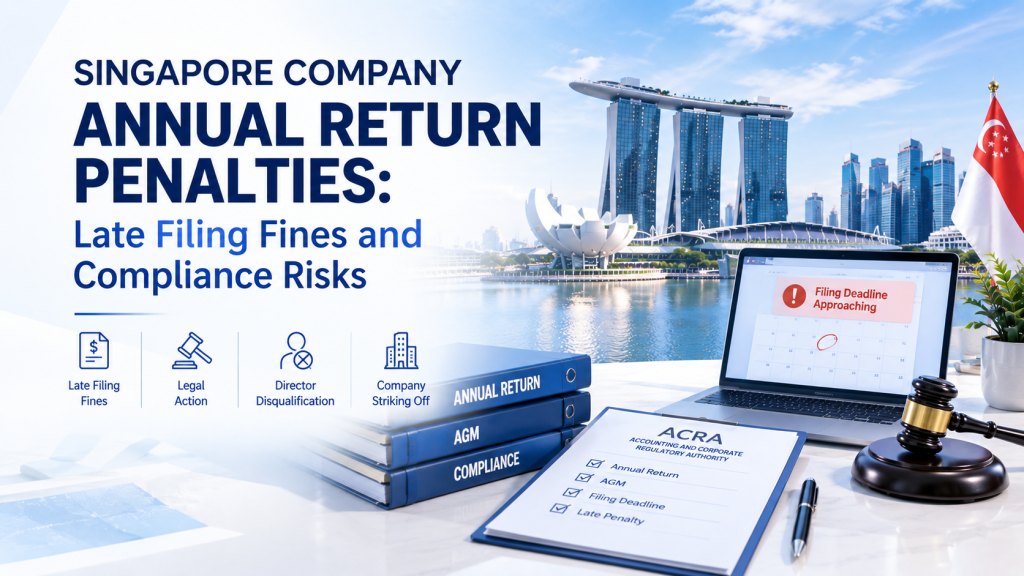
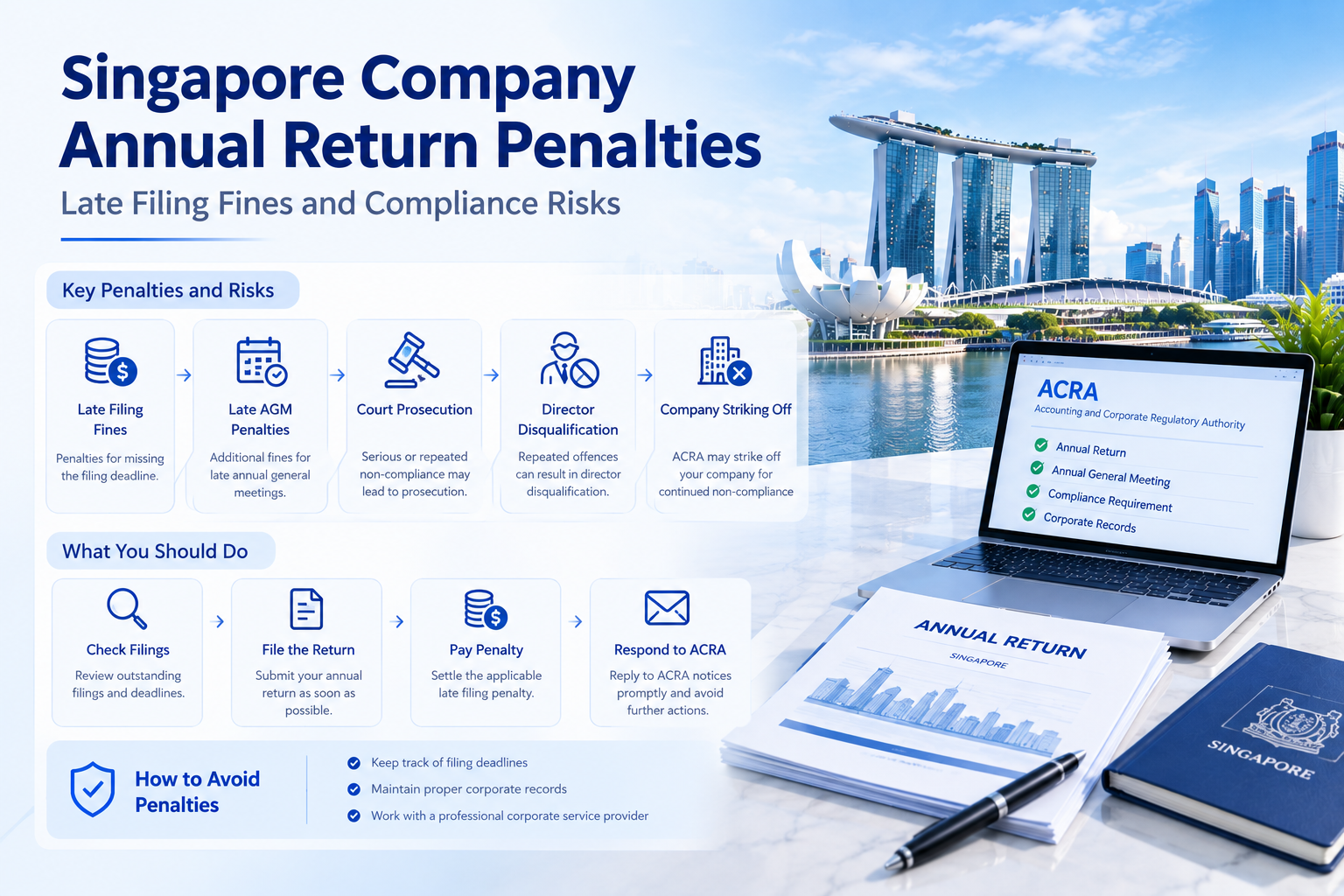
For companies operating in Singapore, completing the Singapore Company Annual Return is an important part of ongoing corporate compliance. Missing the annual return deadline can result in late filing penalties and, in more serious cases, court prosecution, director disqualification, or company striking off.
Therefore, company owners and directors should understand the filing deadlines and potential consequences before an annual return becomes overdue.
Singapore Company Annual Return Requirements
All companies registered in Singapore must file an annual return with the Accounting and Corporate Regulatory Authority (ACRA) every year while the company remains listed as “live”. This requirement also applies to inactive or dormant companies unless the relevant legal requirement provides otherwise.
The filing deadline depends on the type of company and its financial year end (FYE):
- Listed companies: Within five months after the FYE.
- Non-listed companies: Within seven months after the FYE.
- Listed companies with a share capital and an overseas branch register: Within six months after the FYE.
- Non-listed companies with a share capital and an overseas branch register: Within eight months after the FYE.
The annual return provides ACRA with updated information about the company, including its registered details, directors, company secretary, members, share information, and financial statements where required.
In addition, companies should not confuse the annual return with tax filing. Filing the annual return with ACRA does not replace the company's tax filing obligations with the Inland Revenue Authority of Singapore (IRAS).

Singapore Company Annual Return Late Filing Penalties
The most immediate consequence of missing a Singapore Company Annual Return deadline is a late lodgment penalty.
For annual returns due on or after 14 January 2022, the current penalty framework is:
| Late Filing Period | Penalty |
|---|---|
| Up to 3 months after the deadline | S$300 |
| More than 3 months after the deadline | S$600 |
The penalty is applied when the overdue annual return is filed through Bizfile. Therefore, the longer a company waits, the higher the late filing penalty may become. This means the previous practice of describing the penalty as a total of S$300–S$900 is no longer accurate for current annual return filings. The standard late lodgment penalty is now based on whether the filing is within or beyond three months after the deadline.
Late AGM Can Also Result in Penalties
Annual return filing is not the only compliance obligation that companies need to consider. Depending on the company's circumstances, it may also need to hold an Annual General Meeting (AGM).
For financial years ending on or after 31 August 2018, the general AGM deadlines are:
- Listed companies: Within four months after the FYE.
- Non-listed companies: Within six months after the FYE.
However, certain private companies may be exempt from holding an AGM or may choose to dispense with one if the legal requirements are met. Even in these cases, the company must provide the relevant AGM information when filing its annual return. If a company fails to meet its AGM obligations, ACRA may take separate enforcement action. A late AGM can also lead to a late annual return, meaning the company may face consequences for both breaches.
Court Prosecution for Serious or Repeated Non-Compliance
Late filing does not automatically mean that a company will be taken to court. However, ACRA may escalate enforcement when a company repeatedly fails to meet its filing obligations, does not accept a composition offer, or when ACRA decides that court prosecution is appropriate.
Before prosecution, ACRA may offer a composition sum, which allows the company to settle the breach without going to court. For a late AGM or annual return, the minimum composition sum can be S$500 for each breach.
If the matter proceeds to court, ACRA will issue a summons stating the court date, time, and location. A company representative or director must attend as required. More importantly, ignoring a court summons can create additional problems. If a director fails to attend court, a warrant for the director's arrest may be issued.
How Much Can the Court Fine a Director?
The potential court penalty is significantly higher than the standard late filing penalty. According to ACRA's current guidance, a conviction for the relevant filing offence can result in a fine of up to S$10,000 per charge. Recent ACRA prosecution cases also show that directors can receive substantial fines and may face disqualification after repeated filing offences. Therefore, companies should not assume that paying the standard late filing penalty will always resolve every compliance issue.
Director Disqualification for Repeated Filing Offences
Repeated non-compliance can affect the company's directors personally. Under the current rules, a director may be disqualified for five years if the director is convicted of three or more filing offences within five years. During the disqualification period, the individual cannot act as a director or become directly or indirectly involved in the management of a company.
This consequence is different from simply receiving a late filing penalty. It generally arises after repeated filing offences and court convictions. ACRA's recent enforcement cases demonstrate that this is not merely a theoretical risk. In 2026, directors convicted of multiple offences involving failures to hold AGMs and file annual returns received fines and five-year disqualifications.
Company Striking Off by ACRA
Another serious consequence of prolonged non-compliance is that ACRA may strike the company off the register. ACRA can initiate striking off when there is reasonable cause to believe that a company is not carrying on business or is not in operation. Repeated failure to file annual returns is one of the situations that may contribute to such action. Once a company is struck off, it ceases to exist as a legal entity. As a result, businesses should not treat prolonged failure to file annual returns as a simple administrative issue.
Director Disqualification After Multiple Companies Are Struck Off
The consequences can also extend to directors who are associated with multiple companies. If ACRA strikes off three or more companies associated with the same director within five years, the director may be disqualified under section 155A of the Companies Act.
For a first-time disqualification, the period is generally three years after the third company is struck off. For repeat offenders, the period can be five years. This is different from the five-year disqualification triggered by three or more filing convictions. Therefore, company owners should distinguish between repeated filing offences and multiple ACRA-initiated striking-offs.
What Should You Do If Your Singapore Company Annual Return Is Overdue?
If your Singapore Company Annual Return is already overdue, taking action quickly is usually better than allowing the non-compliance to continue.
Check the Outstanding Filings
First, check the company's filing status and identify which annual returns or other statutory filings are overdue.
File the Outstanding Annual Return
Eligible company officers can file the annual return through Bizfile. Companies can also engage a corporate service provider (CSP) to handle the filing on their behalf.
Pay the Applicable Late Filing Penalty
The applicable late lodgment penalty will generally be reflected when the overdue annual return is filed. For current annual return filings, the penalty is S$300 if filed within three months after the deadline and S$600 if filed more than three months late.
Respond to ACRA Notices Promptly
If ACRA has already issued a composition offer, summons, striking-off notice, or another enforcement communication, the company should respond promptly rather than simply completing the overdue filing. For companies with complicated compliance issues, professional assistance may help determine the appropriate next steps.
How to Avoid Singapore Company Annual Return Penalties
The easiest way to avoid penalties is to manage annual compliance before the filing deadline.
Companies should:
- Track the financial year end and annual return deadline.
- Prepare financial statements and corporate information in advance.
- Check director, shareholder, secretary, and registered office information.
- Complete the required AGM or applicable alternative arrangements.
- File the annual return through Bizfile on time.
- Monitor ACRA notifications and compliance reminders.
- Keep evidence of completed filings and payments.
For international entrepreneurs, managing Singapore company compliance from overseas can be more difficult. A corporate service provider such as IngStart can help businesses with Singapore company registration, annual compliance, tax-related services, and other ongoing corporate administration.
Final Thoughts on Singapore Company Annual Return
A Singapore Company Annual Return is a statutory compliance requirement rather than an optional administrative task. Missing the deadline can first result in a S$300 or S$600 late lodgment penalty, while repeated or serious breaches may lead to composition sums, court prosecution, director disqualification, or company striking off.
For this reason, Singapore company owners should monitor annual filing deadlines carefully and deal with overdue filings as soon as possible. Maintaining timely corporate compliance can help protect the company's good standing and reduce the risk of more serious enforcement action from ACRA.
Article Recommendations
- Singapore Company Registration Guide 2026: Requirements, Process & Tips for Global Entrepreneurs
- Singapore Company Annual Filing Guide 2026: Requirements, Documents & Compliance Tips
- Singapore Company Registration Types Guide for Foreign Entrepreneurs
If you still have questions, please contact our team on WhatsApp at +1 213 751 2111. We'll help you find the right solution for your business and keep your company compliant as it grows.