
How to Open an LLC for Non-U.S. Residents: A Complete Step-by-Step Guide (2026)
If you're wondering how to open an LLC for non-US residents, the process is much easier than many entrepreneurs expect. Thousands of founders from around the world successfully register U.S. LLCs every year without being U.S. citizens or permanent residents.
One of the biggest misconceptions about U.S. business formation is that you need to live in the United States or have a Social Security Number (SSN) before registering a company. Fortunately, that's not the case.
As a non-U.S. resident, you can legally form an LLC, apply for an Employer Identification Number (EIN), open a business bank account, and operate your company from virtually anywhere in the world.
The process may seem overwhelming at first, especially if you're unfamiliar with U.S. regulations. However, once you understand the requirements and complete each step in the right order, establishing a U.S. company becomes much more straightforward.
This guide walks you through every stage of the process—from choosing the right state to forming your company, obtaining an EIN, opening a business bank account, and staying compliant with ongoing reporting requirements.

Why Non-U.S. Entrepreneurs Choose a U.S. LLC
The United States remains one of the world's most attractive places to establish a business. Its stable legal system, strong financial infrastructure, and internationally recognized business environment make it an appealing choice for entrepreneurs operating globally.
Creating an LLC offers several advantages, especially for founders who run online businesses or serve international customers.
Some of the biggest benefits include:
- Limited liability protection for business owners
- A professional U.S. business identity
- Access to U.S. banking and payment platforms
- Greater credibility with customers and suppliers
- Flexible ownership and management structure
- Relatively low formation and maintenance costs
For many digital entrepreneurs, an LLC also serves as the foundation for opening payment accounts, working with international marketplaces, and expanding into the U.S. market.
Can Non-U.S. Residents Form an LLC?
Yes.
There are no citizenship or residency requirements for forming an LLC in most U.S. states.
You do not need to be:
- A U.S. citizen
- A permanent resident
- A Green Card holder
- A U.S. tax resident
In most cases, you also don't need a Social Security Number to register your company.
This makes the LLC one of the most accessible business structures for international founders.
However, while forming the company itself is relatively simple, additional steps—such as obtaining an EIN, opening a bank account, or meeting tax filing obligations—may require extra documentation.
What Is an LLC?
A Limited Liability Company (LLC) is a legal business entity that separates your personal assets from your business obligations.
Once your LLC is formed, the company becomes its own legal entity.
This means the business can:
- Sign contracts
- Open bank accounts
- Receive payments
- Own assets
- Hire employees
- Pay taxes
Perhaps most importantly, an LLC helps protect the owner's personal assets from many business-related liabilities.
If the business incurs debts or faces legal claims, the owner's personal assets are generally protected, provided the company is operated properly and corporate formalities are respected.
LLC vs. C Corporation: Which Structure Is Right?
Choosing the right business structure depends largely on your long-term goals.
For most freelancers, consultants, e-commerce sellers, agencies, and SaaS founders, an LLC is often the simplest and most flexible option.
LLCs generally offer:
- Less administrative work
- Flexible taxation
- Lower maintenance costs
- Simpler ongoing compliance
A C Corporation may be more suitable if you plan to:
- Raise venture capital
- Issue shares to investors
- Eventually go public
- Build a high-growth startup backed by institutional investment
Many venture capital firms in the United States prefer investing in Delaware C Corporations, making this structure the standard for venture-backed startups.
If your goal is to launch an online business or manage international operations, an LLC is often the better starting point.
Choosing the Best State for Your LLC
One of the first decisions you'll make is where to register your company.
Unlike U.S. residents, who often form their businesses in the state where they live, non-U.S. entrepreneurs have greater flexibility.
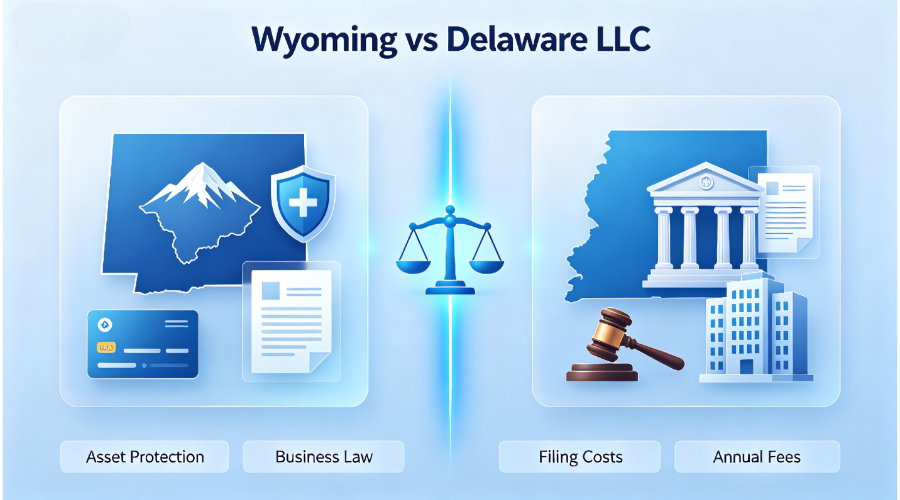
The two most popular choices are Wyoming and Delaware.
Wyoming
Wyoming has become one of the preferred jurisdictions for international entrepreneurs because it offers:
- Low formation fees
- Affordable annual reports
- Strong privacy protections
- Business-friendly regulations
- No state corporate income tax for most LLCs
Its straightforward compliance requirements make it particularly attractive for online businesses and digital entrepreneurs.
Delaware
Delaware is widely recognized as America's corporate capital.
Many large corporations and venture-backed startups choose Delaware because of its well-established business laws and specialized Court of Chancery.
If you plan to seek institutional investment or eventually convert your LLC into a corporation, Delaware may be worth considering.
However, for many small businesses and international founders, Wyoming remains the more practical and cost-effective option.
Step 1: Register Your LLC
Once you've selected a state, it's time to officially create your company.
The formation process generally involves:
- Choosing an available business name
- Preparing formation documents
- Filing Articles of Organization
- Paying the state's filing fee
Although it's possible to complete these steps independently through the Secretary of State's website, many international founders prefer working with a professional incorporation service.
A provider such as Ingstart can simplify the process by assisting with company registration, document preparation, registered agent services, compliance reminders, and ongoing administrative support. This can be especially helpful for entrepreneurs unfamiliar with U.S. filing requirements or managing multiple international businesses.
Before submitting your application, make sure your desired company name is available and complies with your chosen state's naming rules.
Most states also require your company name to include "LLC" or "Limited Liability Company."
Step 2: Appoint a Registered Agent
Every LLC must designate a registered agent.
A registered agent is an individual or company authorized to receive legal notices and official government correspondence on behalf of your business.
The registered agent must maintain a physical address within the state where your LLC is registered.
Because most international founders don't have a physical U.S. presence, they typically hire a professional registered agent service.
Many incorporation providers, including Ingstart, include registered agent services as part of their formation packages, allowing overseas entrepreneurs to satisfy this legal requirement without maintaining an office in the United States.
Step 3: Apply for an EIN
After your LLC has been approved, the next step is obtaining an Employer Identification Number (EIN).
An EIN is issued by the Internal Revenue Service (IRS) and functions as the tax identification number for your business.
Most companies need an EIN to:
- Open a U.S. business bank account
- File federal tax forms
- Hire employees
- Work with payment processors
- Apply for certain business services
Can Non-U.S. Residents Get an EIN?
Yes.
You do not need a Social Security Number to obtain an EIN.
If you don't have an SSN, you'll typically submit IRS Form SS-4 using the appropriate application process for international applicants.
Depending on IRS processing times, receiving an EIN may take anywhere from several weeks to a few months.
Many business formation providers assist clients with EIN applications to help reduce paperwork and minimize delays.
Step 4: Obtain a U.S. Business Address
Although you don't necessarily need a physical office in the United States, having a U.S. business mailing address is often beneficial.
Many financial institutions, payment providers, and government agencies expect businesses to maintain a mailing address where official correspondence can be received.
Virtual mailbox services have become a popular solution for international entrepreneurs.
These services provide:
- Mail forwarding
- Digital mail scanning
- Package receiving
- Secure document storage
Some incorporation providers also include a business mailing address as part of their business formation packages, making it easier to manage company correspondence remotely.
A dedicated U.S. business address can also strengthen your company's professional image when dealing with customers, suppliers, and financial institutions.
Step 5: Get a U.S. Business Phone Number
A dedicated U.S. business phone number isn't legally required to form an LLC, but it can make running your business much easier.
Many banks, payment processors, and online platforms use SMS or phone verification when creating business accounts. Having a U.S. phone number can also improve your company's credibility when communicating with customers, suppliers, or partners.
Today, several cloud-based providers allow international founders to obtain a U.S. phone number without being physically located in the country.
A virtual business number can typically be used for:
- Two-factor authentication (2FA)
- Customer support
- Business verification
- Sales inquiries
- Professional branding
Using a dedicated business phone number also helps separate your personal communications from your company's operations.
Step 6: Open a U.S. Business Bank Account
Opening a business bank account is one of the most important steps after forming your LLC.
A dedicated business account helps keep company finances separate from personal funds while making bookkeeping, tax reporting, and payment processing much simpler.
Can Non-U.S. Residents Open a U.S. Business Bank Account?
Yes—but requirements vary depending on the financial institution.
Some traditional banks require applicants to visit a local branch in person, while many modern fintech banks now support remote applications for eligible international founders.
Banks generally review several factors during the application process, including:
- Company formation documents
- Employer Identification Number (EIN)
- Identity verification
- Business activities
- Source of funds
- Compliance requirements
Approval isn't guaranteed, and individual banks maintain their own onboarding policies.
Popular Banking Options
Several financial institutions have become popular among international entrepreneurs because they support U.S. businesses owned by non-residents.
Common options include:
- Mercury
- Relay
- Wise Business (for international payments)
- Airwallex (available in selected regions)
The right choice depends on your business model, expected transaction volume, supported countries, and the services you need.
If you're unsure which banking solution best fits your business, working with an incorporation provider such as Ingstart can help streamline the process by ensuring your company documents are properly prepared before submitting banking applications.
Step 7: Set Up Online Payment Processing
Once your business bank account is ready, the next step is choosing how you'll accept customer payments.
For most online businesses, this usually means integrating a payment processor such as Stripe or PayPal.
Stripe
Stripe is one of the most widely used payment platforms for internet businesses.
It supports online payments in numerous countries and integrates with major e-commerce platforms, subscription services, and custom websites.
Many non-U.S. founders prefer Stripe because it generally requires:
- A registered business
- An EIN
- A business bank account
- Identity verification
- A business website or service description
Depending on your country and business activities, Stripe may request additional documentation during the onboarding process.
PayPal
PayPal remains a popular payment solution worldwide, but business account requirements can vary depending on the country where the account is registered.
Some applicants may need additional taxpayer identification documents before gaining full access to business features.
For many startups and online businesses, Stripe often offers greater flexibility for scaling internationally, while PayPal continues to be useful because of its broad consumer recognition.
Many businesses ultimately choose to support both payment methods to give customers more flexibility.
Step 8: Understand Your Tax and Compliance Responsibilities
Forming your LLC is only the beginning.
Like any registered business, your company will have ongoing compliance obligations.
These requirements vary depending on your business structure, ownership, and whether your company has U.S.-source income or conducts business within the United States.
Staying compliant is essential to keeping your company in good standing and avoiding unnecessary penalties.
Annual State Requirements
Most states require LLCs to submit annual reports or periodic filings.
Depending on the state, you may also need to pay:
- Annual franchise taxes
- Renewal fees
- State filing fees
Failure to meet these deadlines can result in late fees, administrative dissolution, or loss of good standing.
Federal Tax Filings
Foreign-owned LLCs may have federal reporting obligations even if they owe little or no U.S. income tax.
For example, certain single-member foreign-owned LLCs may need to file:
- Form 5472
- Pro Forma Form 1120
Multi-member LLCs are generally treated as partnerships unless another tax election is made, meaning partnership returns may also be required.
Tax obligations depend on several factors, including:
- Business activities
- Income sources
- Ownership structure
- Tax elections
- Applicable tax treaties
Because every business is different, international founders should seek professional tax guidance when necessary.
Many entrepreneurs also choose ongoing compliance services that monitor deadlines and prepare required filings on their behalf.
Providers like Ingstart offer post-incorporation compliance support, helping businesses manage annual reports, federal filings, and other administrative obligations as they grow.
Frequently Asked Questions
Can a foreigner legally own a U.S. LLC?
Yes.
U.S. law generally allows foreign individuals and foreign companies to own LLCs without requiring U.S. citizenship or permanent residency.
Do I need a Social Security Number?
No.
You can form an LLC without an SSN.
However, you'll still need an Employer Identification Number (EIN) for many business activities, including banking and tax reporting.
Which state is best for non-U.S. residents?
For most online businesses, Wyoming and Delaware remain the two most popular choices.
Wyoming is often preferred for its lower ongoing costs, while Delaware is commonly selected by venture-backed startups and companies planning to raise investment.
Can I manage my LLC from another country?
Absolutely.
Many international founders successfully operate U.S. LLCs remotely using online banking, cloud accounting software, virtual business addresses, and digital communication tools.
How long does it take to form an LLC?
Formation timelines depend on the state.
Some states process applications within a few business days, while others may take several weeks.
Additional services such as obtaining an EIN or opening a bank account may extend the overall timeline.
Do I need to visit the United States?
Not necessarily.
Many steps—including company formation, obtaining an EIN, and opening certain business accounts—can often be completed remotely, depending on the service providers and financial institutions involved.
Final Thoughts
Starting a U.S. LLC as a non-U.S. resident is more accessible today than ever before.
From company formation and tax registration to online banking and payment processing, many aspects of running a U.S. business can now be managed entirely online.
That said, successful business formation isn't just about registering an LLC. Choosing the right state, maintaining compliance, understanding your tax obligations, and building a reliable financial infrastructure are all equally important.
Whether you're launching an e-commerce store, a SaaS startup, a consulting business, or an international agency, taking the time to establish your company correctly from the beginning can save significant time and expense in the future.
If you're looking for a simpler way to manage the entire process, Ingstart provides end-to-end global company registration and compliance services. From LLC formation and registered agent support to EIN applications, annual compliance, and business expansion assistance, Ingstart helps entrepreneurs build and maintain international businesses with confidence—allowing founders to spend less time on paperwork and more time growing their companies.